

-
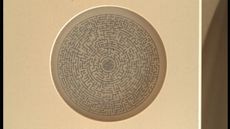 Why does NASA's Perseverance rover keep taking pictures of this maze on Mars?
NASA's Perseverance rover regularly images a Sherlock Holmes–themed maze to calibrate its chemical-hunting SHERLOC instrument.
-
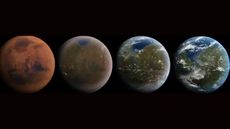 Turning the Red Planet green? It's time to take terraforming Mars seriously, scientists say
A new study debates the complex ethical questions that must be considered if we're to terraform Mars and lays the blueprint for a potential path forward.
-
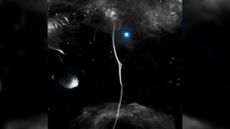 NASA diagnoses fracture in a 'huge cosmic bone' using X-ray observatory
A combination of X-ray from NASA's Chandra observatory and radio data indicates that a galactic "fracture" was likely caused by a special neutron star called a pulsar.
astronomy -
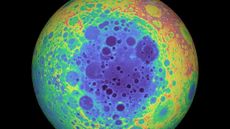 Scientists have dated the moon's oldest, and largest, impact site
The largest and oldest-known impact site on the moon is the South Pole-Aitken basin. Thanks to new research, scientists have dated the basin to the period between 4.32 and 4.33 billion years ago.
the-moon -
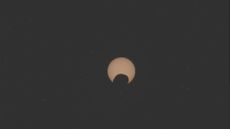 Perseverance rover watches a solar eclipse on Mars
On Sept. 30, NASA's Perseverance rover turned its eyes toward the sky and photographed a solar eclipse from Mars, capturing the tiny moon Phobos crossing the sun's face.
mars -
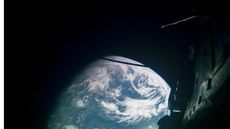 ESA's JUICE spacecraft confirmed Earth is habitable. Here's why
JUICE successfully identified water and the building blocks of life in Earth's atmosphere. In doing so, the probe headed for Jupiter's moons confirmed that its instruments are working properly.
space-exploration -
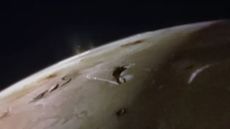 NASA's Juno probe reveals 'fire-breathing' lava lakes across Jupiter's volcanic moon Io
New infrared images showcase "fire-breathing" lakes all across the surface of Jupiter's volcanic moon Io.
jupiter -
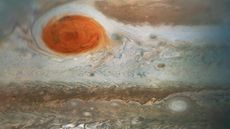 Is Jupiter's Great Red Spot an impostor? Giant storm may not be the original one discovered 350 years ago
Astronomer Giovanni Cassini observed Jupiter's 'Permanent Spot' in 1665, but new research suggests it's a different vortex from today's Great Red Spot.
jupiter -
 Astronauts on Mars may see a green sky, eerie new study suggests
Scientists just observed Mars' eerie green nightglow in the visible light spectrum for the very first time.
mars -
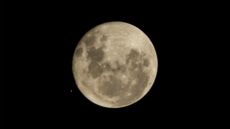 Mars is about to be eclipsed by the moon. Here's how to watch.
On Monday (Jan. 30), the moon will pass in front of Mars from the perspective of Earth in what's known as an occultation.
mars -
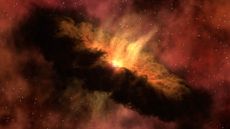 Deep space 'hurricanes' could point the way to alien worlds
When new planets form in distant solar systems, they carve out 'hurricanes' and 'vortices' in the surrounding dust that could lead astronomers straight to them.
exoplanets -
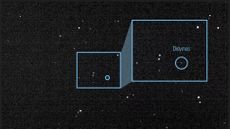 NASA's asteroid-slamming DART spacecraft catches 1st look at target (photo)
Using its DRACO camera, DART has imaged the asteroid Didymos and its moonlet Dimorphos.
asteroids -
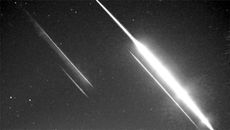 Massive fireball scattered loads of meteorites across southern Ontario
On Sunday (April 17), skywatching cameras in Ontario recorded a massive fireball that likely produced tens to hundreds of grams of meteorites.
meteoroids -
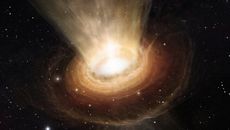 Could the secret of supermassive black holes lie in ultralight dark matter?
Though scientists know there's a supermassive black hole at the center of most galaxies, they can't explain how the gravitational giants formed.
black-holes


