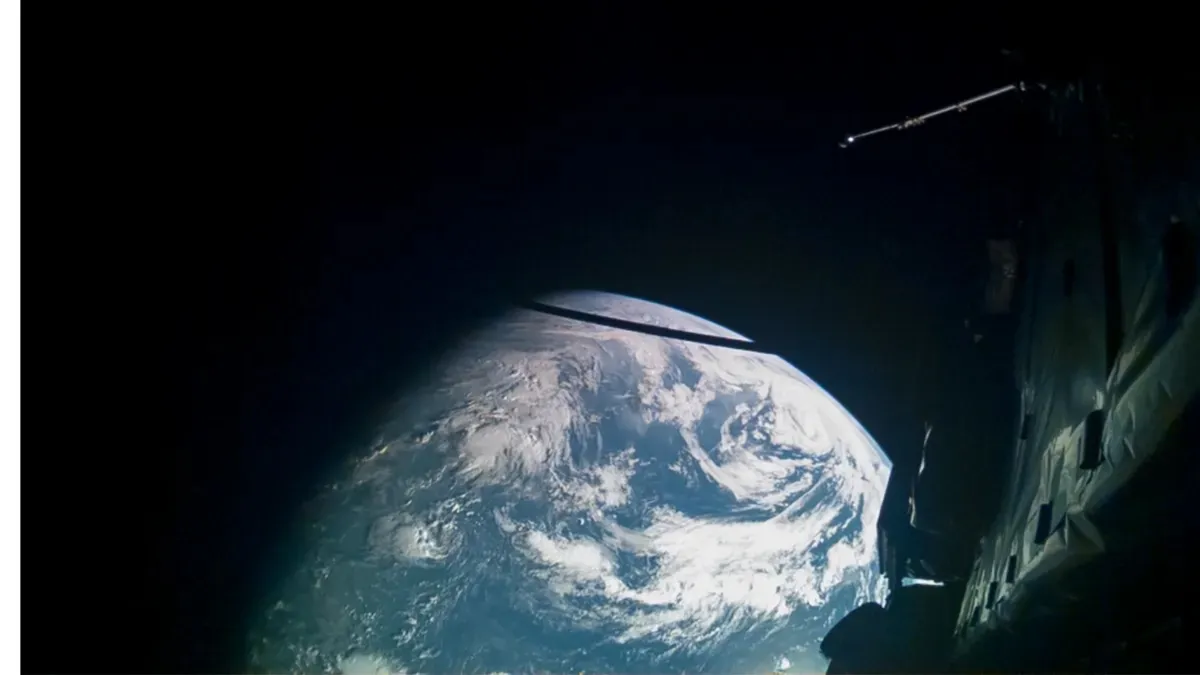
ESA's Jupiter Icy Moons Explorer (JUICE) is ultimately headed for the Jovian system, but on Aug. 20, it took a quick look at Earth. The spacecraft returned some very exciting news: the Earth is indeed habitable.
The probe launched in April 2023 and is currently making its way through the solar system on an eight-year journey to explore Jupiter and three of its moons Ganymede, Callisto and Europa, all of which are believed to have liquid-water oceans beneath their icy shells. During a flyby of Earth on Aug. 20, JUICE was able to successfully identify water in Earth's atmosphere, as well as carbon, hydrogen, nitrogen, oxygen, phosphorous, and sulfur (the "CHNOPS" elements, which are the most common elements in living organisms). And as such, scientists can confirm that there is the potential for life on Earth.
But, uh, don't we know that already? Yes — but the JUICE team had a good reason to run the tests anyway.
JUICE tested two of its instruments during its flyby of Earth, the Moons and Jupiter Imaging Spectrometer (MAJIS) and the Submillimeter Wave Instrument (SWI), which were able to detect the signs of habitability.
"We are obviously not surprised by these results … it would have been extremely concerning to find out that Earth was not habitable!" ESA JUICE project scientist Olivier Witasse said in a statement. "But they indicate that MAJIS and SWI will work very successfully at Jupiter, where they will help us investigate whether the icy moons could be potential habitats for past or present life."
The Pacific Ocean seen by ESA's Jupiter Icy Moons Explorer's MAJIS instrument during the probe's Earth flyby on Aug. 20, 2024 from a distance of 5,405 miles (8,700 km) in three different wavelengths.
(Image credit: ESA/Juice/MAJIS)
When JUICE arrives at Jupiter, it'll perform the same tests on the planet's icy moons to determine if they could possibly support life. So performing a trial run on Earth, the only solar system body known to harbor life, is the best way to ensure the instruments are calibrated properly.
Sign up for the Live Science daily newsletter now
Get the world’s most fascinating discoveries delivered straight to your inbox.
During its Earth flyby, JUICE also collected data about the composition of the atmosphere, including oxygen, ozone and carbon dioxide. Scientists plan to study the concentration of oxygen, in particular, as a point of comparison for the Jovian system — they will then be able to tell if the oxygen levels out there could support Earth's current biological activity.
So while it might not be news that the Earth is habitable, JUICE's study of our planet is important in its own right. Now, on toward Jupiter!
Space.com contributing writer Stefanie Waldek is a self-taught space nerd and aviation geek who is passionate about all things spaceflight and astronomy. With a background in travel and design journalism, as well as a Bachelor of Arts degree from New York University, she specializes in the budding space tourism industry and Earth-based astrotourism. In her free time, you can find her watching rocket launches or looking up at the stars, wondering what is out there. Learn more about her work at www.stefaniewaldek.com.