
















Could the secret of supermassive black holes lie in ultralight dark matter?
Scientists have determined one plausible theory to explain the formation of supermassive black holes.

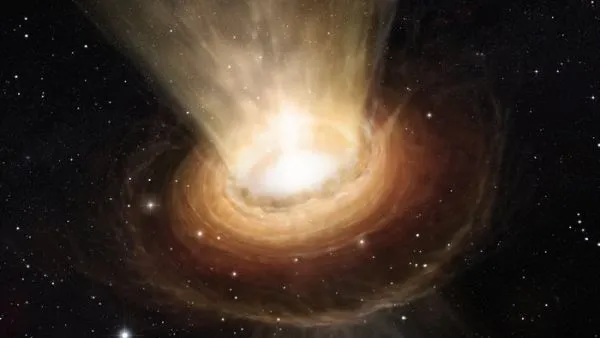
Though scientists know there's a supermassive black hole at the center of most galaxies, they can't explain how the gravitational giants formed.
But physicists Hooman Davoudiasl, Peter Denton, and Julia Gehrlein of the U.S. Department of Energy's (DOE) Brookhaven National Laboratory in New York have determined one plausible theory: a "cosmological phase transition" of ultralight dark matter.
According to the team's model, supermassive black holes might have formed as the universe was cooling from its hot, dense state — before the formation of galaxies. "When the temperature of the universe is just right, the pressure can suddenly drop to a very low level, allowing gravity to take over and matter to collapse," Denton said in a statement.
Related: The 10 wildest things we learned about black holes in 2021
But known particles wouldn't behave quite right under those conditions to form supermassive black holes. So the researchers hypothesized an as-of-yet-unobserved form of matter — ultralight dark matter, which would be 28 times lighter than a proton at the heart of an atom — might be the key to the process.
"The frequency of interactions between known particles suggests matter, as we know it, would not have collapsed into black holes very efficiently," Denton said. "But, if there was a dark sector with ultralight dark matter, the early universe might have had just the right conditions for a very efficient form of collapse."
That collapse of ultralight dark matter would be a phase transition akin to boiling water turning into steam, but in reverse and on the scale of the universe — and it would be dramatic enough to explain how supermassive black holes became so massive so quickly.
Get the world’s most fascinating discoveries delivered straight to your inbox.
Most black holes form when a star collapses, then collect mass over time either by collecting matter that falls into the black hole or by colliding with other black holes.
But supermassive black holes, which have millions or billions of times more mass than regular black holes, are much too large to form by those means, since scientists believe the behemoths formed very early in our universe's history, which wouldn't give them enough time to acquire so much mass. But the Brookhaven team's model of a collapse of ultralight dark matter provides a potential explanation — and a signal to look for.
RELATED STORIES
"These collapses are a big deal. They emit gravitational waves," Denton said. "Those waves have a characteristic shape, so we make a prediction for that signal and its expected frequency range."
Current technology is not sensitive enough to detect that signal, but until then, he said, the researchers will continue refining their model.
A paper describing the theory was published in Physical Review Letters on Feb. 23.
Follow Stefanie Waldek on Twitter @StefanieWaldek. Follow us on Twitter @Spacedotcom and on Facebook.

Space.com contributing writer Stefanie Waldek is a self-taught space nerd and aviation geek who is passionate about all things spaceflight and astronomy. With a background in travel and design journalism, as well as a Bachelor of Arts degree from New York University, she specializes in the budding space tourism industry and Earth-based astrotourism. In her free time, you can find her watching rocket launches or looking up at the stars, wondering what is out there. Learn more about her work at www.stefaniewaldek.com.