

-
 What does a weather report of 30% chance of rain mean?
A percent chance of precipitation shows the probability there will be at least 0.01 inch of rain, snow or sleet at a given location.
weather -
 How much can your stomach expand after a big meal?
The stomach can grow in size after you eat, but by how much?
health -
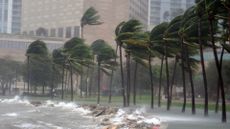 What's the fastest recorded wind speed?
Wind can whip up to surprising speeds, depending on if it's natural or human made.
weather -
 Which are rarer: diamonds or emeralds?
The rarity of precious gemstones comes down to the geologic process of their formation.
geology -
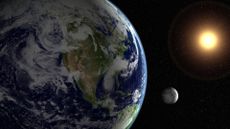 Which way does Earth spin? What about the other planets?
While Earth spins in the same direction as the sun, that's not the case for every planet in the solar system.
astronomy -
 How many stars in the Milky Way die each year?
Stars die at different rates depending on how they kick the bucket.
astronomy -
 T. rex was as smart as a crocodile, not an ape, according to study debunking controversial intelligence findings
A new study debunks previous findings that the dinosaur's intelligence was similar to that of primates, finding instead that they're about as smart as modern-day crocodiles.
neuroscience -
 What would happen if you drilled all the way through Earth?
Intense pressure and sweltering temperature would accompany a trip down through Earth's layers and out through the other side. However, this trip would be possible only in science fiction.
planet-earth -
 Why does ice float?
Why does ice float in water, instead of sinking to the bottom? It has to do with water's density and molecular structure.
chemistry -
 Do lemmings actually jump off of cliffs?
Do these tundra-inhabiting rodents actually jump to their deaths as depicted in a 1958 wildlife documentary?
land-mammals -
 Is hydrogen a metal?
Hydrogen is not a metal on Earth, but scientists keep trying to create metallic hydrogen under high pressure to unlock a new superconductor.
chemistry -
 Why do dogs eat poop?
Life's Little Mysteries Poop eating is a natural behavior in dogs; although it may disgust humans, it usually poses no threat to your canine's health.
Life's Little Mysteries -
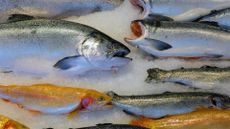 Why is fish so smelly?
Fish smell is from degrading lipids and bacterial reactions that increase in potency over time.
fish -
 Why do coughs linger after a cold?
Coughing is helpful during sickness to protect the lungs from infection. But lasting inflammation may irritate the nerve reflexes that cause coughing.
viruses-infections-disease -
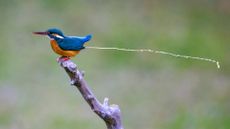 Do birds pee?
Birds do produce urine, but it doesn't come out the same way it does in humans. How birds pee may be an evolutionary adaptation that benefits flight.
birds


