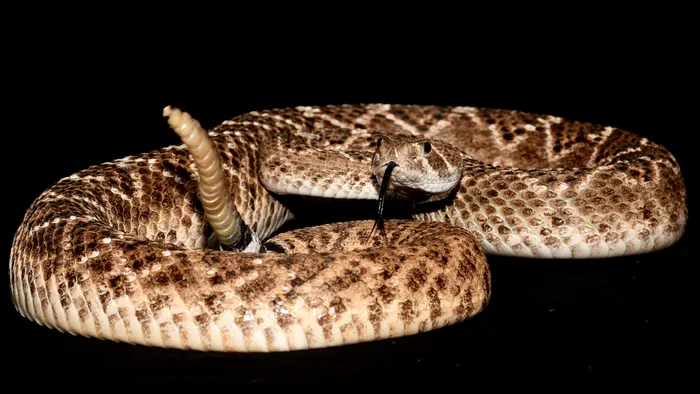
The menacing rattle of a rattlesnake's tail is far more sophisticated than first thought, as the sound can create an auditory illusion that suggests the venomous snake is closer to a potential threat than it really is, according to a new study.
Scientists think that rattlesnakes "rattle" the keratin structure on their tails to warn off predators, gradually increasing the frequency as a possible attacker gets closer. But now they've found the snake may have another trick in its arsenal — a sudden frequency jump in the rattling sound that it uses to fool its listener.
"Our data show that the acoustic display of rattlesnakes, which has been interpreted for decades as a simple acoustic warning signal about the presence of the snake, is in fact a far more intricate interspecies communication signal," senior study author Boris Chagnaud, a professor of neurobiology at Karl-Franzens-University Graz in Austria, said in a statement.
Latest Videos From
Related: What's the biggest animal that a snake can swallow?
Chagnaud discovered the first clue to the mystery of rattlesnakes' "smart signal" high-frequency mode while approaching one of the snakes during a visit to a laboratory. He noticed that the frequency of the snake's iconic rattle increased before suddenly jumping as he approached, but decreased as he retreated.
To figure out what was behind this phenomenon, he and his team recorded the frequency of the rattle as various objects — including a human-like torso and a black disk — were brought closer to the snake. As threats first approached, the rattling rose by a steady rate to a frequency of 40 Hz, but as the objects came closer, the frequency suddenly jumped to between 60 and 100 Hz. According to the researchers, the rattling rate increased more quickly the faster the object approached, but changing the size of the object didn't impact the frequency level.
To figure out why the snake was changing its rattling rate, and why it was using a sudden jump in frequency, the researchers designed a virtual reality grassland with a virtual snake hiding inside of it. Sending 11 volunteers inside the simulation, the researchers asked the volunteers to approach the virtual snake and indicate when the creature was 3.3 feet (1 meter) away. The cyber snake increased its rattling rate as the humans approached, suddenly leaping to 70 Hz as the volunteers came within 13 feet (4 m), and was able to trick all of the human participants into underestimating their distance to it.
Chagnaud thinks that rattlesnakes weave this weird auditory illusion in order to create a "distance safety margin" between them and a potential attacker. He hypothesizes that human hearing, alongside the other mammalian auditory systems that it is closely related to, picks up on the frequency of the rattle and the rule of how it increases with distance, only to be fooled when the snake changes this rule with an unexpected, and sudden, jump in the frequency.
"Imagine you walk towards the snake, it starts to rattle slowly, increasing the rattle events incrementally. If at a distance of 2 meters [6.5 feet] from the snake, the snake suddenly changes this rule, and instead of making the 2 meter sound, it makes the sounds like it's only at 1 meter [3.3 feet], then it fooled you," Chagnaud told Live Science in an email.
Sure enough, when Chagnaud tested this hypothesis by repeating his virtual reality experiment without the frequency jumps, his human participants were far better at guessing the distance to the virtual snake.
"Snakes do not just rattle to advertise their presence, but they evolved an innovative solution: a sonic distance warning device similar to the one included in cars while driving backwards," he said in the statement. "Evolution is a random process, and what we might interpret from today's perspective as elegant design is in fact the outcome of thousands of trials of snakes encountering large mammals. The snake rattling coevolved with mammalian auditory perception by trial and error, leaving those snakes that were best able to avoid being stepped on."
The researchers published their findings Aug. 19 in the journal Current Biology.
Originally published on Live Science.