













Geoscientists Were Wrong About the 'World's Largest Volcano'

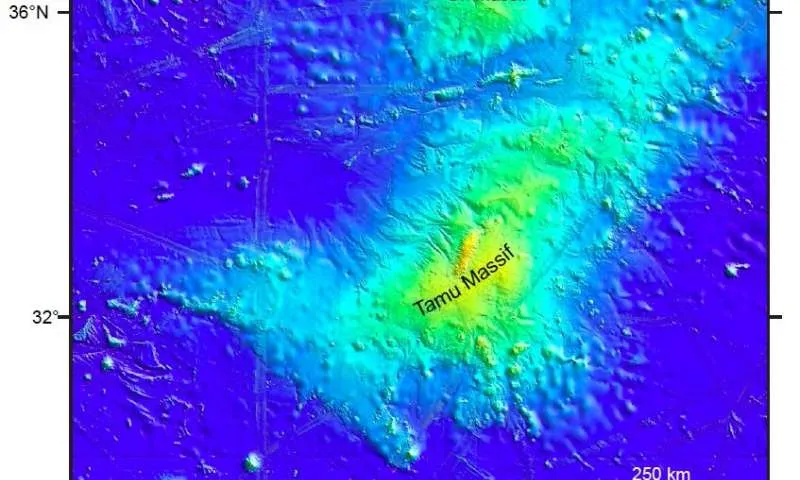
Back in 2013, Tamu Massif — a giant underwater volcano off the coast of Japan — stole Hawaii's crown as the largest single volcano in the world. But it's not a true single volcano at all.
Researchers published a paper in 2013 in the journal Nature Geoscience concluding that Tamu Massif was a giant "shield volcano" — even bigger than Hawaii's Mauna Loa, which rises 30,085 feet (9,170 meters) from the ocean floor and covers thousands of square miles with its ancient, solidified magma flows. Now, in a new paper, researchers conclude that the 2013 paper was wrong, and Tamu Massif isn't a shield volcano. The crown, according to this new research, returns to Mauna Loa.
Shield volcanoes form when a single volcanic plume spills enough lava over time, and that lava spreads far enough, to form a bulge-shaped mountain around the volcano's opening. Mauna Loa is a shield volcano. So are most of the much smaller volcanoes in Iceland. (Cone-shaped volcanoes, like Mount St. Helens, aren't shields but "stratovolcanoes.") In 2013, researchers thought that Tamu Massif formed in this same way. But the new paper suggests they're wrong. [5 Colossal Cones: Biggest Volcanoes on Earth]
Tamu Massif is a shallow volcanic system, with gently sloping sides; it extends about 400 miles (650 kilometers) wide, rising about 2.5 miles (4 km) tall. The massive underwater volcano lies along part of the mid-ocean ridge system, the world-encircling series of boundaries between different tectonic plates. This enormous system is, in a sense, the true largest volcano in the world, because magma can bulge upward and spill out as lava on top of the crust all along its range. But that volcanism doesn't look like the volcanism that forms a shield volcano.
Though Tamu Massif sits along the ridge, researchers thought it formed when a plume of magma burst from its center and flowed outward as lava to cool. That's why they claimed in 2013 it was a single-shield volcano. Now, researchers think it formed when, as part of the ridge's ongoing volcanism, magma squeezed its way slowly up into the crust, causing material that was already there to bulge and spread outward across the seafloor.
The evidence for this is magnetic anomalies — magnetic field lines the researchers detected in Tamu Massif that follow the arrangement of other field lines of the ridge, not the magnetism you'd expect from a shield volcano.
This means that rather than being a single, self-generated volcano placed along the ridge, Tamu Massif is just a part of the ridge system, which forms underwater mountains all over the world. Mauna Loa reigns supreme.
Get the world’s most fascinating discoveries delivered straight to your inbox.
The paper documenting this work was published July 8 in Nature Geoscience.
- Mount Etna: Photos of the Largest Active Volcano in Europe
- Photos: Hawaii's New Underwater Volcano
- Sunset Crater: Spectacular Photos of a Cinder Cone Volcano
Originally published on Live Science.
