













The Most Energetic Light Ever Seen Just Showered Down from the Skies Above Tibet

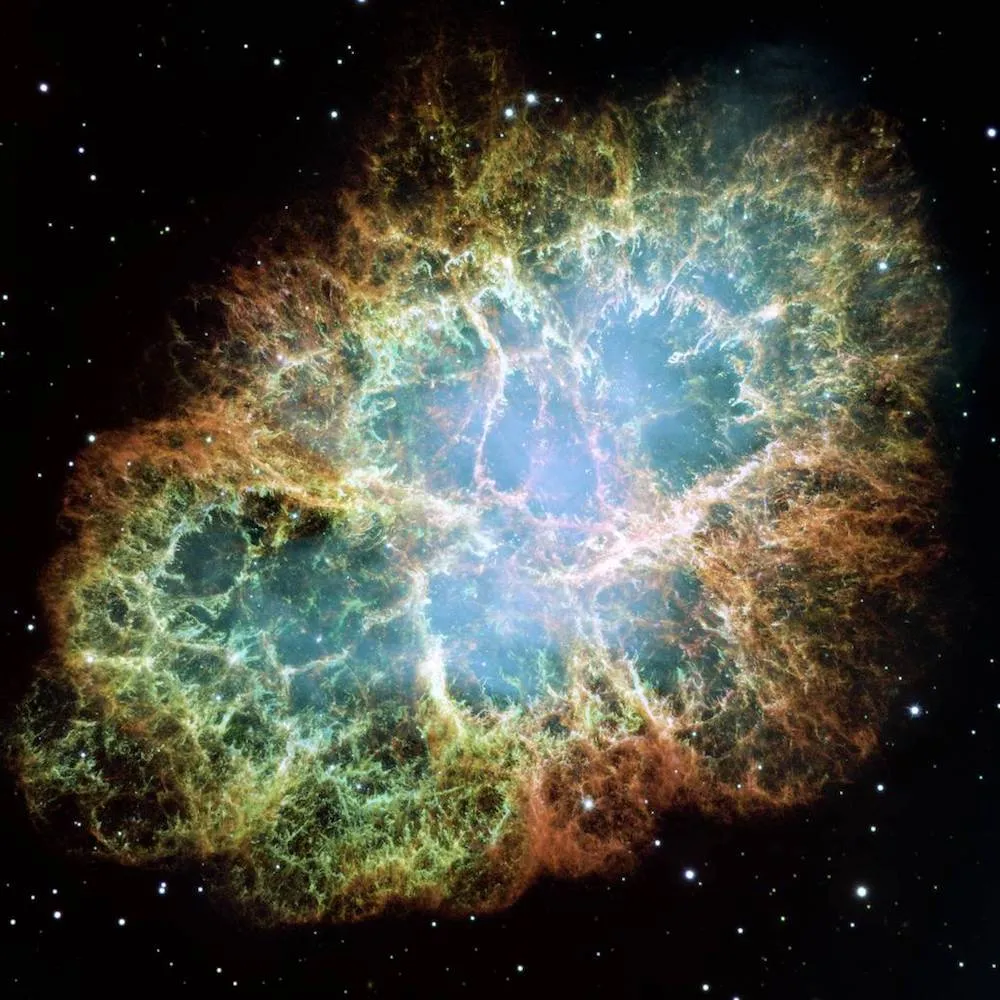
High up on the Tibetan plateau, scientists just measured the most energetic light ever seen. These photons were gamma rays with energies exceeding 100 trillion electronvolts — one even had nearly 500 trillion electronvolts of energy. Previously, only photons with tens of trillions of electronvolts had been seen.
The scientists found the photons had originated in the Crab Nebula, a pulsar, or a powerful spinning supernova remnant 6,523 light-years away.
The new results were discovered with a part of the Tibetan Air Shower Array, an experiment that uses 4 million square feet (36,900 square meters) of detectors to search for high-energy particles like cosmic rays and gamma rays. When such particles hit the upper atmosphere, they create showers of secondary subatomic particles that the array detects. The rarified air over the array, which stands 14,100 feet (4,300 meters) above sea level, allows more of the secondary particles to make it to the ground. [The 12 Strangest Objects in the Universe]
By studying showers of secondary particles called muons, the scientists were able to work backwards to figure out the energy and origin of the incoming gamma rays that caused the showers. In a new paper accepted June 13 to Physical Review Letters, astronomers studying these Crab Nebula showers reported 24 events caused by photons with energies higher than 100 trillion electronvolts. By comparison, particles of visible light from our sun only have an energy of a few electronvolts.
"It's a very, very important result," Felix Aharonian, professor at the Dublin Institute for Advanced Studies, who was not involved with the new work, told Live Science. "It agrees with expectation to a large extent and it could have a lot of implications because now it's experimental results, not just theoretical speculations."
The results specifically help scientists to understand how such high-energy photons are created, and if there is a limit to how much energy they can have. The scientists speculated that in this case, the gamma rays had been accelerated through a process known as Inverse Compton scattering. During this process, super high-energy electrons bounce off lower energy photons, giving the photons tremendous energy. These electrons in the Crab Nebula may have scattered off low-energy photons from the cosmic background radiation — some of the universe's first light.
"We knew that the Crab Nebula was a unique source in the universe," Aharonian told Live Science. "Now we see that yes, the electrons in the Crab Nebula are accelerated up to 1,000 trillion electronvolts."
Get the world’s most fascinating discoveries delivered straight to your inbox.
Shock waves in the magnetic environment in the nebula are likely responsible for accelerating the electrons to such extreme energies. If confirmed, this would add the Crab Nebula to just a couple of other proposed pulsars at the center of the galaxy thought capable of accelerating electrons to this degree.
- 11 Fascinating Facts About Our Milky Way Galaxy
- 15 Amazing Images of Stars
- Spaced Out! 101 Astronomy Images That Will Blow Your Mind
Originally published on Live Science.

Mara Johnson-Groh is a contributing writer for Live Science. She writes about everything under the sun, and even things beyond it, for a variety of publications including Discover, Science News, Scientific American, Eos and more, and is also a science writer for NASA. Mara has a bachelor's degree in physics and Scandinavian studies from Gustavus Adolphus College in Minnesota and a master's degree in astronomy from the University of Victoria in Canada.