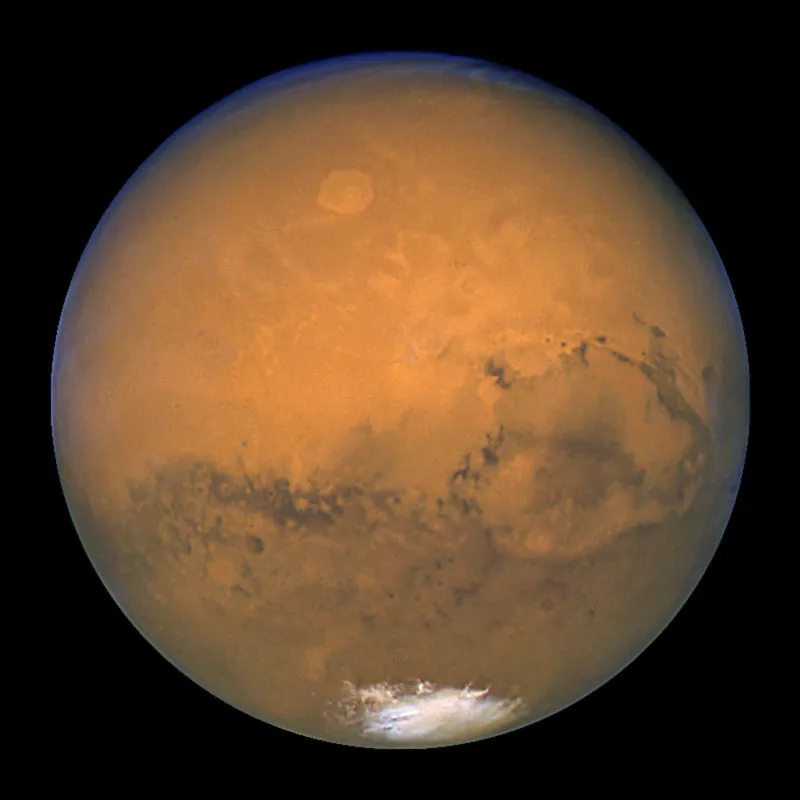
We are rapidly coming up on the pinnacle of the current Mars apparition, when it arrives at opposition to the sun and its closest point to the Earth. But will the weather cooperate for you to get a good look at Mars at its best?
First, be aware that the very best views of Mars will not be confined to a single night. Mars will arrive at opposition to the sun — when it will rise at sunset, reach its highest point in the sky during the middle of the night and set at sunrise — on Friday (July 27). However, because Earth and Mars follow elliptical orbits around the sun, Mars' closest approach to Earth usually occurs either several days before or after opposition. In this case, Mars will come within 35,784,481 miles (57,589,547 kilometers) of Earth four days after opposition, at 3:50 a.m. EDT (0750 GMT) on Tuesday (July 31). It will then take a light beam just 3 minutes and 12 seconds to cross the interplanetary gulf between Earth and Mars.
Nationally, it appears that the Western states will have the best weather during that time frame; more often than not the skies for this region should be mainly clear. It will be a different story, however, over the Central and especially Eastern states, where slow-moving frontal systems, interacting with a very warm and moist air sweeping north from the tropics, will produce considerable cloudiness and scattered to widespread showers and thunderstorms. And yet, even near and along the East Coast, where clouds and showers will predominate, there will be opportunities to get a look at the second smallest planet in the solar system.
For the latest National Weather Service forecasts, check their web page; find the region of the country where you're located and click on the forecast office for your area.
There's a vivid difference between viewing Mars in 2016 (without the dust storm) and 2018!
(Image credit: Frank J. Melillo)
Your best views of Mars, however, might be with just your eyes alone. Right now, through even a large telescope, the view may be a disappointment thanks to a planetwide dust storm in its eighth week, which is obscuring virtually all of the surface details on the planet. Although astronomers have told me that the worst of the storm has passed, there is still a fair amount of airborne dust that is cloaking even the most prominent and well-known Martian features. It might take at least another month or more for the dust to settle enough to allow details of the planet's physical features to be clearly seen.
A view of Mars on July 21, 2018 illustrates how skywatchers won't be able to discern many distinct features during this opposition due to the planet-wide dust storm.
(Image credit: Frank J. Melillo)
The dust has even changed the naked-eye appearance of Mars. Normally, when Mars becomes as bright as it is now, it appears a distinct orange-red in color. But those who have recently seen it say that it appears closer to yellow-orange, a hue similar to the color of ginger ale — certainly not a tint that befits Mars' popular nickname, the Red Planet.
Sign up for the Live Science daily newsletter now
Get the world’s most fascinating discoveries delivered straight to your inbox.
A slow decline in prominence
Even after July 31, however, Mars' inevitable fade-down will initially be gradual. In fact, it will continue to shine at its predicted peak magnitude of –2.8 through Aug. 3. And it will still outshine Jupiter — the planet usually second in brightness only to Venus — through Sept. 5. Mars will continue to rival Sirius, the brightest of all stars, until Sept. 24. In apparent size, as late as Aug. 24, Mars will still appear (telescopically) at least 90 percent as large as on the night of closest approach. [How to Use Mobile Apps to Watch Mars' Closest Approach Since 2003]
Next time . . .
The next opposition of Mars will come on Oct. 13, 2020. That event could be an even more favorable opportunity for northern observers compared to now because Mars will appear more than 30 degrees higher in the sky than it is now. (Your clenched fist held at arm's length is equal to about 10 degrees, so in the fall of 2020, Mars will be "three fists" higher than it is now.) And Mars will be only 2.79 million miles (4.49 million km) farther from Earth compared with this month's opposition; it will appear to shine nearly as bright and, in telescopes, nearly as large as it does now.
Interestingly, there is a long-term cycle of 79 years where the circumstances of any particular Mars opposition will be replicated almost exactly. On July 27, 1939, for instance, Mars made nearly as close an approach to Earth as this year. In fact, at its closest in 1939, it was just 271,000 miles (437,000 km) farther from Earth than it will be this year on July 31. And 79 years from now, on Aug. 3, 2097, Mars will again make another very close approach to Earth, actually coming 287,000 miles (462,000 km) closer than this year.
Oh no! "The hoax" is back
Over the past 14 summers, many have received an email titled "Mars Spectacular," which circulated on the internet from an anonymous source. In turn, this message has gotten passed on to others who couldn't resist forwarding it to their entire address book. The annual email message always declares that on Aug. 27, the planet Mars will be closer to Earth than in the past 60,000 years, thereby offering spectacular views of the Red Planet. The commentary even proclaims, with liberal use of exclamation marks, that Mars will appear as bright as (or as large as) the full moon. But this is wrong for multiple reasons: First, that "Aug. 27" is actually Aug. 27, 2003. Mars did make a historically close pass by Earth that night. And second, during that approach it appeared as it does now to the naked eye — similar to a very bright star, but nothing like a full moon.
This year, there is a change of pace. The date of the Mars hoax has been altered to align with this month's opposition, going from Aug. 27 to July 27. And it's publicized not just with a simple email, but on a full-blown web page. The bogus announcement that Mars will appear as large as the full moon that night — and that the event occurs once every 34,978 years — is now circulating on all social media platforms.
If you've seen this, or had someone send it to you, ignore it or, better yet, delete it.
In a way, it's an immunization. If you make a fool of yourself by sending it to your friends and family, you'll be less likely to send them the next "hard-to-believe" web announcement you get, which may not be so harmless!
Editor's note: If you snap an amazing photo of Mars and would like to share it with Space.com for a story or photo gallery, send comments and images to [email protected].
Joe Rao serves as an instructor and guest lecturer at New York's Hayden Planetarium. He writes about astronomy for Natural History magazine, the Farmers' Almanac and other publications, and he is also an on-camera meteorologist for Verizon FiOS1 News in New York's Lower Hudson Valley. Follow us @Spacedotcom, Facebook and Google+. Original article on Space.com.
Joe Rao is a television meteorologist in the Hudson Valley, appearing weeknights on News 12 Westchester. He has also been an assiduous amateur astronomer for over 45 years, with a particular interest in comets, meteor showers and eclipses. He has co-led two eclipse expeditions and has served as on-board meteorologist for three eclipse cruises. He is also a contributing editor for Sky & Telescope and writes a monthly astronomy column for Natural History magazine as well as supplying astronomical data to the Farmers' Almanac. Since 1986 he has served as an Associate and Guest Lecturer at New York's Hayden Planetarium. In 2009, the Northeast Region of the Astronomical League bestowed upon him the prestigious Walter Scott Houston Award for more than four decades of promoting astronomy to the general public.