















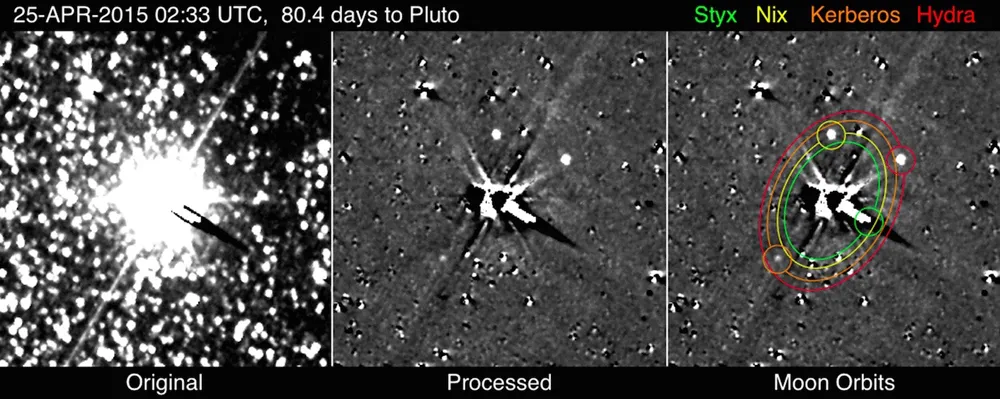
NASA's New Horizons spacecraft has snapped its first-ever family portrait of the Pluto system, capturing the dwarf planet and all five of its known moons.
New Horizons, which is speeding toward a historic flyby of Pluto on July 14, took a series of images from April 25 through May 1 using its Long Range Reconnaissance Imager (LORRI) camera. The shots mark the first time New Horizons has managed to resolve the extremely faint Pluto moons Kerberos and Styx, mission team members said.
"Detecting these tiny moons from a distance of more than 55 million miles [88.5 million kilometers] is amazing, and a credit to the team that built our LORRI long-range camera and [mission team member] John Spencer’s team of moon and ring hunters," New Horizons principal investigator Alan Stern, of the Southwest Research Institute in Boulder, Colorado, said in a statement. [Photos of Pluto and Its Moons]
Pluto's five known satellites are Charon, Hydra, Nix, Kerberos and Styx. At 648 miles (1,043 km) in diameter, Charon is nearly half as wide as Pluto itself, but the other four moons are minuscule. Kerberos and Styx, for example, are thought to be just 4 to 13 miles (7 to 21 km) and 6 to 20 miles (10 to 32 km) wide, respectively.
The four tiny moons are visible individually in the new images, while Charon melds with Pluto in a much brighter blur at the center of the other satellites' orbits. New Horizons scientists processed the original LORRI photos extensively to reduce the Pluto-Charon glare and reveal the faint small moons.
Kerberos and Styx were first spotted in 2011 and 2012, respectively, by New Horizons team members using NASA's Hubble Space Telescope. The spacecraft is poised to begin a moon search of its own in the coming days, as part of an effort to identify hazards that could complicate New Horizons' July 14 Pluto flyby.
"New Horizons is now on the threshold of discovery," Spencer, who's also based at the Southwest Research Institute in Boulder, said in the same statement. "If the spacecraft observes any additional moons as we get closer to Pluto, they will be worlds that no one has seen before."
Get the world’s most fascinating discoveries delivered straight to your inbox.
The $700 million New Horizons mission launched in January 2006 to conduct the first up-close reconnaissance of Pluto and its moons. Pluto has remained mysterious since its 1930 discovery because it is relatively small and lies so far from the sun; even the best Hubble images show the dwarf planet as a blur of pixels.
But New Horizons will bring Pluto into focus: On July 14, the probe will zoom within just 7,800 miles (12,500 km) of the dwarf planet's frigid surface.
Follow Mike Wall on Twitter @michaeldwall and Google+. Follow us @Spacedotcom, Facebook or Google+. Originally published on Space.com.
