













Papers Reveal Isaac Newton's Religious Side
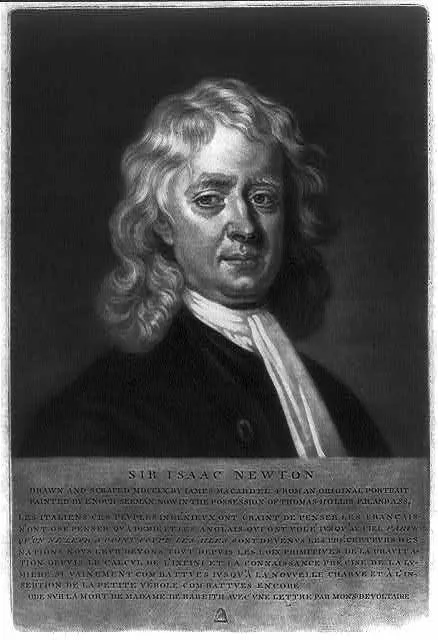
Everybody knows his "what goes up, must come down" universal theory of gravity, but Newton also showed that color is inherent in white light, studied the speed of sound, advanced the heliocentric view of the solar system, and postulated on the origin of the stars. He's also known for his three laws of motion, including inertia and "for every action there is an equal, but opposite, reaction."
JERUSALEM (AP) -- Three-century-old manuscripts by Isaac Newton calculating the exact date of the apocalypse, detailing the precise dimensions of the ancient temple in Jerusalem and interpreting passages of the Bible -- exhibited this week for the first time -- lay bare the little-known religious intensity of a man many consider history's greatest scientist.
Newton, who died 280 years ago, is known for laying much of the groundwork for modern physics, astronomy, math and optics. But in a new Jerusalem exhibit, he appears as a scholar of deep faith who also found time to write on Jewish law -- even penning a few phrases in careful Hebrew letters -- and combing the Old Testament's Book of Daniel for clues about the world's end.
The documents, purchased by a Jewish scholar at a Sotheby's auction in London in 1936, have been kept in safes at Israel's national library in Jerusalem since 1969. Available for decades only to a small number of scholars, they have never before been shown to the public.
In one manuscript from the early 1700s, Newton used the cryptic Book of Daniel to calculate the date for the Apocalypse, reaching the conclusion that the world would end no earlier than 2060.
“It may end later, but I see no reason for its ending sooner,'' Newton wrote. However, he added, “This I mention not to assert when the time of the end shall be, but to put a stop to the rash conjectures of fanciful men who are frequently predicting the time of the end, and by doing so bring the sacred prophesies into discredit as often as their predictions fail.''
In another document, Newton interpreted biblical prophecies to mean that the Jews would return to the Holy Land before the world ends. The end of days will see “the ruin of the wicked nations, the end of weeping and of all troubles, the return of the Jews captivity and their setting up a flourishing and everlasting Kingdom,'' he posited.
The exhibit also includes treatises on daily practice in the Jewish temple in Jerusalem. In one document, Newton discussed the exact dimensions of the temple -- its plans mirrored the arrangement of the cosmos, he believed -- and sketched it. Another paper contains words in Hebrew, including a sentence taken from the Jewish prayerbook.
Get the world’s most fascinating discoveries delivered straight to your inbox.
Yemima Ben-Menahem, one of the exhibit's curators, said the papers show Newton's conviction that important knowledge was hiding in ancient texts.
“He believed there was wisdom in the world that got lost. He thought it was coded, and that by studying things like the dimensions of the temple, he could decode it,'' she said.
The Newton papers, Ben-Menahem said, also complicate the idea that science is diametrically opposed to religion. “These documents show a scientist guided by religious fervor, by a desire to see God's actions in the world,'' she said.
More prosaic documents on display show Newton keeping track of his income and expenses while a scholar at Cambridge and later, as master of the Royal Mint, negotiating with a group of miners from Devon and Cornwall about the price of the tin they supplied to Queen Anne.
The archives of Hebrew University in Jerusalem include a 1940 letter from Albert Einstein to Abraham Shalom Yahuda, the collector who purchased the papers a year earlier.
Newton's religious writings, Einstein wrote, provide “a variety of sketches and ongoing changes that give us a most interesting look into the mental laboratory of this unique thinker.''
- Vote: The Greatest Modern Minds
- The Geniuses Behind the Geniuses
- Geniuses are Just Like Us