The 'easyJet ecoJet' would emit 50 percent less CO2 than today's newest ...
Technology
Shampoo Ingredient Suggests Better Solar Panels
By Charles Q. Choi, Special to LiveScience
posted: 08 May 2007 10:39 am ET
Advanced solar panels could one day be made cheaply with the aid of a shampoo ingredient, new findings suggest.
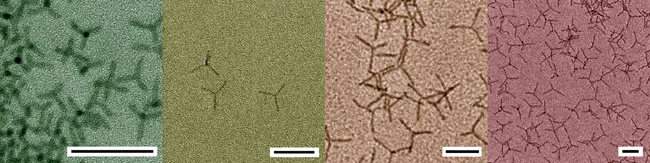
The panels would be made with crystals known as quantum dots, each smaller than a wavelength of visible light and capable of converting sunlight to electricity. Quantum dots are made of semiconductors such as cadmium selenide. The quantum dots that so far appear best at converting light to power are called tetrapods, each possessing four "legs" that seem to help electrons flow better.
Until now there was no good way of creating tetrapods in a uniform manner. Current techniques lead to a lot of tetrapods with crooked arms, missing arms and arms of uneven lengths, each of which vary in how efficient they are for solar power. Even in the best recipe, only about a third of all resulting particles are tetrapods, explained Rice University chemical engineer Michael Wong.
A new formula that Wong and his colleagues devised now results in more than 90 percent tetrapods. The secret is using a shampoo ingredient, findings detailed online April 30 in the journal Small.
A cheaper approach
The researchers were investigating cheaper ways of making tetrapods. Current methods to make tetrapods require expensive compounds known as alkylphosphonic acids. These modify the surfaces of quantum dots that would otherwise become spheres, stunting their growth to prompt the growth of legs, thus forming tetrapods.
Alkylphosphonic acids are negatively charged, binding to the positively charged cadmium exposed on the surface of quantum dots. Wong and his colleagues tried using a variety of positively charged compounds instead. The hope was that these would spur leg growth also by binding to the negatively charged selenium exposed on the surface of the quantum dots.
They found that a positively charged molecule with the tongue-twisting name of cetyltrimethylammonium bromide led to a drastic improvement in tetrapod manufacture. This compound, found in some shampoos, also happens to be 100 times cheaper than alkylphosphonic acids. The new materials the researchers use are also far safer than those used currently, and this could simplify manufacture, Wong told LiveScience.
Promise of tetrapods
Solar panels based on quantum dots could lead to thin flexible solar panels, "doing things that more rigid silicon-based solar cells can't do," Wong said. Quantum dot solar panels could also be manufactured just by spreading films of them on a surface, "which would be much cheaper to make than the chip-making processes you need with silicon."
So far, however, tetrapods are only shown to lead to 3 percent conversion efficiency, well below the typical solar panel, which has an average efficiency of 15 percent. Still, tetrapods could in principle show far higher efficiencies, with research until now stymied by poor tetrapod quality and low manufacture rates.
"Hopefully this will help put tetrapods in the hands of more researchers," Wong said.
The panels would be made with crystals known as quantum dots, each smaller than a wavelength of visible light and capable of converting sunlight to electricity. Quantum dots are made of semiconductors such as cadmium selenide. The quantum dots that so far appear best at converting light to power are called tetrapods, each possessing four "legs" that seem to help electrons flow better.
Until now there was no good way of creating tetrapods in a uniform manner. Current techniques lead to a lot of tetrapods with crooked arms, missing arms and arms of uneven lengths, each of which vary in how efficient they are for solar power. Even in the best recipe, only about a third of all resulting particles are tetrapods, explained Rice University chemical engineer Michael Wong.
A new formula that Wong and his colleagues devised now results in more than 90 percent tetrapods. The secret is using a shampoo ingredient, findings detailed online April 30 in the journal Small.
A cheaper approach
The researchers were investigating cheaper ways of making tetrapods. Current methods to make tetrapods require expensive compounds known as alkylphosphonic acids. These modify the surfaces of quantum dots that would otherwise become spheres, stunting their growth to prompt the growth of legs, thus forming tetrapods.
Alkylphosphonic acids are negatively charged, binding to the positively charged cadmium exposed on the surface of quantum dots. Wong and his colleagues tried using a variety of positively charged compounds instead. The hope was that these would spur leg growth also by binding to the negatively charged selenium exposed on the surface of the quantum dots.
They found that a positively charged molecule with the tongue-twisting name of cetyltrimethylammonium bromide led to a drastic improvement in tetrapod manufacture. This compound, found in some shampoos, also happens to be 100 times cheaper than alkylphosphonic acids. The new materials the researchers use are also far safer than those used currently, and this could simplify manufacture, Wong told LiveScience.
Promise of tetrapods
Solar panels based on quantum dots could lead to thin flexible solar panels, "doing things that more rigid silicon-based solar cells can't do," Wong said. Quantum dot solar panels could also be manufactured just by spreading films of them on a surface, "which would be much cheaper to make than the chip-making processes you need with silicon."
So far, however, tetrapods are only shown to lead to 3 percent conversion efficiency, well below the typical solar panel, which has an average efficiency of 15 percent. Still, tetrapods could in principle show far higher efficiencies, with research until now stymied by poor tetrapod quality and low manufacture rates.
"Hopefully this will help put tetrapods in the hands of more researchers," Wong said.
Related Items from the LiveScience Store
-
KeyKatcher PC Keystroke Spy $79.95
-
Triangle Glass-Face Clock $49.95
More Stores to Explore
Most Popular
- Recommended
- Commented
Community
- From Our Blogs
-
From Our Blogs
Animals
Marketplace Links
- Meet the HP ProLiant DL385 G5
- The HP ProLiant DL385 G5 server helps reduce resources and lets you manage systems-or collaborate-remotely
- Science. Technology. Sustainability.
- Visit the new Innovation Channel on LiveScience.com.
- One-stop destination for the lowest domestic airfares
- Search all airlines, including Southwest now!
- LiveScience Store
- Find everything from weird science to cool gadgets!
- Don't toss it, Recycle it!
- Find local recycling centers now
- Feel Strongly About Energy Options?
- Speak your mind about technologies and innovations in our forums.
- BP
- Beyond Petroleum
- Facing a Dilemma? Let Geek Logik help.
- Use Algebra to inform your decisions
- HP
- Protect and store your business's critical data with HP All-in-One and Disk-Based backup systems