The 'easyJet ecoJet'¯ would emit 50 percent less CO2 than today's newest ...
Strange Things Happen at Full Moon
By SPACE.com Staff
posted: 18 April 2008 01:51 pm ET
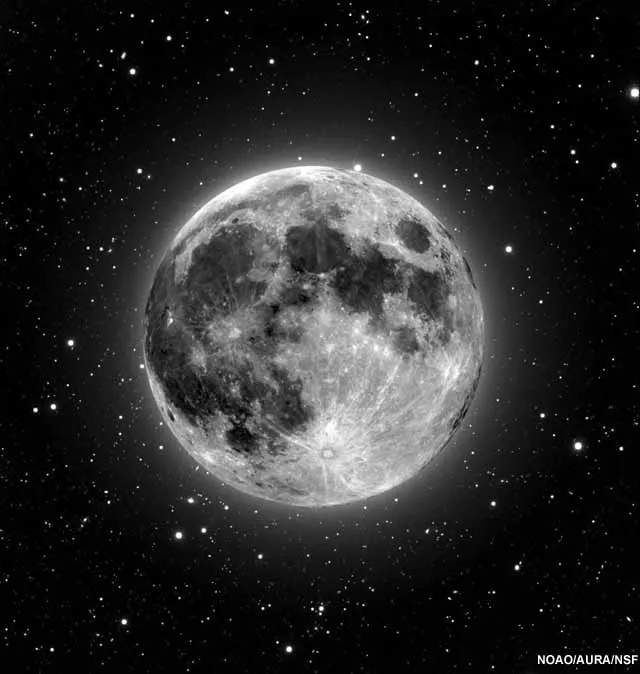
Full moons are said to be behind many strange things, but here's one you didn't know about: At full moon, our favorite satellite is whipped by Earth's magnetotail, causing lunar dust storms and discharges of static electricity.
This new finding, announced this week by NASA, is important to future lunar explorers: Astronauts may find themselves "crackling with electricity like a sock pulled out of a hot dryer," according to an agency statement.
The effect on the moon was first noticed in 1968, when NASA's Surveyor 7 lander photographed a strange glow on the horizon after dark. Nobody knew what it was. Now scientists think it was sunlight scattered by electrically charged moon dust floating just above the surface. That fits with data from NASA's Lunar Prospector, which orbited the moon in 1998-99. During some crossings of the magnetotail, the spacecraft recorded big changes in the lunar night-side voltage.
How it works
Our entire planet is enveloped in a bubble of magnetism generated by the rotating core. The solar wind, a stream of charged particles, pushes the bubble away from the sun and creates a long tail of magnetized material downstream.
"Earth's magnetotail extends well beyond the orbit of the moon and, once a month [at full moon] the moon orbits through it," said Tim Stubbs, a University of Maryland scientist working at the Goddard Space Flight Center. "This can have consequences ranging from lunar 'dust storms' to electrostatic discharges."
Here's what Stubbs and colleagues now think is happening:
At full moon, the moon passes through a huge "plasma sheet" hot charged particles trapped in the tail. The lightest and most mobile of these particles, electrons, pepper the moon's surface and give the moon a negative charge, the researchers explained.
On the moon's dayside this effect is counteracted somewhat by sunlight: Photons knock electrons back off the surface, lessening the negative charge. But on the night side, electrons accumulate and the charge can climb to thousands of volts.
What happens
The researchers speculate on what happens next.
The Surveyor 7 images suggest fine dust particles, all charged up, float above the lunar surface. On the night side, this dust might be intense enough to clog machinery and scratch an astronaut's faceplate.
The extreme differences in charge might cause dust to fly from the negative night side to the less-negative day side, becoming strongest along the regions where the sun is rising or setting.
Wild place
NASA has long been concerned about these electrical charges and moon dust and the overall impacts on astronauts, habitats and machinery. In fact the agency is drawing up plans to probe the secrets of moon dust.
Astronauts walking on the charged terrain might get electrified like sock from a hot dryer. "Touching another astronaut, a doorknob, a piece of sensitive electronics any of these simple actions could produce an unwelcome zap."
"Proper grounding is strongly recommended," Stubbs advised.
The plasma sheet is in a constant state of motion, flapping up and down all the time," said Jasper Halekas of the University of California, Berkeley. "So as the moon orbits through the magnetotail, the plasma sheet can sweep across it over and over again. Depending on how dynamic things are, we can encounter the plasma sheet many times during a single pass through the magnetotail with encounters lasting anywhere from minutes to hours or even days."
This makes for a very dramatic environment.
"The moon can be just sitting there in a quiet region of the magnetotail and then suddenly all this hot plasma goes sweeping by, causing the night side potential to spike to a kilovolt," Halekas said. "Then it drops back again just as quickly."
Anyone on the moon would want to know more about how all this works. And it'd be significantly worse during a solar storm.
"That is a very dynamic time for the plasma sheet and we need to study what happens then," he says.
Most Popular
- Recommended
- Commented
- Skull of Large Extinct Primate Reconstructed
- Gulf's 'Dead Zone' Less of a Mystery
- The Long History of the 2008 Financial Mess
- People Love Angry-Faced Cars
- Americans Clueless About Plans to Create New Life Forms
- Mysterious DNA Found to Survive Eons of Evolution
- Animals Have Personalities, Too
- World of Warcraft Video Game Succeeds in School
- Narcissists Tend to Become Leaders
- What Does the Vice President Do, Anyway?
- Intelligent Design: An Ambiguous Assault on Evolution
- Americans Clueless About Plans to Create New Life Forms
- The Long History of the 2008 Financial Mess
- Intelligent Design: Belief Posing as Theory
- Creation Museum Claims Big Crowds
- Catastrophe Killed Dinosaur Herd, New Species Emerges
- Flying Cars Near Takeoff
- Kansas Gym Ghost Mystery Solved
- Mysterious DNA Found to Survive Eons of Evolution
- Oldest 'Footprints' on Earth Found
Animals
Marketplace Links
- Meet the HP ProLiant DL385 G5
- The HP ProLiant DL385 G5 server helps reduce resources and lets you manage systems-or collaborate-remotely
- Science. Technology. Sustainability.
- Visit the new Innovation Channel on LiveScience.com.
- One-stop destination for the lowest domestic airfares
- Search all airlines, including Southwest now!
- HP
- The HP portfolio of server solutions helps you push the envelope-without pushing your budget to the brink. ProLiant technology, affordably priced.
- LiveScience Store
- Find everything from weird science to cool gadgets!
- Don't toss it, Recycle it!
- Find local recycling centers now
- Feel Strongly About Energy Options?
- Speak your mind about technologies and innovations in our forums.
- BP
- There’s energy security in energy diversity.
- Facing a Dilemma? Let Geek Logik help.
- Use Algebra to inform your decisions
- HP
- Protect and store your business's critical data with HP All-in-One and Disk-Based backup systems