













Thinking on Spinal Cord Function Turned on its Head

A new study reveals that the spinal cord seethes with a tug of war between electrical signals, overturning thinking on how it works.
Intriguingly, these conflicting signals could help animals respond more rapidly. And the findings could shed light on how our brains evolved, researchers said.
The core components of brains and spinal cords are cells known as neurons, which flicker with electrical activity. The spinal cord helps control thousands of "motor neurons," the cells that directly operate the muscles of the body based on instructions from the brain.
Working together
In order to create even a single motion, complex systems of motor neurons must work as one. Until now, scientists thought the spinal cord helped synchronize these networks by acting like a pacemaker, alternating between signals that excited or inhibited motor neurons to generate a rhythm for those cells to follow.
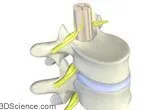
Two thoracic vertebrae in a human with the spinal cord and nerves exiting the column. Credit: 3DScience.com
Now researchers investigating a scratching behavior in red-eared turtles find that spinal cord signals both excite and inhibit their targets at the same time.
"Our findings contradict conventional wisdom about spinal cord functions," said researcher Rune Berg, a neuroscientist at the University of Copenhagen in Denmark.
Get the world’s most fascinating discoveries delivered straight to your inbox.
At first glance, this behavior might seem like a waste of energy. "It'd be like holding down the accelerator and the brake in the car at the same time. Not very economical," researcher Jorn Hounsgaard, a neuroscientist at the University of Copenhagen, told LiveScience.
Tug of war
The researchers speculate this tug of war helps keep neurons constantly close to the threshold of a response, like poising a finger over a button as opposed to either holding the button down constantly or keeping the finger away from the button altogether.
Until now, this kind of tug of war and the faster response times it is speculated to bring were seen only in the higher brain functions in mammals. "The fact that we find this in the spinal cord could mean it is a necessary mechanism for any large network of hundreds of thousands of neurons," Hounsgaard said.
One consequence of this research is that scientists are now unclear as to how motor neurons keep a common time scale. "It's a bit embarrassing," Hounsgaard said.
Hounsgaard, Berg and their colleague Aidas Alaburda at Vilnius University in Lithuania reported their findings in a recent issue of the journal Science.
- Top 10 Mysteries of the Mind
- Brain Chip Alters the Mind
- All About the Mind
Body Parts Quizzes: Parts List / How They Fit / What They Do
