Fossil Skeletons May Be Human Ancestor

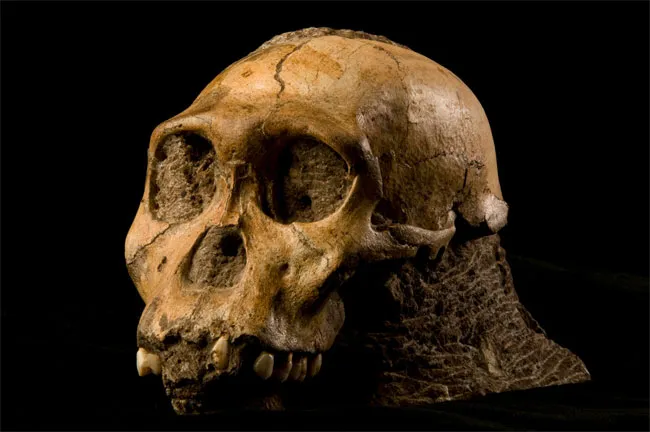
A newfound ancient relative of humanity discovered in a cave in Africa is a strong candidate for the immediate ancestor to the human lineage, an international team of scientists said today.
The remarkably well-preserved skeletons — a juvenile male and an adult female that lived nearly 2 million years ago — were found near the surface in the remains of a deeply eroded limestone cave system.
Scientists don't know how they died, but it's possible they fell into the cave.
The hominids had longer arms than we do, and smaller brains. But their faces were human-like, and scientists say the discovery represents an important look into our pre-human past. Researchers stopped short of calling the new species, dubbed Australopithecus sediba, a missing link.
Australopithecus means 'southern ape.' Sediba means "natural spring, fountain or wellspring in Sotho, one of the 11 official languages of South Africa," said researcher Lee Berger, a paleoanthropologist at the University of Witwatersrand in South Africa. This was "deemed an appropriate name for a species that might be the point from which the genus Homo arises," Berger said.
Rich fossil site
The partial skeletons were found near Johannesburg at a site called Malapa, which means "homestead" in Sotho, in an area named the Cradle of Humankind.
Get the world’s most fascinating discoveries delivered straight to your inbox.
"This is one of the richest fossil sites in Africa," said researcher Daniel Farber, an earth scientist at the University of California at Santa Cruz. Nearly a third of the entire evidence for human origins in Africa come from just a few sites in this region.
The sex of the fossils was determined from the shape of the jaws and hips, while analysis of the teeth suggest the young male was about 12 years old and the adult female in her late 20s or early 30s. Since these specimens apparently died at or about the same time as each other — anytime from hours to weeks apart — the researchers suggest they would almost certainly have known each other in life and may very well have been related.
Both stood upright a little more than 4 feet high (1.2 meters). "The female probably weighed about 33 kilograms (72 lbs.) and the child about 27 kilograms (59 lbs.) at the time of his death," Berger noted. The male was "right on the cusp of adulthood."
In many ways, the skeleton appears to be a mishmash of features, with some resembling members of the human family tree and others more like those of earlier ape-like hominids. (A hominid includes humans, chimpanzees, gorillas and their extinct ancestors, while hominins include those species after the human lineage split from that of chimpanzees.)
For instance, "the brain size of the juvenile was between 420 and 450 cubic centimeters, which is small when compared to the human brain of about 1,200 to 1,600 cubic centimeters," Berger said. "It would look almost like a pinhead."
Still, "the shape of the brain seems to be more advanced than that of australopithecines," Berger noted. Indeed, a number of skull features, such as certain wide, broad lines in the bone, "are ones you tend to attribute to early members of genus Homo," Berger told LiveScience — that is to say, our lineage.
Human-like faces
A number of facial and dental features resemble those of early human species, such as small teeth and a projecting nose. At the same time, "it had very long forearms — in fact, as long as an orangutans," Berger said, similar to other members of the genus Australopithecus. Its fingers were curved, ideal for climbing trees, yet relatively short, like in humans.
Its legs were relatively long and the ankles seem to be intermediate between modern humans and earlier hominids. Critically, its pelvis and hip were more advanced than other australopithecines, approaching the hip structure of the extinct human species Homo erectus.
This indicates that A. sediba was able to walk upright in a striding manner.
Despite the differences in sex, the male and female skeletons physically resembled each other, something they seem to have had in common with the human family tree but not with more distant relatives, such as chimpanzees. This could mean that A. sediba leaned toward social behavior "where you don't necessarily have a dominant alpha male and you are lowering violence between males who are probably working more cooperatively in a group," Berger suggested.
Time machine
A combination of dating techniques determined the rocks encasing the fossils are 1.95 million to 1.78 million years old.
"This fits in a critical moment in time," Berger explained. The human lineage is thought to have originated between 1.8 million to 2 million years ago, but the hominid fossils unearthed so far from that period have proven remarkably poor, giving scientists a great deal of room for speculation as to how our family tree evolved.
Due to A. sediba's age and physical traits, the researchers believe it is a convincing candidate for the immediate ancestor to the genus Homo. Based on its physique, they suggest its appearance signified the dawn of more energy-efficient forms of walking and running.
Many scientists believe the human genus Homo evolved from Australopithecus a little more than 2 million years ago, but that possibility has been widely debated, with other experts proposing an evolution from the genus Kenyanthropus. This new species might help clear up that controversy.
"These fossils give us an extraordinarily detailed look into a new chapter of human evolution, and provide a window into a critical period when hominids made the committed change from dependency on life in the trees to life on the ground," Berger said. "Australopithecus sediba appears to present a mosaic of features demonstrating an animal comfortable in both worlds."
Not a missing link
Based on its age and overall details of its body, researchers suggested A. sediba descended from Australopithecus africanus, which lived between 2 million and 3 million years ago and seemed to have eaten mostly soft foods like fleshy fruits, young leaves and perhaps some meat. This new species appears more similar to humans than do Australopithecus afarensis, most famed for Lucy, or Australopithecus garhi, which was discovered in 1996.
"We are perhaps at the beginning of a more coherent view of the diversity of the earliest South African hominids," said paleoanthropologist Ian Tattersall at the American Museum of Natural History in New York, who did not take part in this research. These specimens provide "a better position to perceive the larger evolutionary patterns among hominids in a critical part of the timeframe."
As intriguing as the new fossil is, "it's not everything the rumor mill said it was going to be," said paleoanthropologist John Hawks at the University of Wisconsin at Madison. "It's not a missing link."
One of the biggest mysteries in human evolution is when the human genus Homo arose.
"What sets us apart most from the australopithecines is the size of our brain," Hawks said. With this new fossil, "while it has a somewhat Homo-like face, it doesn't have a Homo-like brain — it's smaller than the average for the earlier [Australopithecus] africanus."
"Maybe these findings suggest we look to South Africa for a possible origin for Homo, but there's not a smoking gun here," Hawks added. Intriguing fossils have also emerged in East Africa, and even Asia, and much remains unknown when it comes to Central Africa and West Africa. All these clues raise the question of which species were our ancestors and which just evolved similar traits in a parallel manner. "We just need to find more skulls," he noted.
Regardless of whether they are a side-branch removed from humanity or whether they are our ancestors, these new hominids are "a time machine," Berger said, a window into the evolutionary pressures and processes during that crucial period when the human lineage arose.
Setting the scene
The sedimentary and geological setting the skeletons were found in suggests the two hominids died about the same time, shortly before a mud flow carried them to where they were buried.
"We think the environment [Australopithecus] sediba lived in was, in many ways, similar to the environment today," said researcher Paul Dirks, a geologist at James Cook University in Australia. "For example, one with predominantly grassy plains, transected by more vegetated, wooded valleys. However, the rivers flowed in different directions and the landscape was not static, but changed all the time."
The hominids were found along with at least 25 other species of animals, including saber-tooth cats, hyenas, a wild dog, a wildcat, a horse, a species of antelope known as a kudu, and smaller animals such as mice and rabbits. The fact that the hominid fossils were intact and well-preserved suggests they were trapped in the cave beyond the reach of scavengers that could have scattered their skeletons.
All these fossils were preserved in a hard, concrete-like substance known as calcified clastic sediment that formed at the bottom of what appears to be a shallow underground lake or pool.
"We believe the cave originally was deep and only accessible through vertical entranceways, which made it hard for animals to escape once they became trapped," Farber said.
Cause of death?
The cave would have likely once been some 100 to 150 feet deep (30 to 45 meters). "We are looking at very eroded and denuded portions of this cave system, where nature has exposed what had once been the deep reaches," Farber said.
The cave might have acted as a death trap for animals seeking water.
"We would speculate that perhaps at the time of their death, the area in which [Australopithecus] sediba lived experienced a severe drought," Dirks said. "Animals may have smelled the water, ventured in too deep, fallen down hidden shafts in the pitch dark, or got lost and died."
Although researchers can only speculate on how these hominids died, Farber speculated that they probably fell into the cave. "Even now, there are places where you can fall into unexpected cracks in this landscape," he said.
A deeper understanding of the environment these hominids lived in could yield critical insights into their evolution. For instance, was there anything about their surroundings that might have driven them to stand upright?
"Those were the original questions that we will continue to look at as part of the broader study," Farber said. The scientists will detail their findings in the April 9 issue of the journal Science.
A child's discovery
The scientists began the research that uncovered A. sediba in March of 2008, when Berger and Dirks started mapping the roughly 130 caves and 20 fossil sites identified in the region over the past several decades. By July that year, the 3-D capabilities of Google Earth then allowed Berger to identify nearly 500 new caves from satellite images, which further research discovered included more than 25 fossil sites previously unknown to science.
"It is a powerful, powerful tool for science," Berger said of Google Earth. "I happen to know paleontologists around Africa who are using that tool to hunt for fossils."
In late July 2008, using Google Earth, Berger noted a series of caves running along a fault that pointed to a blank area in the region, an area that appeared to have clusters of trees that typically marked cave deposits. On August 1 that year, when Dirks was dropped off with his dog Tau to map the caves, he almost immediately discovered a rich new fossil site.
Two weeks after that, Berger explored this fossil site with his nine-year-old son Matthew and his postdoctoral student Job Kibii.
"Matthew ran off the site, about 15 meters (50 feet) off-site, and within about a minute-and-a-half, he said, 'Dad, I found a fossil," Berger said. "I thought it would be an antelope fossil, because that's usually all we find, but as I walked toward him, I found he found a hominid clavicle (collarbone) sticking out of the rock." That bone was the first remains found of A. sediba — the collarbone of the juvenile.
Fossil preparators have worked arduously over the last two years to extract the rest of the bones from the rock. In celebration of this find, the children of South Africa have been invited to a competition to decide what the name for the juvenile skeleton will be.
The future of the past
In the meantime, the researchers said there are at least two other skeletons emerging from the site. He also refused to confirm or deny whether they might have found any tools these hominids might have left behind.
"The presence of tools is something that would have enormous ramifications, obviously," Berger said. "We're treading carefully in that area."
The skulls from the fossils they have retrieved so far are well-preserved enough to reconstruct their faces, Berger noted.
"Sometime in the future, we will look into the face of sediba," he said.
The researchers might even be able to retrieve DNA or proteins from the site.
"We are seeing some organics preserved in various parts of the assemblage," Berger noted.
- Top 10 Mysteries of the First Humans
- Humans Still Evolving as Our Brains Shrink
- Top 10 Things That Make Humans Special