















How the Battle of Actium Changed the World

Each Monday, this column turns a page in history to explore the discoveries, events and people that continue to affect the history being made today.
It was the pivotal moment in an ancient soap opera, one marked by intrigue, romance, betrayal and widespread consequence.
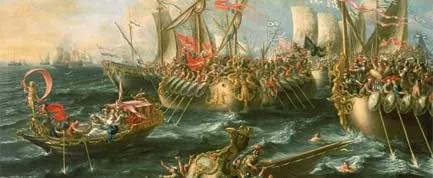
The Battle of Actium in 31 B.C. was an epic showdown that pitted Mark Antony and Cleopatra against spurned former ally Octavian. When Octavian eventually reigned supreme in battle, it meant the end of the Roman Republic for good and the beginning of the Roman Empire, whose influences were ultimately felt throughout the world.
Antony's colossal defeat also led to his and Cleopatra's Shakespearean double-suicide, providing plenty of movie fodder 2,000 years later.
Roman soap opera
Rome had been a republic for more than 450 years when things started to dissolve. De facto leader Julius Caesar was assassinated on the Ides of March in 44 B.C., escalating a messy civil war and creating a power vacuum that would be filled by two equally power-hungry politicians and militarists – Mark Antony and Octavian, Caesar's adopted son.
Power sharing between the two was tenuous, but a truce was formed when Antony was betrothed to Octavian's sister. It wouldn't last long, however, because – in true soap opera form – there would soon be another woman to contend with.
Get the world’s most fascinating discoveries delivered straight to your inbox.
Cleopatra, a beautiful and shrewd queen who already had a son by Julius Caesar, was the Pharaoh of Egypt when Rome started to implode. When Mark Antony passed through Egypt after a battle in the Near East, she seduced him too, angering Octavian over the disregard of his sister.
The resulting tension between Antony and Octavian in 31 B.C. had less to do with Octavian's hurt pride than the worry over Antony and Cleopatra's growing influence in the region, historians say, but it certainly makes for an interesting story.
Movie-style showdown
It's hard to imagine a more movie-worthy showdown than the one between Antony and Cleopatra on one side with a fleet totaling 500 warships, and Octavian on the other with almost 1,000, for control of the entire vast territory of the Roman Republic.
The Battle of Actium was fought in the waters off Greece – a Roman territory, at the time – and ended in the complete obliteration of Antony and Cleopatra's forces. When it was over, the waters were choked with the naval wreckage, historians at the time noted, as well as the bodies of 5,000 sailors.
Antony and Cleopatra did not go down with their navy. Recognizing their impeding defeat, the lovers fled in their separate ships and were chased down by Octavian. They both committed suicide instead of being captured. To seal his victory and eliminate competition, Octavian went to Egypt and executed Cleopatra's children by Antony as well as Julius Caesar's one and only son.
Worldwide consequences
Shakespeare turned the story of Antony and Cleopatra into a famous play, but historically, the Battle of Actium had even more important consequences.
Octavian, for his part, remained standing as the sole ruler of Rome in a time when the Republic was hanging on by a thread. Just a few years later, he was renamed Augustus and declared divine head of the new Roman Empire, a system that would last a further 400 years and engulf much of Europe, as well as parts of the Middle East and Africa under its rule.
Rome's influence over the language, religion and architecture of the 2.2 million square miles it once controlled lasts until this day.
By killing Julius Caesar and Cleopatra's son Caesarion, Octavian also effectively ended a 4,000-year tradition in Egypt. There would not be another true pharaoh in that country, which was absorbed under the banner of the empire.
