













Ants Save Mates Trapped in Sand
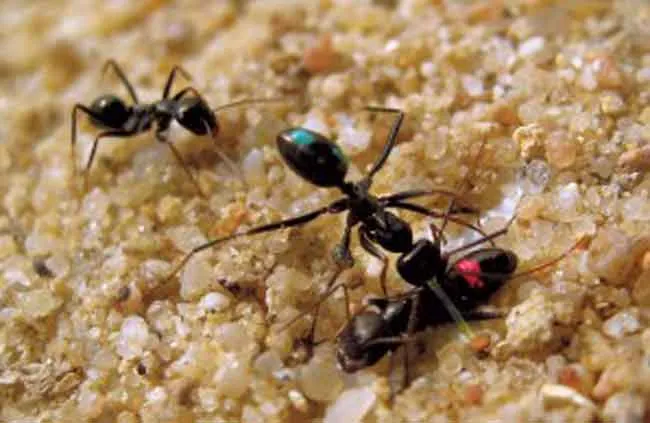
Helpful acts, such as grooming or foster parenting, are common throughout the animal kingdom, but accounts of animals rescuing one another from danger are exceedingly rare, having been reported in the scientific literature only for dolphins, capuchin monkeys, and ants. New research shows that in the ant Cataglyphis cursor, the behavior is surprisingly sophisticated.
Elise Nowbahari of the University of Paris North, Karen L. Hollis of Mount Holyoke College in South Hadley, Massachusetts, and two colleagues mimicked a natural situation—an ant restrained by collapsing sand and debris.
But hidden beneath the sand was a nylon snare holding the ant firmly in place. The ant’s nestmates consistently responded by digging around the victim and tugging at its limbs until they found the trap, then biting at the nylon strand. Potential rescuers did not, however, do the same for unrelated ants or insects of other species.
The ants’ ability to discern and then tackle the unfamiliar nylon snare demonstrates cognitive and behavioral complexity, unlike such simple actions as digging or limb pulling, which could arguably be elicited by a chemical distress signal. Nowbahari and Hollis distinguish rescue behavior from other cooperative acts in that both participants risk physical harm (rescuing ants could themselves be trapped under falling sand), with no possibility of reward for the rescuer aside from the benefits of kin selection.
The research was detailed in the journal PLoS ONE.
- Image Gallery: Ants of the World
This article was provided to LiveScience by Natural History Magazine.
Get the world’s most fascinating discoveries delivered straight to your inbox.