













Helicopters Collect Whale Snot from Blowholes
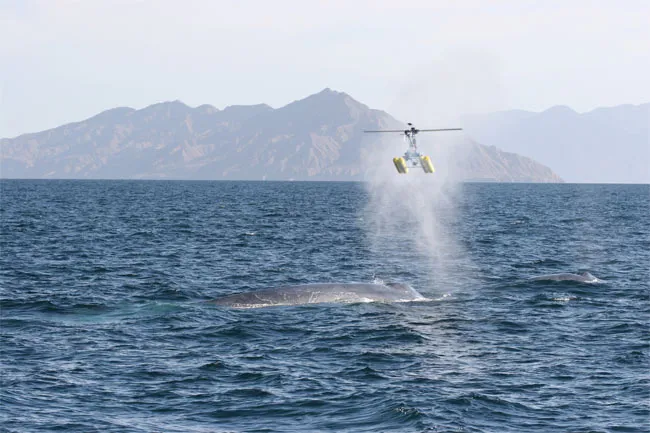
Tiny, remote-controlled helicopters hovering above the blowholes of whales have collected snot samples that could help scientists learn which bacteria lurk in seemingly healthy cetaceans in the wild.
"Up until now, all the information we have from whales comes from captive animals or animals that are dead or stranded, and that's hardly representative of the normal population," said Karina Acevedo-Whitehouse of the Zoological Society of London.
The research is focused primarily on blue whales and gray whales, with some tests on sperm whales. Early results show that blue whales and gray whales harbor fairly distinctive communities of bacteria.
Acevedo-Whitehouse wanted to figure out a baseline of bacteria and other micro-organisms held by whales. Then, by continuing to monitor the individuals, she and other scientists would be able to spot a sick whale, one with blowhole samples containing anomalous bacteria.
Her new technique involves using a 3.5-foot (about a meter) remote-controlled helicopter with Petri dishes attached to the craft's bottom. When the equipment is ready, Acevedo-Whitehouse and her colleagues work aboard a small boat, scanning the ocean for the whales' blows, which appear as a sprinkler mist shooting from the ocean surface. The mist contains the whale's exhalation of air, water vapor and sometimes mucus.
Once the whale is spotted, an operator directs the helicopter directly above and through the mist, which sprays up onto the Petri dishes. Back at the lab, the researchers analyze DNA from the samples to identify particular micro-organisms.
Other tricky things about collecting whale snot: For one, unlike the gregarious gray whales, blue whales are much shyer, and so the scientists need to keep a distance in their small boat while deploying the helicopter. A video camera onboard the helicopter gave the operator and other scientists a view of what the craft was seeing to help in maneuvering.
Get the world’s most fascinating discoveries delivered straight to your inbox.
In 2006, the researchers obtained their first blue-whale samples. "That was fantastic when we were able to actually position the helicopter right on top of the whale and collect the sample," Acevedo-Whitehouse told LiveScience. "For me, it's one of the most memorable experiences."
She said her research would not have been possible without the assistance of colleagues at CICIMAR (a research institution that is part of the National Polytechnic University of Mexico), who have at least 20 years of natural history and other ecological information on the whales.
"If you collect information on disease for whales or animals you don't know anything about, it's difficult to infer more population-type processes," Acevedo-Whitehouse said.
- Video – Gray Whale Population Takes a Dive
- Images: The World's Biggest Beasts
- Video – Why Whales Are Starving
Jeanna Bryner is managing editor of Scientific American. Previously she was editor in chief of Live Science and, prior to that, an editor at Scholastic's Science World magazine. Bryner has an English degree from Salisbury University, a master's degree in biogeochemistry and environmental sciences from the University of Maryland and a graduate science journalism degree from New York University. She has worked as a biologist in Florida, where she monitored wetlands and did field surveys for endangered species, including the gorgeous Florida Scrub Jay. She also received an ocean sciences journalism fellowship from the Woods Hole Oceanographic Institution. She is a firm believer that science is for everyone and that just about everything can be viewed through the lens of science.