













Ancient Elephants Loved Water

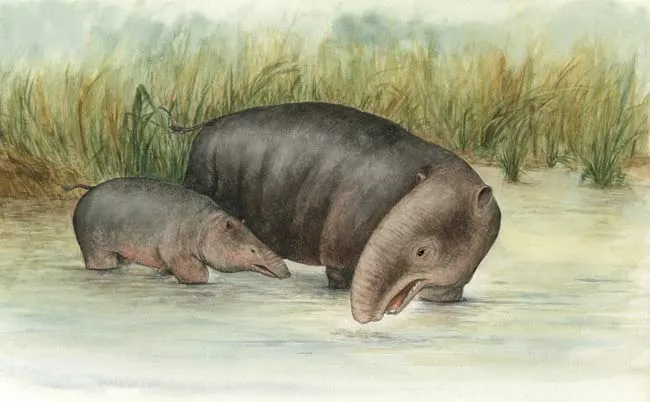
Elephants, those large and lumbering landlubbers, used to live partially in the water, according to new research.
A recent study found that an ancient elephant ancestor called Moeritherium spent most of its time in rivers and swamps.
Scientists knew that elephants are related to modern aquatic creatures such as manatees, but they had never identified an ancient elephant relative that lived in water. Now the evolutionary link is there.
"I think it’s the first real evidence that there is a semi-aquatic lineage to the elephants," said Alexander Liu, a graduate student in paleobiology at Oxford University. "It's something that people have expected but not been able to actually show."
Moeritherium had a large body, small eyes set high on its long snout, and the very beginnings of what would become a trunk.
Liu, along with Erik Seiffert of Stony Brook University and Elwyn Simons of Duke University, analyzed the teeth enamel of Moeritherium, which lived in the Eocene epoch, more than 37 million years ago. By measuring chemical signatures in the enamel, the researchers were able to learn what the animal ate and whether its food came primarily from land or water.
"We found that its diet was very similar to that of fully aquatic animals," Liu told LiveScience. "But we know they can't have been fully aquatic, because the bones we do have show that it must have walked around and put weight on its feet."
Get the world’s most fascinating discoveries delivered straight to your inbox.
The Moeritherium fossils were found in Egypt, which would have been a tropical rainforest when the animal was alive. The researchers think the creature might have had a lifestyle similar to that of a hippo, spending time in rivers and swamps, rather than a seafaring animal like a whale.
It probably weighed about 500 to 700 pounds (225 to 350 kg). While it didn't have very large ears or a trunk, it had a prehensile upper lip which would eventually evolve into the modern elephant's trunk.
"Elephants are very advanced and thought by a lot of biologists and zoologists to be a very intelligent lineage of animals, so it's nice to be able to discover a bit more about their history," Liu said.
The researchers will detail their findings April 14 in the journal Proceedings of the National Academy of Sciences. The project was funded by the Earth Sciences Department at Oxford University and St. Peter's College at Oxford University, and from grants by the U.S. National Science Foundation and the Leakey Foundation.
- Video: Elephant Doppelgangers
- Top 10 Animal Senses that Humans Don't Have
- Images: The World's Biggest Beasts
