













Good Rhythm Helps Birds Compete
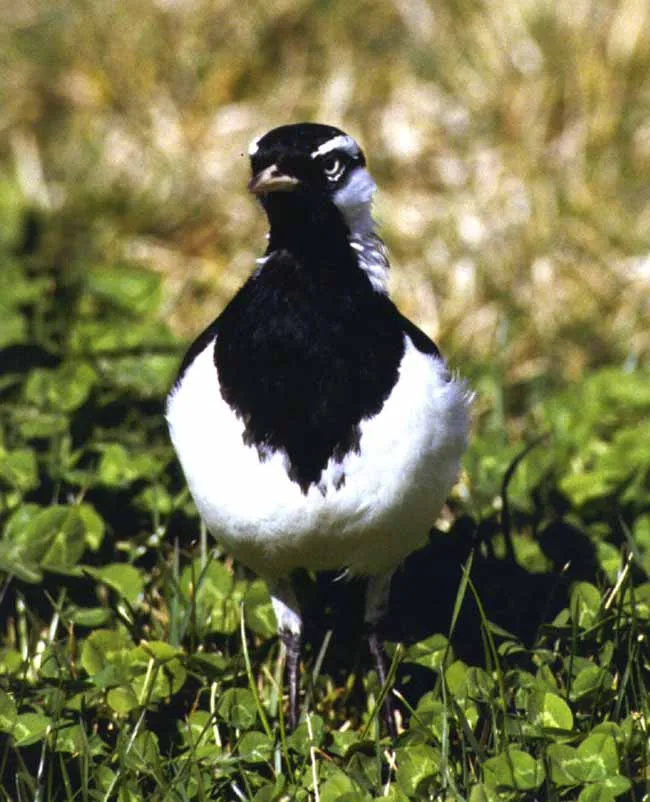
Jam sessions in the avian world, rather than drawing a crowd, keep out pesky intruders, new research suggests.
And magpie-lark duets with the most rhythm present a more threatening deterrent than those whistling off beat.
"When partners sing, they signal to other magpie-larks that they are working as a team to defend their territory," said co-researcher Michelle Hall of the Max Planck Institute for Ornithology in Germany.
Teamwork in the animal world is a common practice, particularly when defending shared resources. For instance, lions roar in choruses that signal their group's size to scare off rivals. Other animals, such as gibbons, chimpanzees and wolves, use similar noise-making displays to intimidate potential enemies.
Smooth singers
Australian magpie-larks (Grallina cyanoleuca) defend their territories in male-female pairs. One bird in the pair repeats a note that sounds like "peewee," which is immediately followed by "wit" from the other member of the couple. Past research has shown that bird duets are more threatening territorial displays than avian solos.
A hierarchy also exists within dueting chirpers since the magpie-larks vary in their singing and synchrony skills.
Get the world’s most fascinating discoveries delivered straight to your inbox.
Highly coordinated partners produce duets in which the notes are so closely spaced that to the untrained ear they sound like one "voice." The less talented, or less practiced, singers whistle tunes that include gaps, note overlaps or irregular tempos. Does this synchrony, or lack of it, have a payoff? And if so, the study scientists wondered how these timing differences influence the level of threat perceived by outsiders.
Team work
To test the effect of duet precision, Hall and Robert Magrath of Australian National University, Canberra, broadcast coordinated and uncoordinated songs within 12 magpie-lark territories. Male magpie-larks chirped out more songs and initiated more duets with their mates in response to the most synched-up duets than they did for the sloppier duets. A boost in song rate is a sign of aggression, the scientists say.
"Song is a first line of defense in territorial songbirds," Hall told LiveScience. "And I had found in previous experiments that male song rate was related to the threat of territorial intrusion."
The researchers suggest the degree of rhythm signals pair stability and how well the two birds work-and fight-together. In that way, the defensive duets convey accurate information about their threat to potential intruders.
Duet precision is a complex and coordinated task and, as such, birds with a longer-term union or those acting as a team should produce the most rhythmic songs. For instance, variables like distance between the birds in a pair could make for more songs with bad rhythm.
But even when separated, skilled singers were able to maintain a smoothly stitched beat by working as a team to make tempo adjustments, the scientists write in a report of their research published in the June 5 issue of the journal Current Biology.
And couples that had been together longer bellowed well-coordinated duets more often than "newlyweds, supporting, the researchers said, the idea that duet talent also signals pair stability. That stability would translate into an ongoing motivation to work together and defend their territory.
- Video: Extraordinary Birds
- Images: Rare and Exotic Birds
- Top 10 Animal Senses Humans Don't Have
Jeanna Bryner is managing editor of Scientific American. Previously she was editor in chief of Live Science and, prior to that, an editor at Scholastic's Science World magazine. Bryner has an English degree from Salisbury University, a master's degree in biogeochemistry and environmental sciences from the University of Maryland and a graduate science journalism degree from New York University. She has worked as a biologist in Florida, where she monitored wetlands and did field surveys for endangered species, including the gorgeous Florida Scrub Jay. She also received an ocean sciences journalism fellowship from the Woods Hole Oceanographic Institution. She is a firm believer that science is for everyone and that just about everything can be viewed through the lens of science.