















How Fish Hire a Cleaning Service
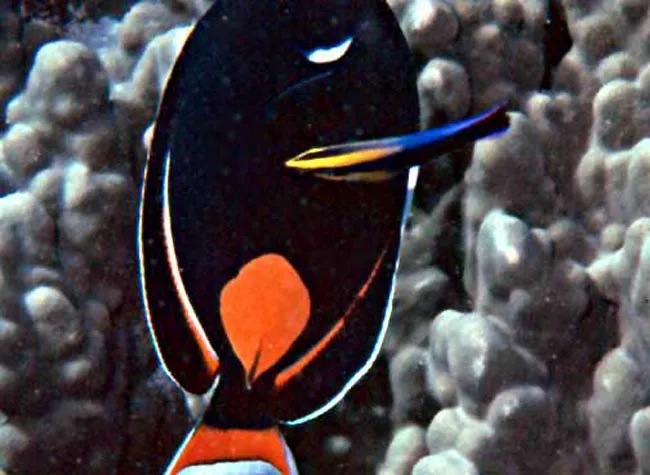
In the human world, peeking at your neighbors as they're cleaned is frowned upon, but some fish rely on information gained by rudely spying on their neighbors to survive.
Fish living in coral reefs often pick up skin parasites or experience buildup of dead skin cells. To keep healthy and tidy, the fish rely on small "cleaner" fish to nibble away the parasites and detritus.
A new study, detailed in the June 22 issue of Nature, reveals that "client" fish choose their cleaners by watching them go to work on other fish.
One common cleaner fish, the yellow, blue, and black striped Labroides dimidiatus, can choose to remove parasites from the skin of client, or they can cheat and dine on the clients mucus, the tastier option.
But there is no penalty for cheating. The clients, in this study Scolopsis bilineatus, rarely eat their cleaners, even the cheaters. So scientists have long wondered why cheating isn't rampant.
It alls comes down to the hiring process and how clients "eavesdrop" to select the most trustworthy cleaners.
The researchers set up an experiment where client fish could observe two cleaners, one dutifully munching away at another client's parasites and another swimming freely near another client.
Get the world’s most fascinating discoveries delivered straight to your inbox.
Taking the cleaner fishes' past performances into account, the clients chose the cooperative, hard-working fish significantly more often than the loafer.
The authors suggest that the client fish establish a rating system for the cleaners they observe and enlist the aid of those that score highly. The finding illustrates that complex social networks exist in the aquatic world and that this type of selective behavior could be the evolutionary roots of altruism and reputation.
- Without Sharks, Food Chain Crumbles
- Altruistic Love Related to Happier Marriages
- Overfishing Puts Stress on Coral Reefs
- Five Deep-Sea Fish on Brink of Extinction
- Starving Bacteria Cooperate to Make 'Superstrain'