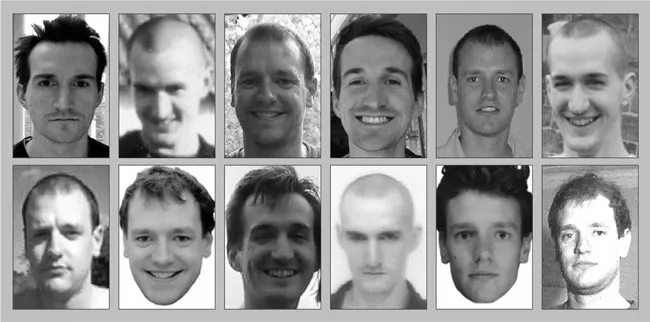
Most people don't spend much time puzzling over the gender of strangers, but it's common for the human brain to run into serious gender confusion when viewing faces from a distance. Researchers have found that small groups of brain cells each have their own bias toward interpreting facial gender one way or the other.
The biases show up only when the images of faces are small, such as three-quarters of an inch (about the size of a postage stamp), according to a recent study. The experiment led to surprising results — people interpreted identical faces as being male or female depending on where the facial image appeared in their field of vision.
"It's the kind of thing you would not predict — that you would look at two identical faces and think they look different," said Arash Afraz, a psychologist at MIT's McGovern Institute for Brain Research.
Latest Videos From
The strange results may depend upon the organization of brain cells related to vision. Small groups of cells analyze the stimuli coming from different parts of our field of vision, and each group has its own bias toward, say, seeing male or female faces, according to Afraz and colleagues from Harvard University.
Such gender bias usually remains hidden, because people don't usually squint at tiny faces from far away. Many groups of the brain cells (not just the skewed ones) become active when looking at faces at more-usual sizes, and so their average response hides any subtle bias.
Besides, people also usually rely on many other clues in addition to a face to figure out gender— clues that include voice, clothing, hairstyle and social mannerisms.
But the researchers teased out the hidden bias by having up to 11 volunteers watch as small faces were flashed for 50 milliseconds each on different parts of a computer screen. The faces fell all along the spectrum of masculine to feminine characteristics and included a range of androgynous faces, including faces that were more feminine- or more masculine-looking.
The small faces triggered the bias by activating just a few groups of brain cells that leaned more strongly toward male or female — similar to a sampling bias in public polling. (If you survey just five people in the neighborhood about their political affiliation, there's a good possibility of getting all Democrats or all Republicans.)
"The effect of the random variation will be washed out in the large sample statistics," Afraz said in an e-mail. "However, in the cases that the system cannot make a large enough sample, the biases show."
For faces, no single person had the same pattern of bias as the next person, but each individual's bias held up in a repeat experiment. Some people would judge androgynous faces as being female when the faces appeared in the upper-right corner of their vision, even as others deemed those same faces male.
Such patterns of bias were not limited to facial gender. A similar bias emerged when volunteers tried to judge the ages of faces.
Just how such biases developed among this or that clump of brain cells remains a mystery. But Afraz speculated that the biases may just reflect the small differences and imperfections in the biological process that created the cells.
"Note that these cells are not factory-generated silicon chips," Afraz told LiveScience. "Cells are essentially bags of fat and water, and carry a lot of biological variance and intrinsic biases by their nature."
The researchers also looked for possible bias in factors such as color and orientation of faces. For instance, past research suggested that white male faces have a reddish tint, while female faces have a greenish tint.
But they found much smaller differences for those visual factors among the volunteers. That's perhaps because the brain only needs very small groups of cells to make a clear identification of color or orientation of objects, and so the faces in the experiment still triggered enough neurons to eliminate any uncertainty.
The study is detailed in the Nov. 24 issue of the journal Current Biology.
- Top 10 Controversial Psychiatric Disorders
- 10 Things You Didn't Know About the Brain
- Top 10 Spooky Sleep Disorders