
 Live Science Plus


Dawn of the Universe Recreated

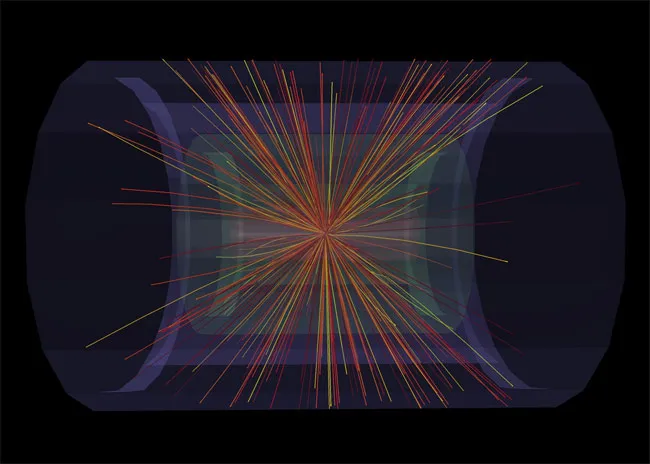
Just weeks after the world's largest particle accelerator began smashing together heavy lead ions to create little Big Bangs, the experiment has produced a primordial state of matter akin to what existed at the dawn of the universe.
The Large Hadron Collider (LHC), a 17-mile-long (27 kilometer) underground ring run by the European Organization for Nuclear Research (CERN) near Geneva, began colliding lead ions together Nov. 8. These atomic nuclei contain 82 protons, and are much heavier than the lone protons the accelerator was previously colliding.
Now two experiments at the LHC – called ATLAS and CMS, respectively – have reported a phenomenon called "jet quenching" that scientists say could reveal secrets about the nature of matter and the evolution of the universe.
Jet quenching
After two ions crash into each other, detectors measure jets of particles that emerge from the high-energy collision. Jets are formed as the basic constituents of nuclear matter, called quarks and gluons, fly away from the collision point.
In proton collisions, jets usually appear in pairs, emerging back to back. However, in the tumultuous conditions created by heavy ion collisions such as those made by lead nuclei, the jets interact with a hot dense medium created when temperatures are so high that the basic constituents of matter break apart.
This leads to a characteristic signal, known as jet quenching, in which the energy of the jets can be severely degraded, signaling interactions with the medium more intense than ever seen before.
"ATLAS is the first experiment to report direct observation of jet quenching," said ATLAS spokesperson Fabiola Gianotti in a statement. "The excellent capabilities of ATLAS to determine jet energies enabled us to observe a striking imbalance in energies of pairs of jets, where one jet is almost completely absorbed by the medium."
Probing very early universe
Jet quenching is a powerful tool for studying nature, especially the behavior of the medium of broken-down particles, called quark-gluon plasma. This plasma is created when super-high temperatures break apart protons into their constituent quarks and gluons. The quarks and gluons then float around in a kind of primordial soup that resembles the universe shortly after the Big Bang.
"It is truly amazing to be looking, albeit on a microscopic scale, at the conditions and state of matter that existed at the dawn of time," said CMS spokesperson Guido Tonelli. "Since the very first days of lead-ion collisions, the quenching of jets appeared in our data while other striking features, like the observation of Z particles, never seen before in heavy-ion collisions, are under investigation. The challenge is now to put together all possible studies that could lead us to a much better understanding of the properties of this new, extraordinary state of matter." (A Z particle is nearly identical to a massless photon yet is very massive.)
The quark-gluon plasma was created for the first time ever at a smaller particle accelerator called the Relativistic Heavy Ion Collider (RHIC) at Brookhaven National Laboratory on Long Island. That finding was announced in February 2010.
The ATLAS and CMS measurements offer a new possibility to use jets, which interact with the primordial soup, to probe this unique state of matter, scientists said. Future jet quenching and other measurements from the LHC experiments will provide powerful insight into the properties of the primordial plasma and the interactions among its quarks and gluons, they said.
Preliminary results from the experiments will be presented at a seminar on Dec. 2 at CERN.
- Twisted Physics: 7 Recent Mind-Blowing Findings
- Behind the Scenes at Humongous U.S. Atom Smasher
- Video: How the LHC Will Search For Exotic Magnetic Particles
Editor’s Note: This story has been corrected to reflect the accurate location of Brookhaven National Laboratory.
Get the world’s most fascinating discoveries delivered straight to your inbox.
