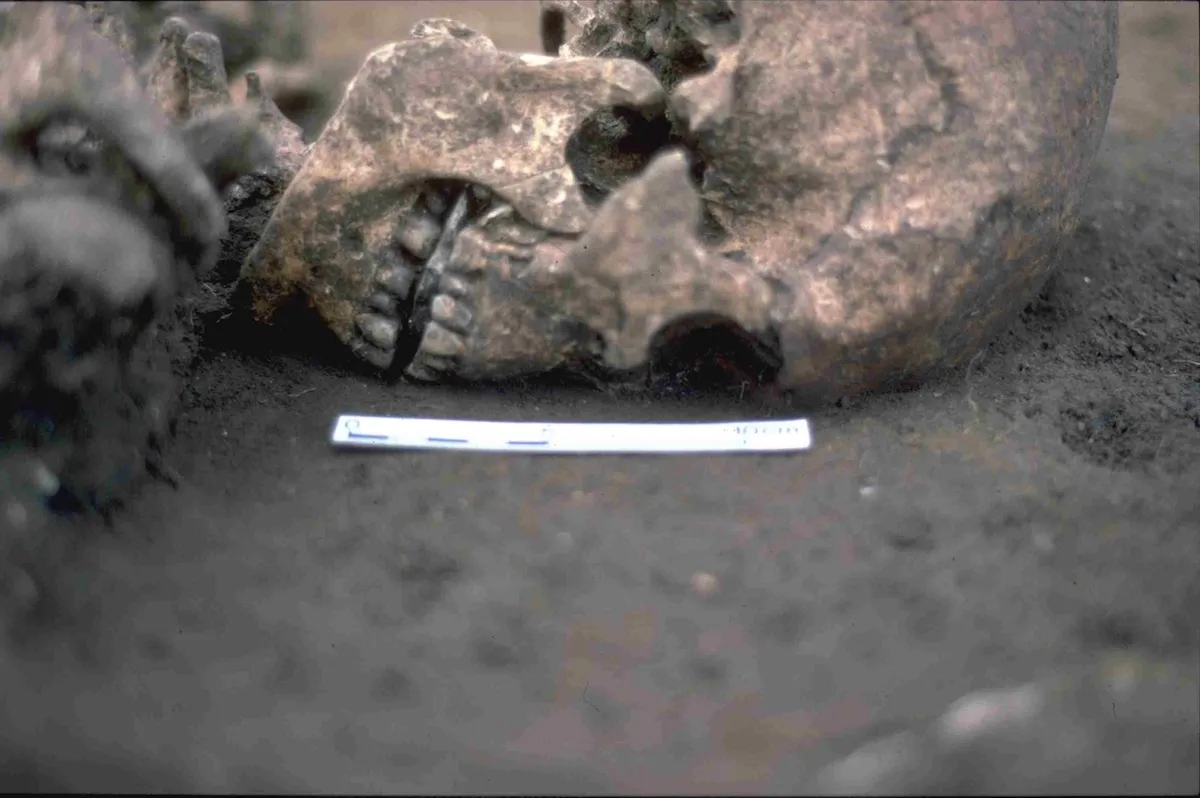
A man who lived some 1,500 years ago may have had his tongue cut out, though archaeologists, who found his remains buried with a flat rock in his mouth, are not sure the reason for the possible amputation.
The skeleton was excavated in 1991 near the village of Stanwick in Britain. But it wasn't until recently that a team led by Simon Mays, a human skeletal biologist with Historic England, a public group that promotes England's history, did an in-depth analysis of the skeleton.
The skeleton belongs to a male who was between 25 and 35 years old when he died, they found. When alive, the man suffered a serious oral infection that spread to other parts of his body and led to new bone growth in his mouth and other parts of his skull. A tongue amputation, Mays said, could cause just such an infection. [The 25 Most Mysterious Archaeological Finds on Earth]
Additionally, the team analyzed several other burials — dating between the third and seventh centuries A.D. — which had been excavated over the past few decades in Britain. They found several burials in which a skeleton's head was missing, likely due to decapitation, and in its place was a rock or pot. In one instance, a skeleton was found with its left foot missing — a pot put in its place.
After analyzing the evidence, they researchers concluded that the flat rock in the man's mouth may have been "a symbolic replacement for [a] tongue that was amputated in this individual during the lifetime of this man," Mays said. He cautioned that "we still have other scientific studies that we want to do on this and other burials."
Mysterious amputation
Why the man's tongue would be cut out is a mystery. Excavation photographs taken in 1991 reveal that the man's skeleton was found facedown with his right arm sticking out at an unusual angle, possible evidence that the man was tied up when he died, Mays said.
The 1,500-year-old skeleton was found face down with the right arm bent at an unusual angle. Study researchers say that he may have been tied up when he died. His lower body was destroyed by modern-day development.
(Image credit: Historic England)
However, Mays said that so far his team has found no evidence in ancient texts that the cutting out of tongues was practiced as a form of punishment when the man was alive — a time when the Romans controlled Britain.
Sign up for the Live Science daily newsletter now
Get the world’s most fascinating discoveries delivered straight to your inbox.
Mays' team also examined modern-day medical literature, looking for more clues. They found that "people who are suffering epileptic fits or people suffering from neurological diseases, such as Parkinson's diseaseor Alzheimer's disease, quite often bite their tongues or bite their lips," Mays said. However, "I wasn't able to come across any cases of that sort where there was complete severing of the tongue."
Mays did find cases in the modern medical literature in which people suffering from severe mental illnesses had psychotic episodes and bit off their tongue. As such, the ancient man may have suffered from such an illness, Mays said. He added that he may have been tied up when he died because people in the community thought of him as a threat.
Mays' team presented these preliminary results recently in Toronto at the joint annual meeting of the Archaeological Institute of America and the Society for Classical Studies.
Owen Jarus is a regular contributor to Live Science who writes about archaeology and humans' past. He has also written for The Independent (UK), The Canadian Press (CP) and The Associated Press (AP), among others. Owen has a bachelor of arts degree from the University of Toronto and a journalism degree from Ryerson University.