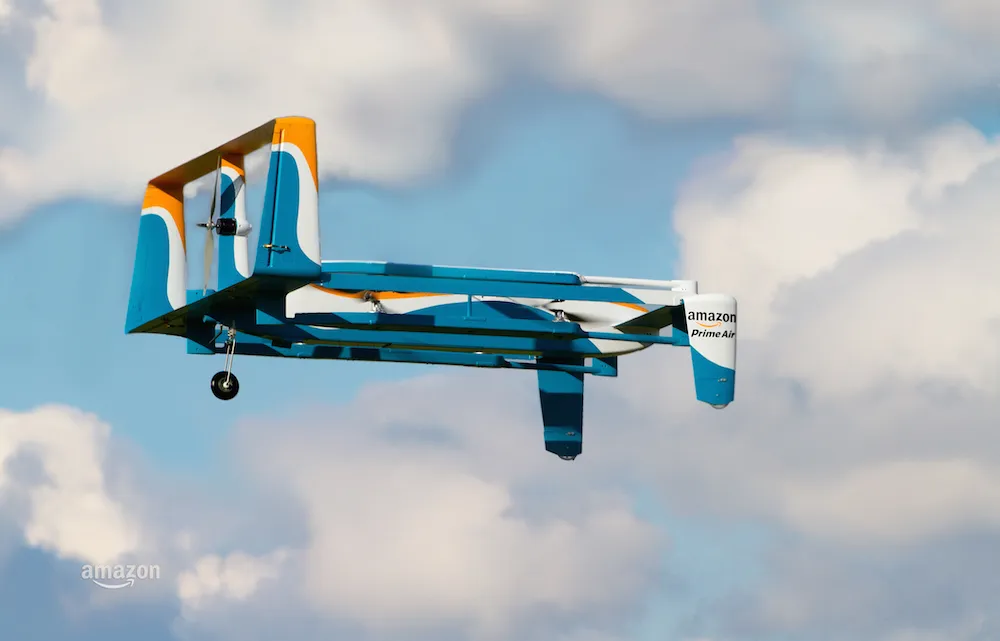
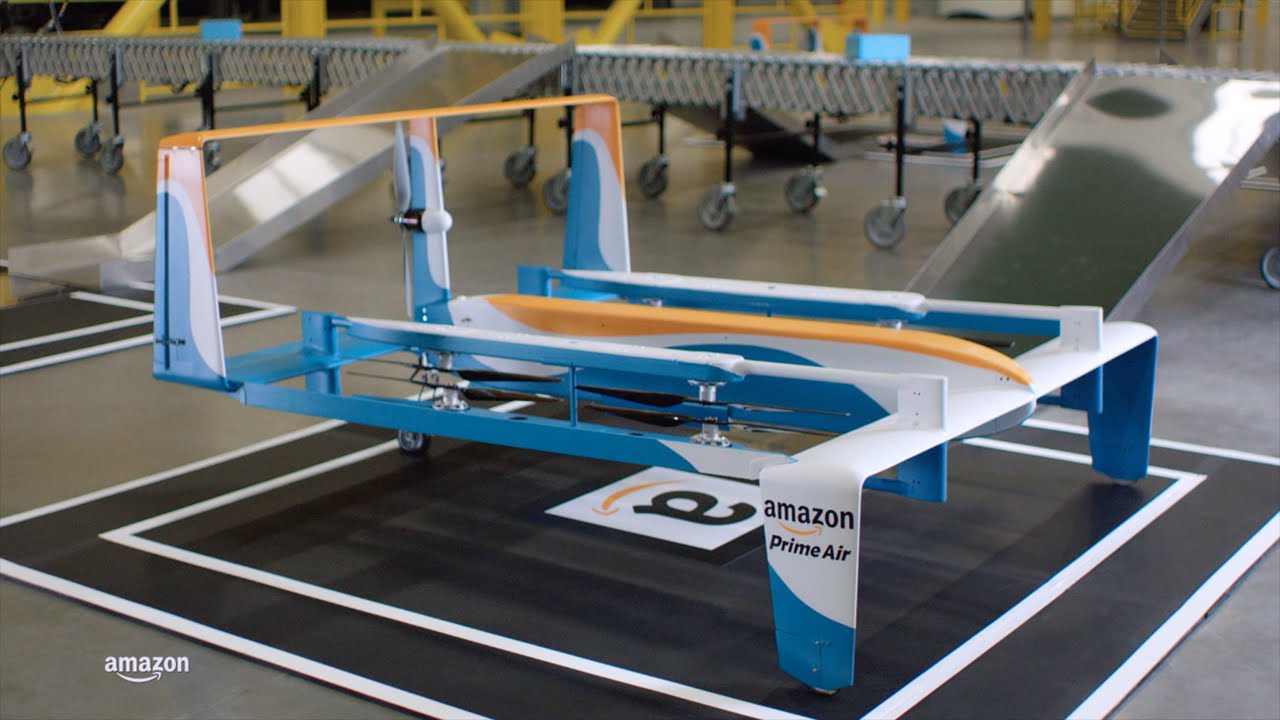
Amazon unveiled a prototype drone yesterday that could one day deliver packages to online shoppers' doorsteps just minutes after they press the "buy" button.
The new drone, or unmanned aerial vehicle (UAV), was created for Prime Air, a same-day delivery service that Amazon first announced in 2013. In the new YouTube video yesterday (Nov. 29) describing this futuristic service, the company said that its small drones (they weigh just 55 pounds, or 25 kilograms) could deliver packages in 30 minutes or less. However, you won't be able to get that new bowling ball shipped to you via Prime Air; the drones can only deliver packages weighing 5 lbs. (2.3 kg) or less.
Embedded with "sense-and-avoid" technology, the highly autonomous UAVs can safely fly beyond an operator's line of sight, according to Amazon, which also stated that the delivery vehicles can carry packages to customers within a 10-mile (16 kilometers) radius of an Amazon warehouse. [9 Totally Cool Uses for Drones]
Latest Videos FromLive Science
In the company's new video, a drone figures out where to land by setting its sights on a large white square that a customer has placed in the backyard. When the customer retrieves the package, she lifts up this landing square and carries it back inside the house. The whole process seems to take just a few seconds.
But before such a cutting-edge delivery technique takes off, it will need to be supported by authorities in the United States, the United Kingdom and Israel — the three countries in which Prime Air vehicles are currently being tested.
Amazon won approval to test its drones in the U.S. in April, but the Federal Aviation Administration (FAA) stipulated that the company must test its drones at altitudes under 400 feet (122 meters). The flying bots must also not exceed speeds of 100 mph (160 km/h), and they have to remain within the pilot's line of sight, according to the FAA's decision.
The regulations imposed on Amazon by the FAA are similar to those imposed on all commercial drone operators. In February, the administration outlined a set of rules stating that drones used for commercial purposes should weigh no more than 25 lbs. (25 kg) and must be flown no higher than 500 feet (150 m). The FAA also ruled that all such drones must fly where operators can see them. People who fly drones for other reasons (to take photos, for example) must follow similar rules in the U.S.
These regulationsdon't seem to be holding Amazon back from testing its prototype drones. However, in order for Prime Air to function as a practical and efficient delivery service, some of the FAA's rules first need to be changed — specifically, the line-of-sight requirement, according to Missy Cummings, a former fighter pilot who is the director of the Humans and Autonomy Lab at Duke University. In an interview in February, Cummings told Live Science that the FAA's ruling is a "good first start" but that it's "still holding back big segments of the industry."
And Amazon isn't the only company with a futuristic delivery option that could be hampered by government regulations. Google is working on its own UAV prototype as part of its Project Wing drone delivery service. At a NASA-sponsored drone conference in July, Dave Vos, the project leader behind the forward-thinking service, said that Google drones could be dropping packages on customers' doorsteps within a decade.
Amazon didn't specify when its prototype drone might be used to make actual deliveries, but the company's website does state that, one day, seeing a Prime Air vehicle could be "as normal as seeing mail trucks on the road."
Follow Elizabeth Palermo @techEpalermo. Follow Live Science @livescience, Facebook & Google+. Original article on Live Science.