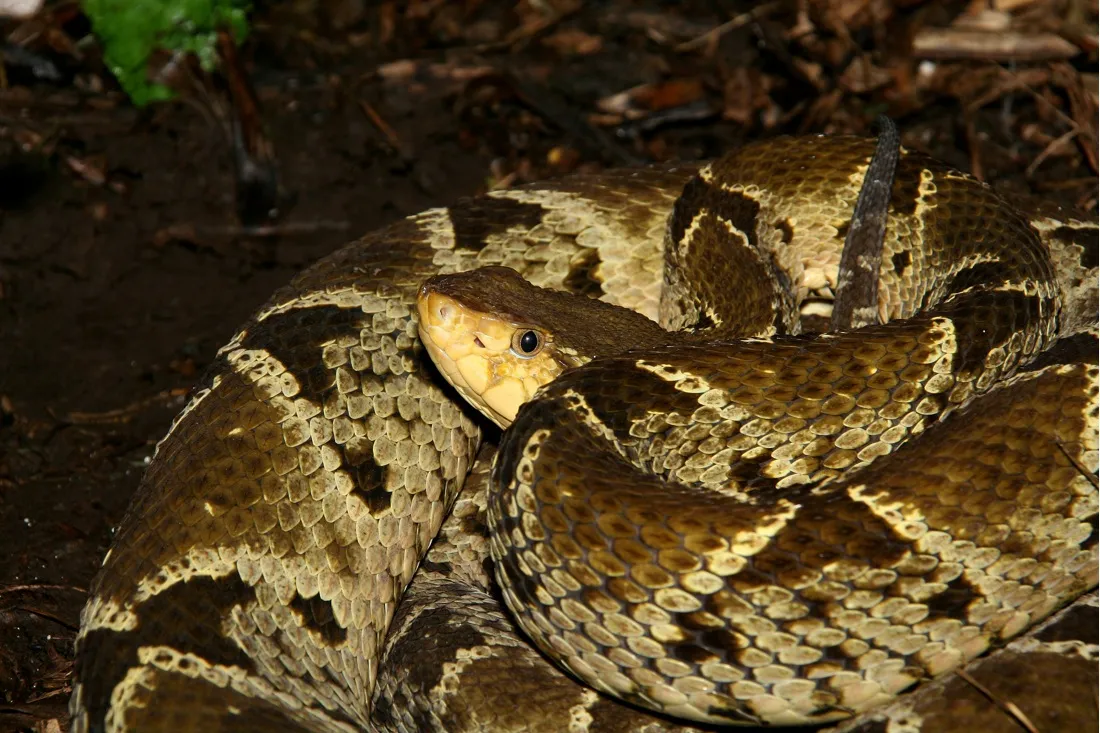
A female terciopelo (Bothrops asper) from the Costa Rican Caribbean. Terciopelo are responsible for most snakebites in the tropical regions of Central and South America. The snake's venom is toxic to the blood, causing clots and necrosis (tissue death). Untreated, bites can be fatal.
In Costa Rica, El Niño has a strange side effect: More snakebites.
Both the hot and cold phases of the El Niño Southern Oscillation (known as El Niño and La Niña, respectively) are accompanied by an increase in snakebites in the Central American country, according to a new study published today (Sept. 11) in the journal Science Advances. Here's how the climate cycle might be tied to slithering creatures: Snakes are ectothermic, meaning they get their body heat from outside sources. That means their activity is sensitive to climatological factors.
"Snakebites, probably the most neglected of the neglected tropical diseases, [are] another disease showing changes in [the] face of climate change," study researcher Luis Fernando Chaves, a scientist at the Institute of Tropical Medicine at Nagasaki University in Japan, told Live Science. [See Photos of Snakes from Around the World]
Snakebites are relatively rare in the United States, but pose a huge problem in many regions, particularly southeast Asia and sub-Saharan Africa. A 2008 study published in the journal PLOS ONE found that at least 421,000 people are bitten by venomous snakes worldwide each year, and some 20,000 die — but those are conservative estimates. Given spotty statistics and reporting, the number of bites could be closer to 1.8 million and related deaths might reach 94,000, the authors reported.
Costa Rica is home to 22 species of venomous snake, according to the Costa Rica Star. The one that most often bites humans is the terciopelo (Bothrops asper), which can be deadly without antivenom treatment. [The World's 6 Deadliest Snakes]
A female terciopelo from Costa Rica's Caribbean Basin. In 2013, Discovery producer Steven Rankin was bitten by a terciopelo while scouting a location for the show "Naked and Afraid."
(Image credit: Davinia Beneyto)
What made Costa Rica useful for studying snakebites, however, was its widely available and free healthcare system. Not only do doctors keep good records of snakebites in the country, Chaves said, people also have access to healthcare after a bite, meaning even the poorest victims get reported.
Sign up for the Live Science daily newsletter now
Get the world’s most fascinating discoveries delivered straight to your inbox.
Chaves and his colleagues studied a database of snakebites that occurred between 2005 and 2013 — 6,424 in total. They found some predictable patterns: There are fewer snakebites at higher elevations, where the climate is cooler. Every degree Celsius increase in average temperature was linked to a 24 percent increase in the number of snakebites. Poorer areas were harder-hit than wealthier areas, in part because poor people in rural areas are often farmers or farm workers, which puts them in direct contact with snakes, Chaves said. Poverty-stricken citizens are also less likely to have well-built homes that keep snakes out, he added.
Snake weather
The crucial finding, however, was an odd increase in snakebites during both El Niño and La Niña. El Niño brings hot, dry weather to Costa Rica; La Niña brings cool moisture.
It's simple enough to explain why hot weather might lead to more snakebites: Snakes are more active when it's warmer, Chaves said. The increase in snakebites linked to the cool weather of La Niña is a little more complicated. The researchers think this increase is linked to El Niño, too, though. Costa Rica has a torrential rainy season, so El Niño's drier weather (which is just less wet) is actually beneficial for plants compared to the usual deluge, Chaves said. More productive plants translate to more prey animals for snakes, which likely lead to a serpentine population eruption.
This is all well and good for the snakes until the El Niño pattern fades, at which point the snakes lose their abundant food supply. The prospect of starvation probably pushes snakes into areas they wouldn't normally go — near humans. This delayed reaction to El Niño's warmth could explain why the number of snakebites goes up again months later, during the cold La Niña. The snakebite count drops again when neither climate pattern is in play, the researchers found.
"This pattern is different from what has been observed for other diseases affected by El Niño," Chaves wrote in an email to Live Science. "For example, in vector-borne diseases (those diseases transmitted by mosquitoes and other bloodsucking insects), only one phase tends to be important."
Snakebites qualify as a neglected tropical disease, according to the World Health Organization, partly because victims tend to be poor and living in rural areas, without access to quality healthcare. In Africa, in particular, the need for antivenom outstrips supply, said study researcher José María Gutiérrez, a scientist at the Clodomiro Picado Institute in Costa Rica, which produces antivenoms for Central America.
Adding to the problem, the manufacturer Sanofi Pasteur recently announced it can no longer afford to produce Fav-Afrique, an antivenom effective against 10 sub-Saharan African snake venoms. Supplies — already short — will run out next year.
The Fav-Afrique shortage won't affect Costa Rica or Latin America, as it's specific to sub-Saharan snakes, Gutiérrez told Live Science. Clodomiro Picado and other manufacturers do make antivenom for Africa, he said, though they don't meet the full need.
"The problem of antivenom availability in Africa is much more complex than the decision of a company to stop production," Gutiérrez said. "It is a multifactorial health problem that demands multifactorial analyses and solutions."
Stephanie Pappas is a contributing writer for Live Science, covering topics ranging from geoscience to archaeology to the human brain and behavior. She was previously a senior writer for Live Science but is now a freelancer based in Denver, Colorado, and regularly contributes to Scientific American and The Monitor, the monthly magazine of the American Psychological Association. Stephanie received a bachelor's degree in psychology from the University of South Carolina and a graduate certificate in science communication from the University of California, Santa Cruz.