 Live Science Plus





You are now subscribed
Your newsletter sign-up was successful
Want to add more newsletters?

Delivered Daily
Daily Newsletter
Sign up for the latest discoveries, groundbreaking research and fascinating breakthroughs that impact you and the wider world direct to your inbox.

Once a week
Life's Little Mysteries
Feed your curiosity with an exclusive mystery every week, solved with science and delivered direct to your inbox before it's seen anywhere else.

Once a week
How It Works
Sign up to our free science & technology newsletter for your weekly fix of fascinating articles, quick quizzes, amazing images, and more

Delivered daily
Space.com Newsletter
Breaking space news, the latest updates on rocket launches, skywatching events and more!

Once a month
Watch This Space
Sign up to our monthly entertainment newsletter to keep up with all our coverage of the latest sci-fi and space movies, tv shows, games and books.

Once a week
Night Sky This Week
Discover this week's must-see night sky events, moon phases, and stunning astrophotos. Sign up for our skywatching newsletter and explore the universe with us!
Join the club
Get full access to premium articles, exclusive features and a growing list of member rewards.
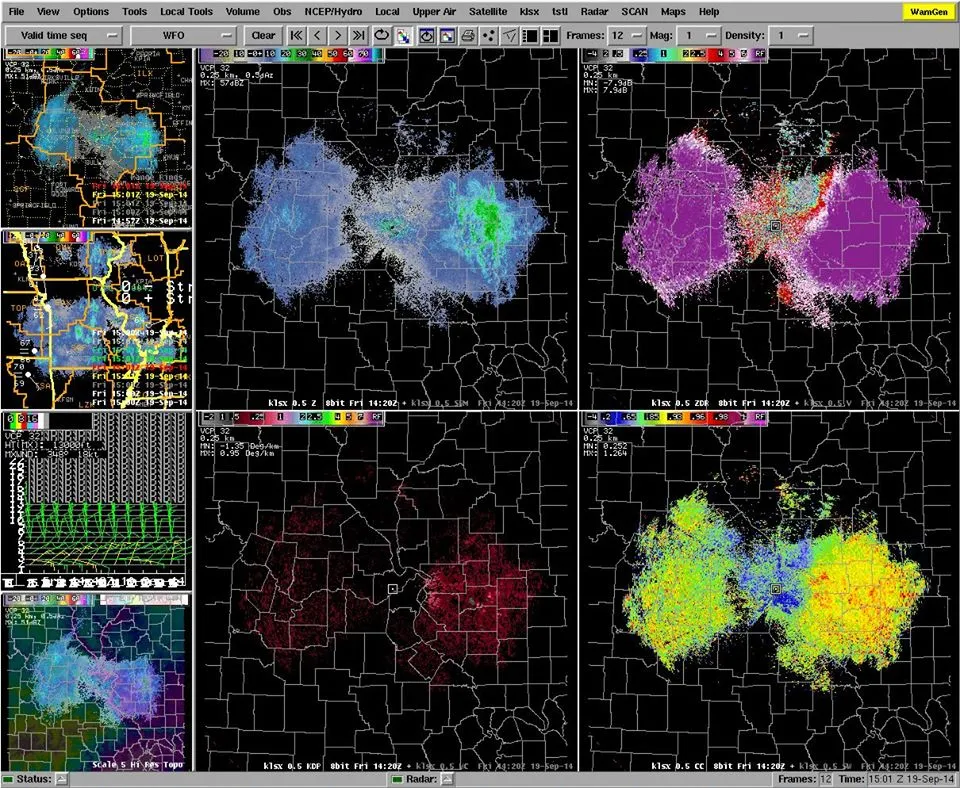
A mysterious butterfly-shaped cloud spotted over St. Louis last week was built from actual butterflies, the National Weather Service said.
In a rare coincidence, a giant swarm of migrating monarch butterflies resembled a butterfly on radar for a short time Friday afternoon (Sept. 19). Forecasters suspect hundreds of monarchs were flying between 5,000 feet and 6,000 feet (1,525 meters to 1,825 meters) above the ground, heading south to Mexico. Though small, their fluttering wings are good radar targets, the National Weather Service (NWS) said on Facebook. No one saw the butterflies, but the radar signals suggest the "targets" were flapping, flat and biological, similar to a monarch.
The double-butterfly is not the first time a radar image mirrored its maker. In 2011, a startled flock of blackbirds in Beebe, Arkansas, looked like a bird's head and beak. A strange radar image that puzzled forecasters in Huntsville, Alabama, in June 2013, turned out to be reflective particles used to test military radar. [See Images of the Mysterious Radar Blob over Alabama]
The butterfly-blob's timing matches up with a recent monarch exodus from the Great Lakes region, as tracked by the nonprofit Monarch Watch. The eastern population spends summers spread across the Great Lakes and the northeastern United States and Canada, and then migrates in the fall toward Michoacán, in western central Mexico. (A western population summers in California, but also winters in Mexico.)

The monarchs may have gathered together because of favorable weather conditions. Monarchs take advantage of air currents to soar like birds, conserving energy for their two-month trip to Mexico. Sometimes the butterflies fly in ones or twos, but swarms of dozens or hundreds of stunning orange-winged insects have been sighted by people tracking their migration, according to Monarch Watch.
Exposure to drought, cold temperatures and pesticides along the migration routes and in Mexican forests has triggered a dramatic decline in the monarch population. The numbers hit a record low of 33 million butterflies overwintering in Mexico in 2013.
Email Becky Oskin or follow her @beckyoskin. Follow us @livescience, Facebook & Google+. Original article on Live Science.

