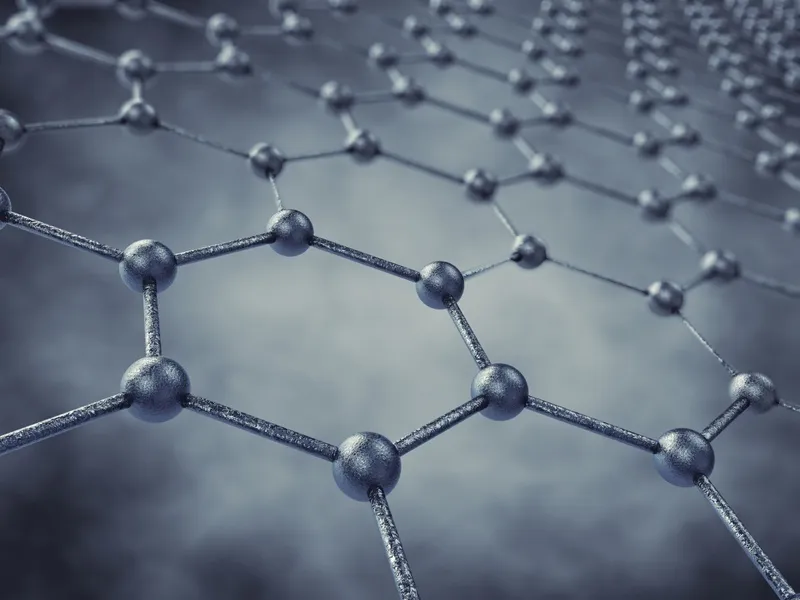
Graphene, a hexagonal arrangement of single carbon atoms that extends across two dimensions, lighter than steel but many times stronger, with better electrical conductivity than copper.
Graphene is often touted as a miracle material— it easily conducts electricity and it's hundreds of times stronger than steel. But now tests of real-world samples of graphene show that while the carbon material is possibly the strongest material produced today, it's also as brittle as ordinary ceramic.
A team of scientists from Rice University and the Georgia Institute of Technology tested small pieces of "bilayer" graphene, two single-atom-thick sheets of pure carbon resting one atop the other,by making tiny cracks in them with focused beams of ions. They then pulled the graphene, to see how fast the cracks expanded until the material broke. [8 Chemical Elements You've Never Heard Of]
"It's very sensitive to [the] presence of [a] crack. In steel if you have a crack, there, it's not so dangerous. Steel has a huge resistance to crack extension. Graphene is more like window glass," said Ting Zhu, an associate professor of mechanical engineering at Georgia Tech and one of the authors of the study.
An electron microscope image shows a pre-crack in a suspended sheet of graphene used to measure the overall strength of the sheet in a test at Rice University.
(Image credit: The Nanomaterials, Nanomechanics and Nanodevices Lab/Rice University)
The measure of a material's resistance to cracks, called fracture toughness, is not just the tensile strength — how likely it is to break when tugged on. It also measures how much punishment a given substance can take before cracking when being twisted. Metals, for instance, are ductile; it takes a lot of twisting and bending to break a spoon. A piece of glass resists twisting and doesn't stretch, but it breaks quickly if any twisting or pulling force is applied past a certain threshold, and even a tiny crack will make it shatter.
Zhu, working with Jun Lou at Rice, found that graphene with cracks is 10 times more prone to breakage than steel, and closer in fracture toughness to aluminum oxide or silicon carbide-based ceramics.
Sign up for the Live Science daily newsletter now
Get the world’s most fascinating discoveries delivered straight to your inbox.
The relatively low fracture toughness means that it takes only a small crack in a piece of graphene to weaken it. And such small cracks are a natural consequence of making graphene.
Graphene is made in several ways, among them chemical vapor deposition, in which carbon vapor is allowed to cool and settle on a surface, and exfoliation, in which graphite (from which graphene is derived) is put into a solvent. The sheets of graphene can be large in the former case, but they aren't perfect. The resulting lattice of carbon atoms that makes up the graphene has small defects — an atom missing or misaligned here and there. The defects won't make much difference when using graphene as a conductor or semiconductor, but for mechanical applications, such as making flexible displays or boosting structural strength of other materials, the imperfections start to matter.
Perfect graphene can take about 100 Gigapascals (14 million pounds per square inch) of force before it breaks. But the imperfect graphene the researchers made can withstand only a tiny fraction of that, about 4 Megapascals (580 pounds per square inch).
The experiments aren't just important for the study of graphene. Other materials that can take on a two-dimensional structure might behave in a similar way, and as such the new research, detailed today (April 29) in the journal Nature Communications, might offer important insights.
"This kind of modeling could be applied to study many other 2D materials, such as molybdenum disfulfide or boron nitride," Zhu said.
Editor's Note: This article was updated to correct the last quote, which had aluminum sulfide instead of molybdenum disfulfide.
Jesse Emspak is a contributing writer for Live Science, Space.com and Toms Guide. He focuses on physics, human health and general science. Jesse has a Master of Arts from the University of California, Berkeley School of Journalism, and a Bachelor of Arts from the University of Rochester. Jesse spent years covering finance and cut his teeth at local newspapers, working local politics and police beats. Jesse likes to stay active and holds a third degree black belt in Karate, which just means he now knows how much he has to learn.