















Volcanoes Partly to Blame for Global Warming 'Pause'

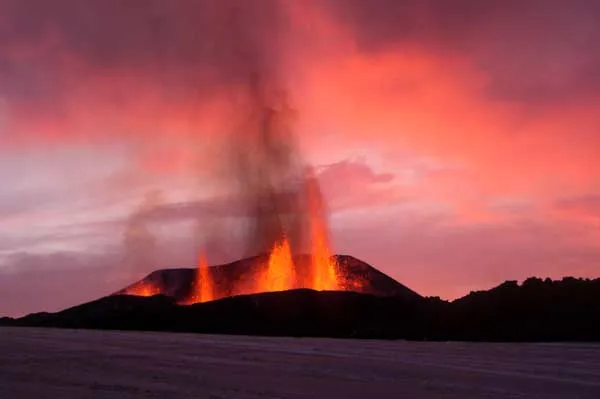
Cooling caused by volcanic eruptions accounts for 15 percent of the recent global warming "pause," the mismatch between actual warming and climate-model predictions, according to a new study.
The slowdown in global warming, sometimes called a pause or hiatus, started in 1998, when Earth's average surface temperatures halted their feverish rise. The average rate of warming was 0.31 degrees Fahrenheit (0.17 degrees Celsius) per decade between 1970 and 1998, but dropped to 0.072 F (0.04 C) per decade between 1998 and 2012. The Intergovernmental Panel on Climate Change (IPCC) had predicted the temperature trends seen in the 20th century to continue at their disco-era pace.
It turns out that a series of 17 small volcanic eruptions since 2000 pumped enough aerosols into the atmosphere to explain a significant portion of the slowdown, researchers report today (Feb. 23) in the journal Nature Geoscience. Aerosols are fine, airborne particles — such as sulfate — that scatter the sun's energy, cooling the Earth. This cooling has offset the ongoing warming caused by greenhouse gases such as carbon dioxide, the researchers said. (All told, humans have released about 100 times more carbon dioxide than the amount of CO2 belched by volcanoes since 1750, according to the IPCC.)
"Part of the lack of the increase in warming for the last 15 years may be due to the cooling effect of volcanoes," said Céline Bonfils, a study co-author and climate scientist at Lawrence Livermore National Laboratory (LNNL) in Livermore, Calif.
Small but mighty
In 2011, scientists discovered that small volcanoes can significantly change the planet's climate. Before then, researchers thought that only big eruptions the size of 1991's Mount Pinatubo blast could effectively cool the Earth. Most climate models reflected this bias toward big eruptions, ignoring climate shifts from smaller blasts. [Video: The Painterly Mixing Of Aerosols In Our Atmosphere]
"The most recent [climate] simulations include all the major volcanoes up until Pinatubo in 1991; then the aerosols decay back to zero," said Mark Zelinka, a study co-author and LLNL climate scientist. "It was only recently that it was known that these medium-sized volcanoes were putting a lot of highly reflective particles into the stratosphere." The stratosphere is the layer of the atmosphere above the one in which people live (the troposphere), and extends about 6 to 31 miles (10 to 50 kilometers) above Earth's surface.
Get the world’s most fascinating discoveries delivered straight to your inbox.
In the new study, the researchers correlated 17 volcanic eruptions since 2000 with shifts in troposphere temperatures, for which there is a global satellite record of temperature trends. The same stumble in warming trends since 1998 also hit the troposphere.
The 17 volcanoes include some that made worldwide headlines, such as Iceland's troublesome Eyjafjallajökull, and less-disruptive eruptions, such as 2011's lava flows at Nabro, in Eritrea.
Using computer models and statistical tests, the researchers calculated that aerosols from the volcanoes reduced global troposphere temperatures. The aerosols also cooled the troposphere by reflecting sunlight.
"We see a statistically significant correlation with not only temperature, but reflected sunlight — which are both independent measures," Zelinka said. "That is a pretty key advance."
The results show that the slowdown in global warming can't be pinned on a single culprit, the researchers said. Other factors blamed for the global-warming slowdown include an uptick in sulfur-dioxide pollution from China and an unusually long minimum in solar activity. Recent measurements of deep ocean temperatures also indicate some of the missing heat is being absorbed at deeper levels in the ocean — a result supported by continued sea level rise. (Water expands as it warms.)
"The devil is really in the details," said Ryan Neely, an atmospheric scientist at the National Center for Atmospheric Research in Boulder, Colo., who was not involved in the study. "What’s important these days is how do you get down to decadal-scale predictability in climate change and global warming, and you have to pay attention to every detail, every eruption.
"This is the first really rigorous test of whether changes in volcanic activity relate to tropospheric temperatures, and they've done a really excellent job," Neely said.
Email Becky Oskin or follow her @beckyoskin. Follow us @livescience, Facebook & Google+. Original article on Live Science.
