













Secret to Ancient Roman Sundial Revealed in 3D Simulations

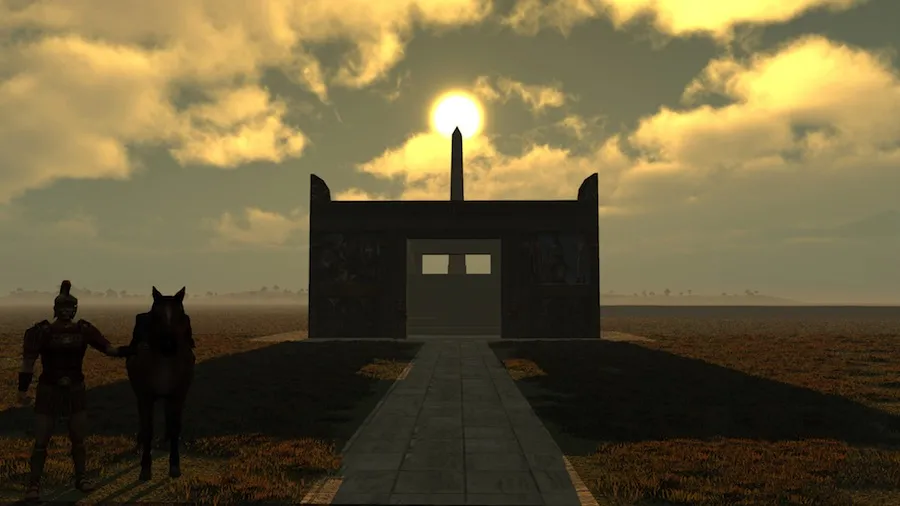
Using NASA data and new computer simulations, researchers say they've discovered how the sun would have lined up with an Egyptian obelisk and the famed Ara Pacis in ancient Rome.
The Ara Pacis, or "Altar of Peace," was dedicated in the year 9 B.C. to honor the Pax Romana, an era of relative peace established by Rome's first emperor Augustus. Today the building is recognized as a masterpiece of Augustan architecture, and it is housed in a glass, cube-shaped museum along the Tiber River. But in ancient times, it would have stood in the northern outskirts of the city, near an Egyptian obelisk that the Romans uprooted from Heliopolis and repurposed as a gnomon, or giant sundial.
Many historians had long accepted German scholar Edmund Buchner's theory that the shadow of the obelisk (which now sits in the Piazza Montecitorio) would hit the center of the facade of the Ara Pacis on Augustus' birthday, Sept. 23. Bernard Frischer, a professor of informatics and computing at Indiana University Bloomington, said he wanted to use this well-known alignment as part of an interactive 3D simulation of the Ara Pacis in its original context. [In Photos: Ancient Bronze Age Sundial Discovered]
"I made the simulation more to illustrate a technical point about how we can publish such [an] interactive simulation on a webpage along with the text discussing it," Frischer told LiveScience in an email. "But the simulation, once completed, showed that Buchner was wrong. That was a big surprise."
The simulation used data from NASA's Horizons System, which can conjure up the position of stars and planets at any time in history as seen from any spot on Earth. The model also drew on archaeological information about the sundial's original meridian line and the obelisk's original height.
Frischer and colleagues found that the sun would have appeared on top of the obelisk not on Augustus' birthday, but on Oct. 9, the annual festival of the Temple of Palatine Apollo. Though the find was surprising, Augustus did have a major connection to Apollo, his favorite deity and patron god. The Temple of Palatine Apollo was the most lavish new temple that Augustus built, and inscriptions also show that Augustus dedicated the obelisk to Apollo, Frischer explained.
"I think Buchner erred because he was too concentrated on Augustus' birthday and so only made one calculation of where the shadow would fall," Frischer said, "Before we made our simulation — which can instantaneously calculate a lighting solution for the shadow of the obelisk over a forty-year period for anyone virtually exploring the 80,000 sq. meter area — scholars only proposed a single date, time and observation point."
Get the world’s most fascinating discoveries delivered straight to your inbox.
Buchner probably only did a single calculation for practical reasons, as traditional methods to find solar alignments were very time-consuming and subject to error, Frischer said, but in his new simulation, "millions of calculations can be made instantaneously."
Frischer said he calls this kind of work "simpiricism," or empiricism supported by computer simulations. He announced his findings earlier this month at the Vatican's Pontifical Archaeological Academy in Rome.
The project isn't Frischer's first foray in reconstructing pieces of ancient Rome bit by bit. Back in November, he unveiled the Digital Hadrian's Villa Project, which turns the opulent Roman compound into a video game-style virtual world to be explored using avatars.
Follow Megan Gannon on Twitter and Google+. Follow us @livescience, Facebook & Google+. Original article on LiveScience.
