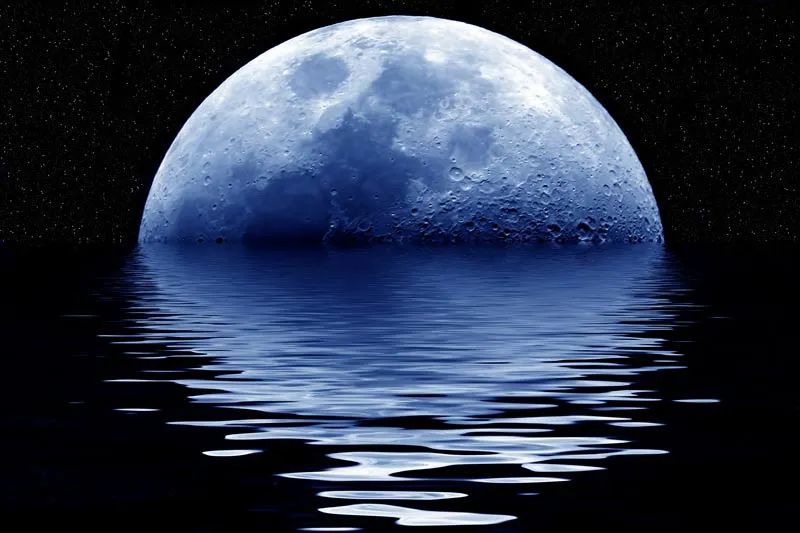
The next blue moon will occur on the last night of August. Although it will appear no bluer than on any other night, it will nonetheless fit the modern definition of the term by being the second full moon in a calendar month. But this technical meaning of "blue moon" arose fairly recently. The phrase has undergone a strange evolution over the past 500 years.
The notion of a blue moon first appeared in writing in the 16th century, according to folklorist Phillip Hiscock, a professor at Memorial University in Newfoundland who has traced the meaning of the phrase through the centuries. "In the English language, the first use that we have is by Cardinal Wolsey" — Henry VIII's notorious advisor, Hiscock said. "Cardinal Wolsey writes about his intellectual enemies who 'would have you believe the moon is blue.'"
Aside from the occasional blue-tinged moon that can peak through a volcanic ash cloud, moons almost always hover between white and yellow, and so to call the moon blue was to state an absurdity. "The phrase was a kind of metaphor for absurdity or impossibility," Hiscock told Life's Little Mysteries.
Latest Videos From
By the 1700s, the phrase had acquired a related meaning: never. "It sort of slipped sideways from impossibility to a temporal notion of impossible in time," Hiscock said.
From there, "blue moon" took a turn for the less stringent, eventually surfacing in 19th-century London as street slang for "a long time." Although it had probably been in use for a while, the slang first appeared in print in an 1821 book about working-class London. "A man is quoting someone on the street in London as saying, 'I haven't seen you this blue moon.' The author of the book gives a little note, and the note tells me this is a phrase he was unfamiliar with," Hiscock said. "The note reads, 'Blue moon — this is usually intended to imply a long time.'" [How Colors Got Their Symbolic Meanings]
The next literary reference came in 1869, when, in an autobiographical account of a shipwreck survivor, a man wrote of "that indefinite period known as a 'blue moon.'" Seven years later, the phrase appeared again, this time without explanation or quotation marks. Discussing diet, a character in an 1871 book admits to eating "a fruit pastry once in a blue moon."
The lack of explanation "shows clearly that, at least in Britain where these quotes come from, that phrase seemed to reach popularity in the middle part of that century between the '20s and '70s," Hiscock said.
Although no one knows how or why the phrase "blue moon" became harnessed to rare lunar events, we know where it happened: the state of Maine.
Because each season is three months long, seasons typically have three full moons. However, on occasion, the dates will align in such a way that a season will experience four. Farmers' almanacs published in Maine began calling the third full moon in a season with four a "blue moon."
Theories abound as to why the publishers did this. Some say that third moon was traditionally called "blue" in the Czech language, while others think the term comes from the French phrase double moon, "la deux lune," which sounds like blue moon. Other theories hold that almanacs started out printing the various types of moons in different colors, while still others assert that those third moons were bad luck, thus rendered blue. But Hiscock thinks the simplest explanation may be the most compelling: "It seems to me absolutely possible that someone just took the English meaning, 'now and again,' and assigned this astronomical meaning."
The final step in the evolution of the phrase (so far, at least) resulted from a journalist's error. In 1946, the amateur astronomer James Hugh Pruett wrote an article about the term "blue moon" for Sky & Telescope magazine. Whether purposefully or by mistake, he simplified the usage of the term found in the Maine Farmers' Almanac, and defined a blue moon as the second full moon in a calendar month — a coincidence of dates that occurs about every three years. By the time Pruett's error was discovered half a century later, the simple definition had stuck. [Why Does the Moon Look Bigger on the Horizon?]
Blue moons clearly have a rich history, but Hiscock thinks they have only now entered their heyday. As reflected in the number of businesses and products that have adopted "Blue Moon" for their name, "over the past quarter-century this term has really captured the imagination of North America and beyond," he said. "I think the phrase has a real hook to it for people, and I suspect that's because we are essentially a society of people alienated from nature. We grow up in cities and live lives that have nothing to do with the physical seasons or astronomical cycles, and when we hear things that connect us to those things we often become very excited."
He added, "Blue moon links people in a way that a lot of other things cannot. It feels old-fashioned while at the same time right here and now. It reduces that alienation from nature for many people."
Follow Natalie Wolchover on Twitter @nattyover or Life's Little Mysteries @llmysteries. We're also on Facebook & Google+.

 Live Science Plus