













Sea Ice Loss Could Alter Arctic Air Chemistry

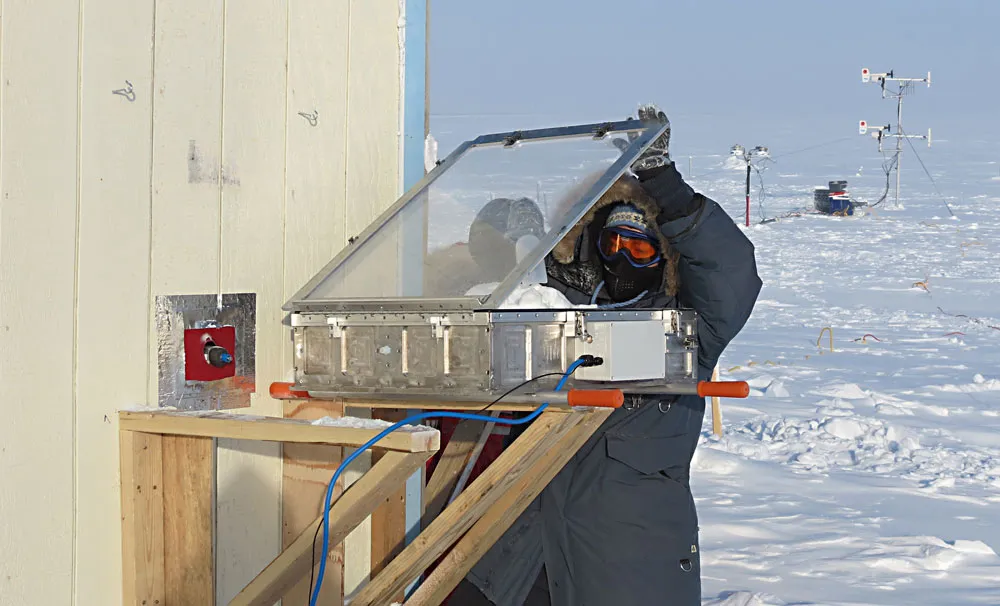
Over the past 30 years, the Arctic has warmed more than any other place on the planet, and that warming and the resulting melt of the region's sea ice presents a number of potential adverse effects, from impacts on weather systems to the decline in the habitats of native species.
Now, a team of scientists have found evidence that the Arctic warming and melting sea ice could be changing the chemistry of the Arctic atmosphere through reactions that happen on the snow that sits atop the sea ice and in the air above it. These reactions purge pollutants from the atmosphere and destroy toxic surface-level ozone (which differs from the protective ozone layer higher up in the atmosphere).
Air temperatures in the Arctic are 7 degrees Fahrenheit (4 degrees Celsius) higher now than they were in the period from 1986-1996, according to the National Snow & Ice Data Center, which keeps tabs on the seasonal fluctuations in sea ice. Satellite records have shown that the area of the Arctic Ocean covered by sea ice at the end of the summer melt season has declined by 30 percent over the past three decades, the NSIDC says. [10 Things You Need to Know About Arctic Sea Ice]
The Arctic is also subject to what is called a feedback loop of warming, because as ice melts that would otherwise reflect the sun's rays, it is replaced by open ocean, which absorbs those rays, causing further warming. Scientists have been trying to gain a more complete picture of just how this warming and melting is changing the Arctic ecosystem, including how the atmosphere above it might be altered.
"In the Arctic, climate change is happening at an accelerated pace," said Kerri Pratt, a postdoctoral researcher at Purdue University and part of the team studying how sea ice melt is affecting the atmosphere. "A big question is, 'what will happen to atmospheric composition in the Arctic as the temperatures rise and snow and ice decline even further?'"
Snow is the key
To help answer that question, Pratt and team leader Paul Shepson, also from Purdue, studied how sea ice plays a role in the reactions of gaseous bromine with atmospheric ozone. The team was looking for the source of this bromine, thought to be the sea ice itself, and conducted experiments on top of the snow-covered ice to observe the chemical reactions taking place under a range of conditions.
Get the world’s most fascinating discoveries delivered straight to your inbox.
They found that the bromine comes not from the sea ice, but from reactions in the snow pack on top of it.
"We had an 'of course!' moment when we realized it was the snow on top of the sea ice. The snow is what is in direct contact with the atmosphere," Pratt said in a news release on the research, which was funded in part by the National Science Foundation and detailed recently in the journal Nature Geoscience.
A form of bromine (derived from sea salt) and sunlight react on the frozen surface of the snow crystals. The bromine then diffuses out into the spaces between the grains of ice and reacts with ozone, producing even more bromine that gets swept up into the atmosphere to react with ozone once more, Pratt explained.
Changing chemistry
Airplane passes above areas of young ice with snow atop them also detected a product of the reactions between ozone and bromine. That product was not detected over areas of open ocean. The team couldn't look for the product over areas of older ice as they are increasingly hard to find and were too far from where the team was working, Pratt told OurAmazingPlanet.
While the snow is where the reactions that produce the bromine occur, "sea ice is critical to the process," Pratt said. "Without it, the snow would fall into the ocean, and this chemistry wouldn't take place. This is among the reasons why the loss of sea ice in the Arctic will directly impact atmospheric chemistry."
Exactly how this chemistry will change will require more study of the myriad variables that come into play, including precipitation, Pratt said.
"It will change with less sea ice, but we're still figuring out how it will change," she said.
Follow Andrea Thompson @AndreaTOAP, Pinterest and Google+. Follow OurAmazingPlanet @OAPlanet, Facebook and Google+.Original article at LiveScience's OurAmazingPlanet.

Andrea Thompson is an associate editor at Scientific American, where she covers sustainability, energy and the environment. Prior to that, she was a senior writer covering climate science at Climate Central and a reporter and editor at Live Science, where she primarily covered Earth science and the environment. She holds a graduate degree in science health and environmental reporting from New York University, as well as a bachelor of science and and masters of science in atmospheric chemistry from the Georgia Institute of Technology.