















Ancient Snail Shells Hint at Future Global Warming

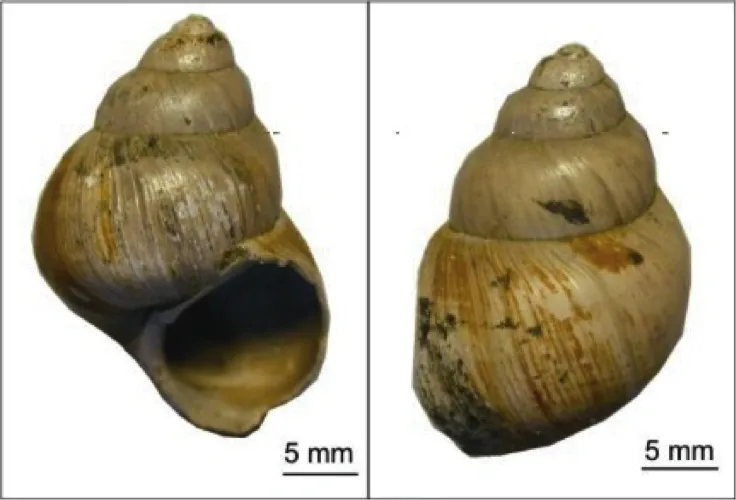
A major global cooling event 34 million years ago chilled land as well as sea, according to climate clues found in an unusual place: fossil snail shells.
The new research, published today (April 22) in the journal Proceedings of the National Academy of Sciences, reveals the historical links between carbon dioxide in the atmosphere and surface temperatures on Earth. Between about 333.5 million years ago and 34 million years ago, the climate transitioned from the balmy, carbon-dioxide-rich Eocene epoch climate to the cooler, low-carbon-dioxide Oligocene epoch. Scientists estimate that concentrations of carbon dioxide in the atmosphere dropped from 1,000 parts per million to about 600 to 700 parts per million in this time frame.
During this time, ice sheets emerged over Antarctica and the ocean cooled by some 9 degrees Fahrenheit (5 degrees Celsius). Researchers have been able to peg ocean temperatures accurately using cores of rock and mud drilled from the deep ocean. Figuring out what was happening on land has been more difficult, however.
So study researcher Michael Hren, a professor of chemistry and geosciences at the University of Connecticut, and his colleagues turned to snails. They tested fossils of a freshwater snail, Viviparus lentus, from the Isle of Wight in Great Britain, looking for variations in carbon and oxygen molecules called isotopes. [Gallery: Strange & Slimy Snails]
Most important, the researchers examined how the carbon and oxygen isotopes were bound together in the fossils. These bonds are temperature-dependent, so they told researchers how chilly or warm the water was when the snails lived. From that information, the scientists could calculate how hot the air must have been.
The shells revealed that freshwater temperatures cooled by 18 degrees F (10 degrees C) during the Eocene-Oligocene transition. The water-cooling translates to about a 7.2 degree to 11 degree F (4 to 6 degrees C) drop in air temperatures over northern Europe, the scientists reported.
These findings are important because human greenhouse gas emissions could drive atmospheric carbon dioxide up to near-Eocene levels. Ice cores put pre-industrial carbon dioxide levels at about 278 parts per million from A.D. 1000 to A.D. 1800. Today, atmospheric carbon dioxide levels are at about 397 parts per million and climbing. According to a 2011 study in the journal Science by researchers at the National Center for Atmospheric Research (NCAR), if carbon dioxide continues to rise as it is today, Earth's atmosphere could hit 900 to 1,000 parts per million of carbon dioxide by 2100.
Get the world’s most fascinating discoveries delivered straight to your inbox.
"We are on a path to fundamentally alter our global climate state," Hren said in a statement. "These data definitely give you pause."
Follow Stephanie Pappas on Twitter and Google+. Follow us @livescience, Facebook & Google+. Original article on LiveScience.com.

Stephanie Pappas is a contributing writer for Live Science, covering topics ranging from geoscience to archaeology to the human brain and behavior. She was previously a senior writer for Live Science but is now a freelancer based in Denver, Colorado, and regularly contributes to Scientific American and The Monitor, the monthly magazine of the American Psychological Association. Stephanie received a bachelor's degree in psychology from the University of South Carolina and a graduate certificate in science communication from the University of California, Santa Cruz.