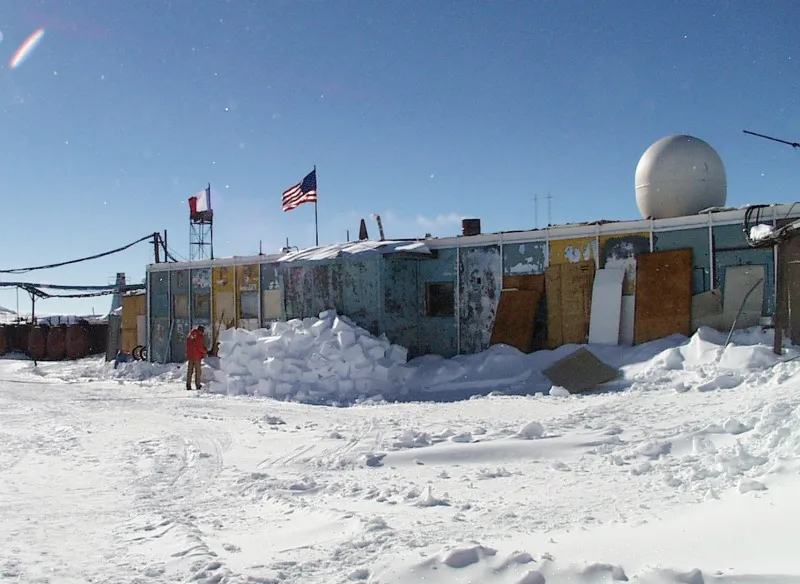
Russian scientists camped at the coldest place on Earth say they have recovered water samples from Lake Vostok, buried beneath more than 2 miles (3 kilometers) of Antarctic ice.
Cut off as it is from the surface, scientists think that the huge freshwater lake hasn't been touched for more than 14 million years. The chemistry of the isolated water could provide a glimpse into Earth's past and primitive forms of life on Earth. Expedition leaders hope the lake is home to cold-loving microbes adapted to life in the dark, icy depths, also cut off from the outside world for millennia.
The Russian team hit lake water ice on Jan. 10 at a depth of 11,174 feet (3,406 meters), according to a statement from Russia's Arctic and Antarctic Research Institute. The drill contained "white bubbly ice," different from the opaque, porous glacial ice capping the lake, the statement said.
The expedition also retrieved Lake Vostok water during their last drilling season, in February 2012, but did not find native life. An analysis of the microbes in the sample they took matched contaminants from the drilling oil and lubricant used to drill the borehole, the team reported in October. That sample was from a depth of 12,366 feet (3,769 m).
Three countries sent scientists to drill into one of Antarctica's buried lakes during the southern summer. Though temperatures are mild compared with winter (the Russian station at Vostok recorded the lowest temperature on Earth in the winter of 1983, at minus 128.6 degrees Fahrenheit, or minus 89.2 degrees Celsius), conditions remain challenging.
The cross-country trek to Lake Whillans.
(Image credit: WISSARD)
A British-led team called off their attempt to drill into buried Lake Ellsworth on Christmas Eve, when their hot-water drill hit a snag after boring almost 1,000 feet (300 m) through the ice.
On Sunday (Jan. 13), a U.S. team finished a brutal 628-mile (1,000 kilometers) trek from McMurdo Station on the coast to buried Lake Whillans, Nature News reported. The lake is more shallowly entombed than Vostok, with only 2,500 feet (762 m) of ice above its surface. Tractors pulled equipment, generators and 500,000 pounds of fuel to the drilling site, and the science team will fly in this week, according to the project's blog.
Sign up for the Live Science daily newsletter now
Get the world’s most fascinating discoveries delivered straight to your inbox.
Becky Oskin covers Earth science, climate change and space, as well as general science topics. Becky was a science reporter at Live Science and The Pasadena Star-News; she has freelanced for New Scientist and the American Institute of Physics. She earned a master's degree in geology from Caltech, a bachelor's degree from Washington State University, and a graduate certificate in science writing from the University of California, Santa Cruz.