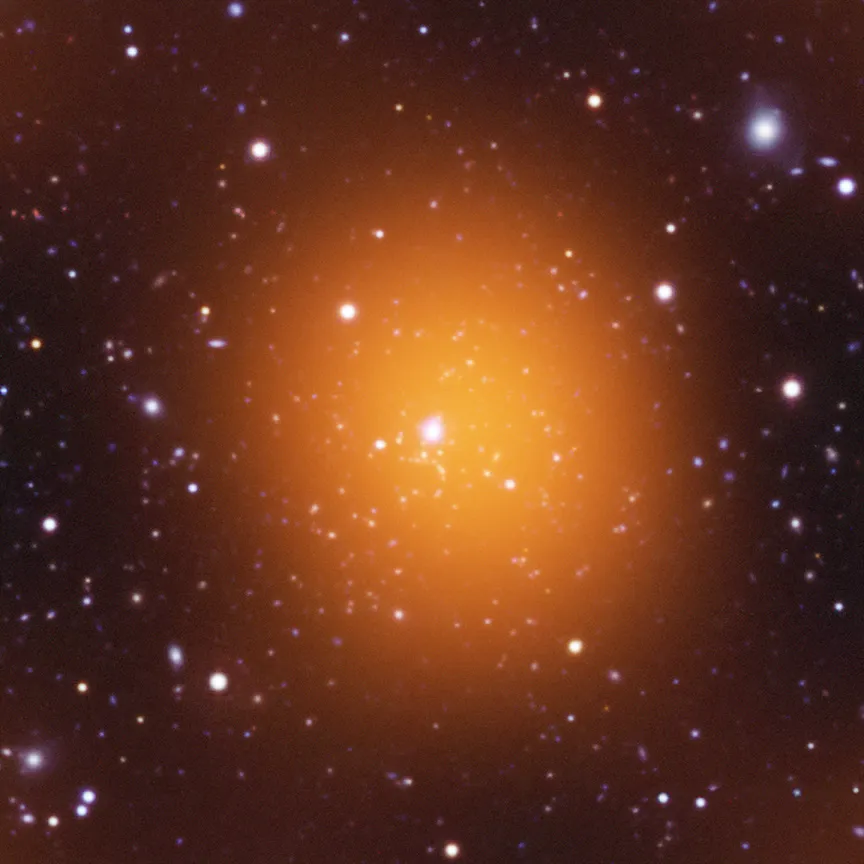
The faraway Phoenix galaxy cluster may be the biggest and brightest such structure ever discovered, and it's forming stars at an unprecedented rate, scientists announced today (Aug. 15).
Here's a by-the-numbers look at the Phoenix cluster — formally known as SPT-CLJ2344-4243 — which researchers say could yield key insights into how galaxies and colossal clusters evolve:
2.5 quadrillion: How many times more massive the Phoenix cluster is than our own sun. This may be an all-time record for galaxy clusters — the most massive structures in the universe, composed of hundreds or thousands of individual galaxies bound together by gravity — researchers said.
"I would say it's in a dead heat for the most massive galaxy cluster," Michael McDonald of MIT, lead author of the study describing Phoenix's remarkable properties, told SPACE.com contributor Charles Choi. "The record-holder, 'El Gordo,' is slightly more massive, but the uncertainty in this estimate is high — it could turn out that with more careful measurements, Phoenix is more massive."
10 billion: The low-end estimate of the mass of the huge black hole at the heart of Phoenix's central galaxy, in solar masses. That's about as massive as the biggest black hole ever discovered.
For comparison, the Milky Way's central black hole weighs in at about 4 million solar masses.
Sign up for the Live Science daily newsletter now
Get the world’s most fascinating discoveries delivered straight to your inbox.
Optical/UV/X-ray composite view of the Phoenix Cluster, with a pull-out from the central region to optical/UV image. Image released August 15, 2012.
5.7 billion: The approximate distance of Phoenix from Earth, in light-years. The cluster is found in the Phoenix constellation, partly explaining its informal name.
However, researchers also chose the moniker as a nod to the mythological bird that rises from its own ashes, since Phoenix's central galaxy has seemingly come back to life with a huge burst of star formation.
2010: The year in which astronomers discovered Phoenix, using the U.S. National Science Foundation-funded South Pole Telescope. But it took the team a little while to learn just what they had found.
"We really didn't realize how remarkable it was until late last year and early this year, when we got follow-up X-ray and optical and ultraviolet and infrared measurements that constrained the star-formation rate," McDonald told reporters today.
740: The approximate number of stars generated per year by the galaxy in Phoenix's center, a new high for the middle of a cluster.
"This extreme rate of star formation was really unexpected," McDonald said. "It's nearly five times higher than the next most star-forming central-cluster galaxy, in Abell 1835. So it's really crushing the record."
Our own Milky Way galaxy produces just one to two new stars every year on average, McDonald added.
This story was provided by SPACE.com, a sister site to LiveScience. Follow SPACE.com senior writer Mike Wall on Twitter @michaeldwall or SPACE.com @Spacedotcom. We're also on Facebook and Google+.
Michael was a science writer for the Idaho National Laboratory and has been an intern at Wired.com, The Salinas Californian newspaper, and the SLAC National Accelerator Laboratory. He has also worked as a herpetologist and wildlife biologist. He has a Ph.D. in evolutionary biology from the University of Sydney, Australia, a bachelor's degree from the University of Arizona, and a graduate certificate in science writing from the University of California, Santa Cruz.