













Ant Poison Paralyzes Prey From Afar

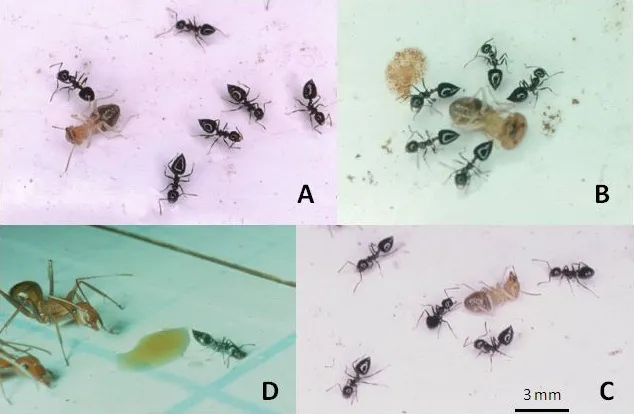
Ant-nest invaders beware: The African ant species Crematogaster striatula has venom so potent that termites don't even need to come in contact with it to feel its wrath. The chemical can kill at a distance as a group of ants approach the termite butt-first.
The poison is emitted by a gland called the Dufour gland, near the worker ants' stingers, and seems to have three functions. The chemicals emitted by the gland not only paralyze and kill termite prey, they also attract ant nestmates nearby to assist them. The ants invoke the chemicals the same way to repel alien ants.
Learning more about how insects defend their homes may also help us defend our homes against pesky invaders. The researchers, led by Angelique Vetillard of the University of Toulouse, in France, characterized the specific chemicals in the venom, providing initial clues about the source of the venom toxicity, which could help researchers produce natural insecticides.
This research provides "a basis from which further studies can be conducted in the search for natural insecticides, including new molecules effective against insects resistant to currently used insecticides," Vetillard said in a statement.
These African ants live among rotting branches on the ground in cocoa-tree plantations. They prey upon the termites, even though these termites have developed elaborate architectural, behavioral, morphological and chemical means to defend themselves.
To figure out how the ants' chemicals work, Vetillard and colleagues set up field experiments. They found that the chemical was more deadly to the termites than to other ants. Invader ants tend to back off and run when cornered, but the termites are more likely to stand their ground in the face of danger. When cornered, the ants were able to poison the termites from a distance of 0.2-to-0.4 inches (5-to-10 millimeters). The researchers suggest their thin skin may also make them more sensitive to the poison.
When an ant detected a termite, it approached with its abdominal tip (containing its chemical-laden stinger) pointed toward the prey. By raising its stinger the ants create tiny particles of the toxins, which fly through the air. The chemicals their stingers emit seemed to draw their nestmates to help them take down the termite invader. As expected, the termite boldly stood its ground; but after about 10 minutes it fell down and rolled onto its back, its legs batting the air, paralyzed.
Get the world’s most fascinating discoveries delivered straight to your inbox.
Next, one lone ant approached, watching for the leg movements to subside. When there were fewer movements of its legs, all of the ants approached the termite and prepared to seize it by an appendage and bring it back to their nest.
When the ant workers discovered several Camponotus brutus, an alien ant species, imbibing honey on their territory, they defended their turf by again very slowly approaching butt first, stinger tip pointed toward the aliens, causing them to retreat. Without there being contact between the antagonists, the intruding ants slowly backed away from the smell of the chemical, though they seemed unhurt.
The study was published today (Dec. 14) in the journal PLoS ONE.
You can follow LiveScience staff writer Jennifer Welsh on Twitter @microbelover. Follow LiveScience for the latest in science news and discoveries on Twitter @livescience and on Facebook.

Jennifer Welsh is a Connecticut-based science writer and editor and a regular contributor to Live Science. She also has several years of bench work in cancer research and anti-viral drug discovery under her belt. She has previously written for Science News, VerywellHealth, The Scientist, Discover Magazine, WIRED Science, and Business Insider.