













Hint of Higgs Boson? 'God Particle' Buzz Rises

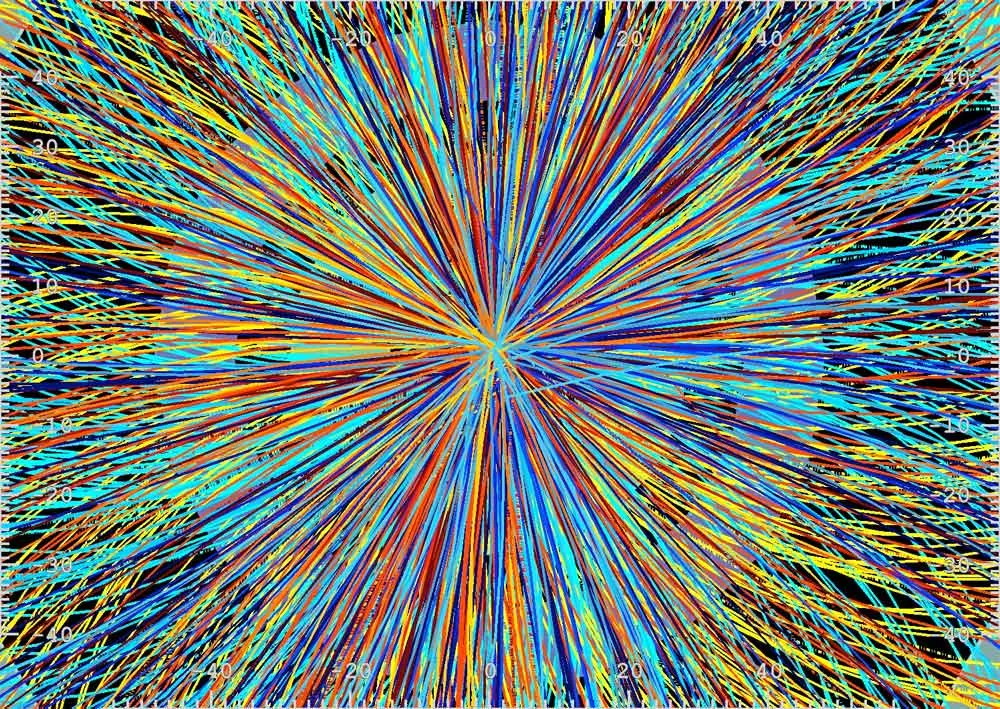
A few anomalous blips of data are giving scientists hope that the elusive Higgs boson, or "God" particle, might soon be found, though it's too early to say whether a discovery is imminent.
Researchers presented their findings at the International Europhysics Conference on High-Energy Physics in Grenoble, France. According to The Guardian newspaper, two independent teams at the European Organization for Nuclear Research's (CERN) Large Hadron Collider (LHC) reported strange data spikes that could hint at the existence of the Higgs boson particle.
In April, a leaked note from one of the teams suggested that a Higgs boson announcement might be forthcoming.
The LHC, a 17-mile (27-kilometer) long underground circular tunnel near Geneva, was built in large part to hunt out the Higgs boson particle. According to the Standard Model, the theory of physics that explains the dynamics of subatomic particles, the Higgs boson is the particle thought to give mass to all particles. By smashing particles into each other at close to the speed of light in the LHC, scientists can break those particles down into more mysterious particles that are impossible to observe any other way.
One of these particles, the Higgs boson, would be a big "get" for physics, because particles with mass are an integral component of the physical world. The particle's ability to explain so much about the universe earned it the moniker the "God particle." [Twisted Physics: 7 Mind-Blowing Findings]
Now, two separate LHC teams report that they've seen spikes in their data consistent with the Higgs boson. The particle is thought to have a mass between 114 and 185 gigaelectronvolts, or GeVs. (One GeV is equivalent to the mass of a proton, the positively charged particle in the nucleus of an atom.)
The unexplained data spikes occur between 120 and 140 GeV, the LHC teams reported. These bumps could be the first observable hint of the Higgs boson, but they could also be statistical glitches or computer model flaws.
Get the world’s most fascinating discoveries delivered straight to your inbox.
"We cannot say anything today, but clearly it's intriguing," LHC physicist Fabiola Gianotti told The Guardian.
Nonetheless, the new data spurred excitement at CERN.
"Discovery or exclusion of the Higgs particle, as predicted by the Standard Model, is getting ever closer," CERN's Director for Research and Scientific Computing, Sergio Bertolucci, said in a statement. “Both occurrences will be great news for physics, the former allowing us to start the detailed study of the Higgs particle, the latter being the first proof of the incompleteness of the Standard Model, requiring new phenomena to be happening within the reach of the LHC.”
You can follow LiveScience senior writer Stephanie Pappas on Twitter @sipappas. Follow LiveScience for the latest in science news and discoveries on Twitter @livescience and on Facebook.

Stephanie Pappas is a contributing writer for Live Science, covering topics ranging from geoscience to archaeology to the human brain and behavior. She was previously a senior writer for Live Science but is now a freelancer based in Denver, Colorado, and regularly contributes to Scientific American and The Monitor, the monthly magazine of the American Psychological Association. Stephanie received a bachelor's degree in psychology from the University of South Carolina and a graduate certificate in science communication from the University of California, Santa Cruz.