













Tiny Clay Head May Have Been Used As Ancient Effigy

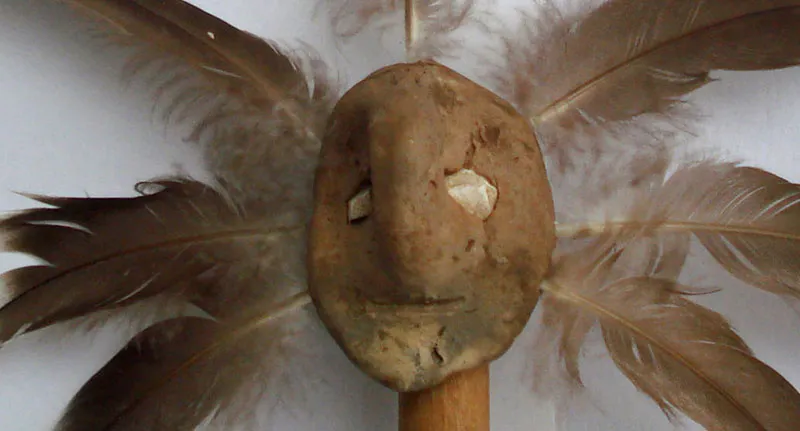
A recently discovered miniature clay head with eerie eyes may have been an effigy used by a shaman more than 1,000 years ago, researchers say.
The head, which was discovered near Ebbert Spring in Franklin Country, Penn., has shells for eyes and tiny holes across its top and sides that may have been used for feathers or hair. A cavity at the base of the neck indicates that it was likely mounted on a stick or wand.
"It might have been used in a ceremony by a shaman of some sort," said lead archaeologist Ronald Powell, of the Society for Pennsylvania Archaeology. Shell is a symbolically important object among Native American cultures and Powell believes that the use of it for eyes, combined with feathers, add weight to the idea that the artifact had a shamanistic use .
He pointed out that viewing the eyes in the outdoor light leaves quite an impression.
"It does give kind of an eerie glow from the incised shell eyes — you have sort of a dusty evening light," Powell told LiveScience. "It would be kind of awestruck for whoever was being subjected to it."
Finding a precise date for the head is difficult, but based on pottery found nearby, Powell estimates it was created around A.D. 900.
Ebbert Spring has been occupied by humans for about 11,000 years, Powell said. The availability of water at the site attracted deer and they, in turn, attracted human hunters, suggesting the site was used during winter.
Get the world’s most fascinating discoveries delivered straight to your inbox.
"It would be sort of a wintering type campsite, at least through the months of August and March probably," said Powell, who detailed his finding in the latest issue of the journal Pennsylvanian Archaeologist.
Enigmatic effigy?
Two researchers not affiliated with the dig told Live Science that it is an interesting artifact but one that is difficult to interpret. [See a photo of the effigy ]
"It's a significant object , but it's a very rare object," said Kurt Carr, senior curator of archaeology at the State Museum of Pennsylvania, who pointed out that the iconography is similar to that used by Iroquois people who settled in northeast North America.
"Heads and faces are a characteristic of Iroquoian peoples — it seems to be part of their art motif if you will," he said. However "this doesn't seem to be Iroquoian; it's awfully far south."
Michael Stewart, an anthropology professor at Temple University in Philadelphia, said that the head may date to more recent times.
Across the Northeast, "you tend to see them [effigy heads] most frequently after A.D. 1300 and much more as you get into late prehistoric times and when European colonists are encountering Native peoples."
Stewart cautions that more peer-reviewed information about the soil and artifacts at Ebbert Spring are needed before any conclusions can be made about the date and purpose of the head.
"Whether it was the personal property of a religious specialist like a shaman or whether it was the ornament or an object used by an individual within that community is something that (based on the evidence so far) I don't think we can say," Stewart noted.
Shell eyes
The key to answering questions about the head may be in the white shell eyes.
"If you look at what is being recorded historically amongst living native people during early historic times, shell plays a very special symbolic role," Stewart said. "You have shell beads being made by different peoples. You have an acknowledgment that the color white is symbolically important — it's the color of life ."
He said that it is interesting that whoever made the eyes used shell.
"It certainly drives home the point that whoever made or used this face, that it meant something very special, that it was symbolically loaded, that had meaning."
Follow LiveScience for the latest in science news and discoveries on Twitter @livescience and on Facebook.

Owen Jarus is a regular contributor to Live Science who writes about archaeology and humans' past. He has also written for The Independent (UK), The Canadian Press (CP) and The Associated Press (AP), among others. Owen has a bachelor of arts degree from the University of Toronto and a journalism degree from Ryerson University.