-
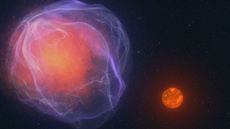 Something 'kicked' this hypervelocity star racing through the Milky Way at 1.3 million miles per hour
A low-mass star has been discovered racing through the Milky Way at over a million miles per hour, a journey that began with either the supernova explosion of a vampire star or an encounter with black holes.
astronomy -
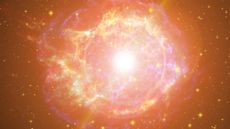 James Webb telescope discovers most distant supernova ever seen
The James Webb Space Telescope has spotted a supernova dating to just 1.8 billion years after the Big Bang, as well as 80 others in the early universe. The ancient explosions could help scientists figure out the mysteries of how the cosmos evolved.
astronomy -
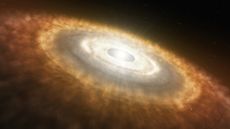 James Webb telescope reveals 'cataclysmic' asteroid collision in nearby star system
The James Webb Space Telescope has caught a snapshot of two massive asteroids colliding in a nearby star system — and it could teach us about how common solar systems like our own are.
cosmology -
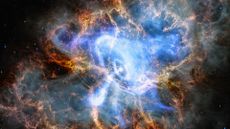 Space photo of the week: James Webb and Chandra telescopes spot a 'lighthouse' pointed at Earth
Images from the James Webb Space Telescope and the Chandra X-ray Observatory have been combined to reveal how the Crab Nebula's neutron star is changing.
astronomy -
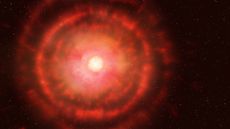 How many stars in the Milky Way die each year?
Stars die at different rates depending on how they kick the bucket.
astronomy -
 'Vanishing' stars may be turning into black holes without going supernova, new study hints
Stars that vanish from the sky may be collapsing directly into black holes without going supernova first, a new study of a bizarre binary star system suggests.
black-holes -
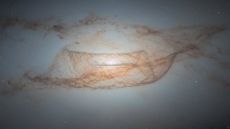 Space photo of the week: Hubble spots a twisted 'train-wreck' galaxy that may hide a cosmic illusion
The Hubble Space Telescope's stunning image of the dusty 'train-wreck' galaxy NGC 4753 reveals what may be one of the greatest optical illusions in the nearby universe.
astronomy -
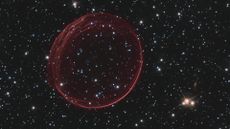 The universe may be dominated by particles that break causality and move faster than light, new paper suggests
With the nature of the universe's two most elusive components up for debate, physicists have proposed a radical idea: Invisible particles called tachyons, which break causality and move faster than light, may dominate the cosmos.
cosmology -
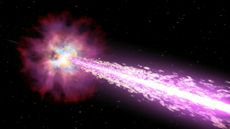 James Webb telescope finds origins of the biggest explosion since the Big Bang — revealing a new cosmological mystery
Seen in 2022, a gamma-ray burst nicknamed the BOAT is believed to be the brightest explosion ever witnessed by humanity. But the James Webb Telescope's search for its origins has only thrown up more questions.
space


