-
 Can super-rotating oceans cool off extreme exoplanets?
New research suggests a way to move heat around "tidally locked" alien planets: ocean currents whipping around the worlds faster than they rotate.
exoplanets -
 Superpowerful 'oscillon' particles could have dominated the infant universe, then vanished
A weird, super-powerful particle that's not truly a particle could have dominated the universe when it was just a second old, releasing a flood of ripples that permeated all of space-time.
particle-physics -
 Mysterious 'kick' just after the Big Bang may have created dark matter
A mysterious "kick" in the early universe may have produced more matter than antimatter. And that imbalance may have also led to the creation of dark matter, researchers now say.
cosmology -
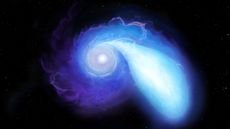 Neutrons' 'evil twins' may be crushing stars into black holes
The universe may be filled with "mirror" particles — and these otherwise-undetectable particles could be shrinking the densest stars in the universe, turning them into black holes.
black-holes -
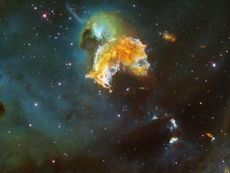 How do stars die?
Surprisingly, the fate of a star is easy to predict. All you need to know is how big it is.
astronomy -
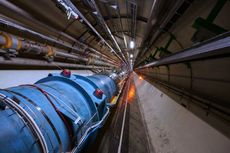 Where are all the squarks and gluinos?
There have been no signs of supersymmetry, and the theory is looking a little shaky, researchers say.
physics-mathematics -
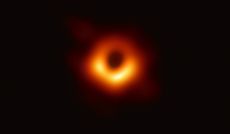 Are primordial black holes really giant gravitinos?
New research proposes that the first black holes came from clumps of gravitinos, exotic, hypothetical particles that managed to survive the first chaotic years of the Big Bang.
black-holes -
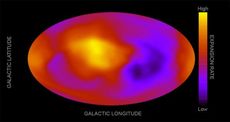 Is there more than one dark energy?
What if there is more than one cosmological agent for dark energy? This mixture would have strange effects in our universe, making it potentially detectable with upcoming surveys.
cosmology -
 Physicists attempt to unify all forces of nature and rectify Einstein's biggest failure
Einstein's failed dream could ultimately become his ultimate triumph, as a small group of theoretical physicists rework his old ideas to explain the most pressing issues of modern science.
physics-mathematics