














Can super-rotating oceans cool off extreme exoplanets?
Super-rotation could help make tidally locked worlds habitable.

Paul M. Sutter is an astrophysicist at SUNY Stony Brook and the Flatiron Institute, host of Ask a Spaceman and Space Radio, and author of How to Die in Space. He contributed this article to Space.com's Expert Voices: Opinions and Insights.
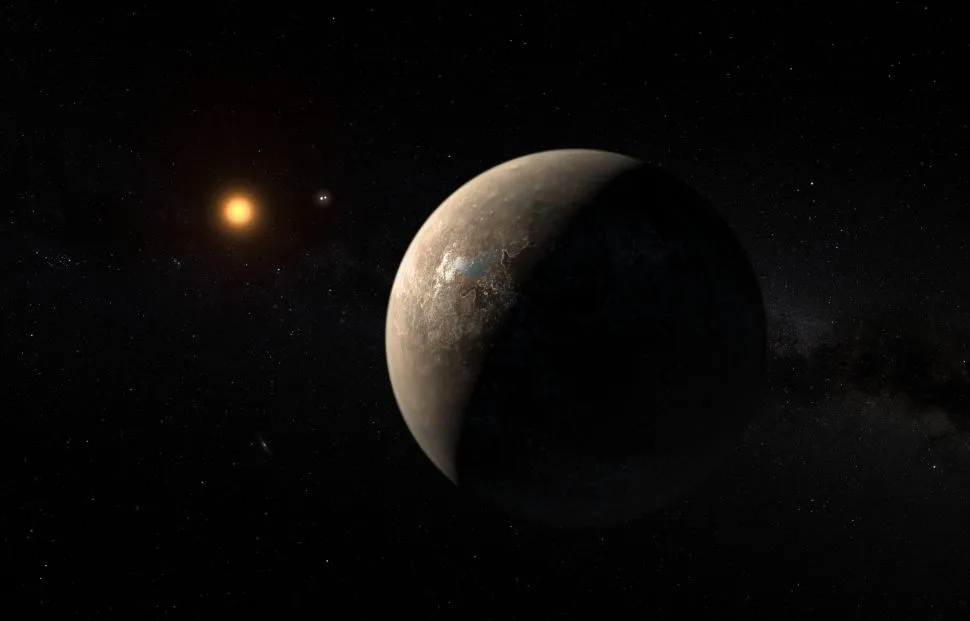
Astronomers continue to find potentially habitable worlds around small, red stars. But those worlds are almost certainly tidally locked, with one side of the planet constantly facing its star.
This poses a severe challenge to the possibility of life on these alien planets, but new research suggests a way to more evenly cool those planets: ocean currents whipping around the worlds faster than they rotate.
Related: 10 exoplanets that could host alien life
Locking it in
We're finding tons of exoplanets out there. With NASA's Kepler mission (whose databases are still fruitful after the space telescope's death), the agency's Transiting Exoplanet Survey Satellite and scores of ground-based missions, astronomers are discovering world after world orbiting distant stars. The ultimate goal: find an Earth-like planet orbiting a sun-like star at just the right distance so that the heat the planet receives from its star is just enough to melt ice, but not too hot to boil it away.
This is the "habitable zone," the region around every star where liquid water can stay nice and liquid. And while we haven't yet found an exact copy of Earth, we have come close: planets roughly the size of our own, orbiting within the habitable zone, but around small, red dwarf stars.
On one hand, this is amazing, because red dwarfs are by far the most common kind of star in the galaxy, and so there must be scores of planets in a multitude of habitable zones. But on the other hand, it's kind of frustrating, because of something known as tidal locking.
Get the world’s most fascinating discoveries delivered straight to your inbox.
When a small object orbits close to a large object (like, say, the moon around Earth or a planet around a star), the bigger object will raise tides on the smaller one. (Technically, the smaller object also raises tides on the bigger object, but they're not nearly as major and we don't need to worry about that now.) With those extra tidal lumps, the smaller object will slowly develop a lopsided preference: instead of getting any old rotation it wants, it will end up "locking."
This locking forces the rotation of the small object to match its orbit around the larger one. You can see the results of this just by looking at the full moon: since the moon is tidally locked to Earth, it always presents the same face to us, and it wasn't until the space age that we were able to get a glimpse of its backside.
Related: How exoplanet habitable zones work
The best rotation
Tidal locking is bad news for life. If you're on a planet orbiting a red dwarf star, its light is so weak that you need to be smashed right up against that star to get in its habitable zone. Close enough that you'll get tidally locked. That means one side of the planet will constantly face the sun, while the other will be locked in permanent midnight.
So, even though on average the temperatures of the planet may be peachy-keen, one side will be too hot and the other too cold.
Unless there's a way to transport heat from the hot side to the cool side.
Because of Earth's tilt, our planet is unevenly heated by the sun, and in response it tries to balance everything out through wind and ocean currents, which constantly carry heat from one place to another.
But in order to efficiently transport heat on a tidally locked planet, those currents have to super-rotate — they have to move faster than the rotation of the planet itself, if they have any chance of warming up the night side and cooling off the day side.
Super-rotation is already well known in planetary atmospheres. The atmosphere of Venus, for example, whips around the surface every four Earth days, while the surface itself takes a lazy 243 Earth days to complete a single rotation. Titan, the largest moon of Saturn, probably has a super-rotating atmosphere. It even happens on Earth: high-altitude winds above the equator are occasionally capable of super-rotation.
Super-rotating atmospheres are great and all, but the real deal when it comes to heat transport isn't air but water. If a tidally locked exoplanet truly wants to stay mild, its ocean currents better move fast.
Physics on an exotic world
That's exactly what a new study, recently appearing on the preprint journal arXiv, set out to examine. And that study has some good news to report: depending on the conditions, tidally locked exoplanets are capable of oceanic super-rotation.
According to the study, the super-rotation in the alien oceans is initially driven by strong winds, then amplified by deep-water waves in the oceans. Those waves, known as Kelvin and Rossby waves, are common to any ocean on a rotating planet, including Earth, where they are responsible for the formation of giant pressure systems and jet streams.
On a tidally locked planet, the same physics apply, and these waves amplify each other to drive massive currents of water, faster than the planet itself rotates.
The researchers found that these super-rotating currents are only possible at the equator, and naturally this can be messed up by a variety of unknown factors. If there's a big enough continent in the way, for example, it can stop the current dead in the tracks. If the planet is tilted or has too shallow of an ocean, that can also prevent the super-rotation from occurring.
But still, super-rotation of ocean currents on tidally locked exoplanets is certainly possible, which is a relief for any hopes and dreams of alien life on those exoplanets. The more their atmospheres and oceans can transport heat around those worlds, the better chance life has for thriving.
Learn more: "Oceanic Superrotation on Tidally Locked Planets"
Follow us on Twitter @Spacedotcom or Facebook.

Paul M. Sutter is a research professor in astrophysics at SUNY Stony Brook University and the Flatiron Institute in New York City. He regularly appears on TV and podcasts, including "Ask a Spaceman." He is the author of two books, "Your Place in the Universe" and "How to Die in Space," and is a regular contributor to Space.com, Live Science, and more. Paul received his PhD in Physics from the University of Illinois at Urbana-Champaign in 2011, and spent three years at the Paris Institute of Astrophysics, followed by a research fellowship in Trieste, Italy.