
-
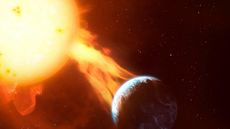 'Cannibal' CME from rare 'anti-Hale' sunspot will slam into Earth today, bringing auroras to 23 US states
Northern lights are projected across the Northern U.S. and Europe tonight as Earth gets hit by a strong solar eruption.
the-sun -
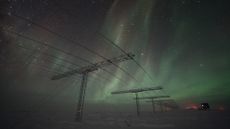 Earth's magnetic field has a weak spot — and it's getting bigger, putting astronauts and satellites at risk
This could be bad news for satellites and spacefarers.
planet-earth -
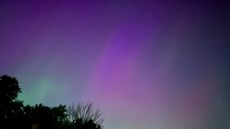 Powerful Mother's Day geomagnetic storm created radio-disrupting bubbles in Earth's upper atmosphere
Researchers have provided some new insights about the powerful geomagnetic storm that flared up last Mother's Day, after a big solar storm hit Earth.
-
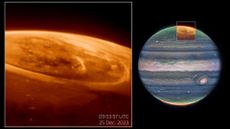 James Webb telescope reveals 'impossible' auroras on Jupiter
Scientists looked at Jupiter's massive auroras using the James Webb and Hubble Space Telescopes — and found a mystery they can't fully explain.
jupiter -
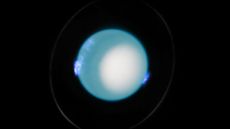 Scientists finally know how long a day on Uranus is
An 11-year Hubble study has finally revealed how long a day lasts on Uranus.
uranus -
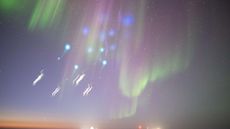 NASA launches rockets into auroras, creating breathtaking lights in Alaskan skies (photos)
The sounding rockets released vapor tracers and pressure sensors at different altitudes across central and northern Alaska during a sudden auroral substorm.
astronomy -
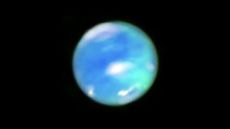 James Webb telescope captures auroras on Neptune for first time ever
The James Webb Space Telescope has successfully detected auroras on Neptune for the first time ever, finishing a job that NASA's Voyager 2 probe began decades ago.
neptune -
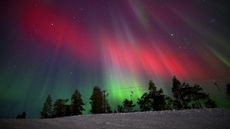 Auroras possible in a dozen US states tonight as 'coronal hole' unleashes particle storm on Earth
Auroras are possible over the U.S. tonight (March 25) as a "moderate" geomagnetic storm hits Earth.
the-sun -
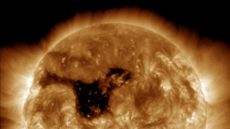 Gigantic 500,000-mile 'hole' in the sun's atmosphere aims aurora-sparking solar wind at Earth (photo)
The gigantic coronal hole is blasting high-speed solar wind toward Earth, potentially igniting vibrant auroras and minor geomagnetic activity on Jan. 31.
the-sun


