














Scientists may finally be close to explaining strange radio signals from beyond the Milky Way
Fast radio bursts erupt in the sky around 10,000 times a day, but scientists still struggle to explain them. New research could put astronomers one step closer to a solution.

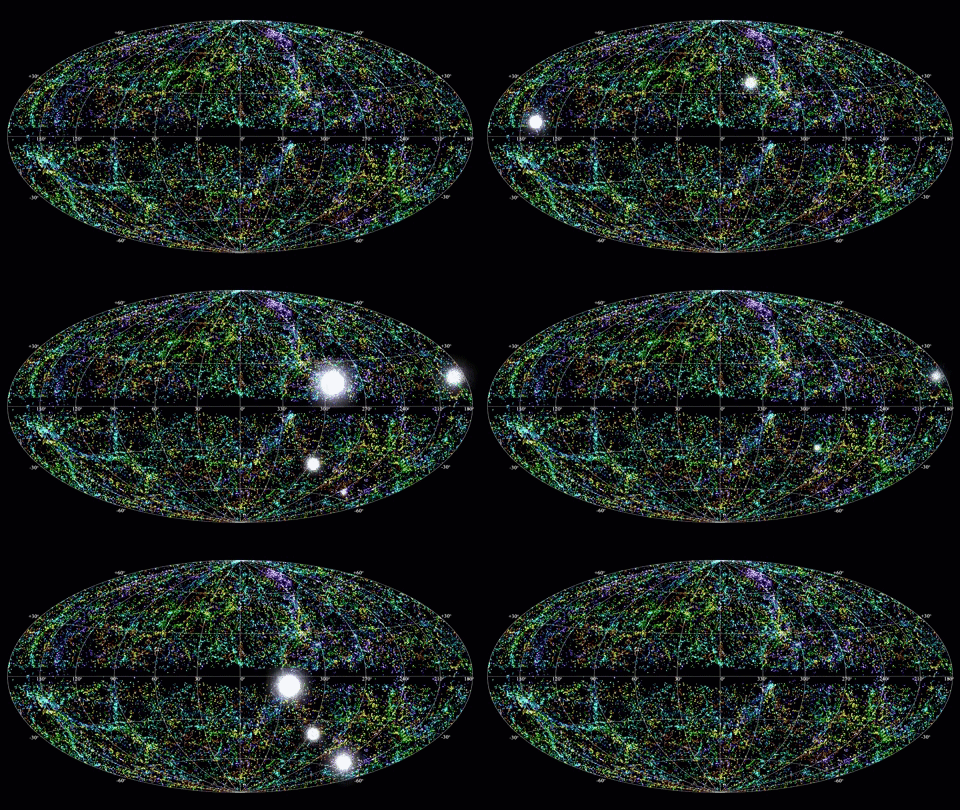
Fast radio bursts (FRBs) are intense, short-lived blasts of radio waves hailing from beyond the Milky Way that can emit the same amount of energy in just thousandths of a second that the sun takes three days to emit.
However, despite their power and the fact that around 10,000 FRBs could erupt in the sky over Earth every day, these blasts of radiowaves remain mysterious. One of the biggest puzzles surrounding FRBs is why most flash once and then disappear while a tiny minority (less than 3 percent) repeat the flash. This has led scientists on a quest to discover the mechanisms that launch FRBs. Some even believe different celestial objects can produce both repeating and non-repeating FRBs.
Scientists from the University of Toronto used the Canadian Hydrogen Intensity Mapping Experiment (CHIME) to focus on properties of polarized light associated with 128 non-repeating FRBs. This revealed the one-off FRBs seem to originate in faraway galaxies that are much like our own Milky Way, as opposed to the extreme environments that launch their repeating cousins. The results could bring scientists closer to cracking the lingering celestial puzzle of FRBs at last.
Related: Hubble tracks farthest and most powerful fast radio burst back to 'blob' of 7 galaxies
"So far, when we've thought about FRBs, we've only looked at them in the same way that we would look at a star in the sky, thinking about how bright it is, maybe figuring out how away far it is, things like that," research lead author Ayush Pandhi, a Ph.D. student at the Dunlap Institute for Astronomy & Astrophysics and the David A. Dunlap Department of Astronomy & Astrophysics at the University of Toronto, told Space.com. "However, FRBs are special because they also emit polarized light, meaning the light coming from these sources is all oriented in one direction."
The key difference about this research is it really drilled down on the investigation of polarized light.
Polarized light is made up of waves that are orientated in the same way — vertically, horizontally, or at an angle between those two directions. Changes in polarization could explain the mechanism that launched the FRB and thus reveal what its source was. Polarization can also reveal details about what environments the FRB needed to traverse before reaching our detectors on Earth. This study represented the first large-scale look at the non-repeating 97% of FRBs in polarized light.
Get the world’s most fascinating discoveries delivered straight to your inbox.
There has been a gap in non-repeating FRB research because it is much easier to observe repeating FRBs as astronomers already know where they are going to occur, meaning it is possible to point any radio telescope at that patch of sky and wait. With non-repeating FRBs, astronomers must have a telescope that can look at a large area of the sky all at once because they don't really know where the signal will come from.
"They could pop up anywhere in the sky. CHIME is unique in that sense because it looks at such a large patch of the sky all at once," Pandhi said. "Also, people have not really looked at that polarization yet because it's much harder to detect just on a technical level.
"Other studies have looked at the polarization of maybe 10 non-repeating FRBs, but this is the first time where we've looked at more than 100. It allows us to reconsider what we think FRBs are and see how repeating and non-repeating FRBs may be different."
To repeat or not to repeat?
In 2007, astronomers Duncan Lorimer and David Narkevic, who was Lorimer's student at the time, discovered the first FRB. It was a non-repeating burst of energy that's now commonly referred to as the "Lorimer Burst." Five years after this, in 2012, astronomers discovered the first repeating FRB: FRB 121102. Then, more repeating bursts gradually revealed themselves.
Astronomers naturally wonder whether there is a different phenomenon behind these two types of FRBs. And Pandhi 's team indeed found that non-repeating FRBs seem to be a little different from repeating FRBs, as most of the former seem to come from galaxies like our own Milky Way.

An illustration of the CHIME observatory.
While the origins of FRBs are shrouded in mystery, these bursts of radiowaves can act as messengers of the environments they pass through while racing to Earth. That information is encoded in their polarization.
"If the polarized light passes through electrons and magnetic fields, the angle at which it's polarized rotates, and we can measure that rotation," Pandhi said "So if an FRB passes through more material, it'll rotate more. If it passes through less, it'll rotate less."
The fact that the polarization of non-repeating FRBs is less than that of repeating FRBs indicates the former seems to pass through less material or weaker magnetic fields than the latter. Pandhi added that, while repeating blasts of radiation seem to be coming from more extreme environments (like the remains of stars that have died in supernova explosions) their non-repeating brethren seem to emerge in slightly less violent environments.
"Non-repeating FRBs tend to come from environments that have either weaker magnetic fields or less stuff around them than repeating FRBs," Pandhi continued. "So repeating FRBs seem to be a little bit more extreme in that sense."

An artist's impression of a fast radio burst (FRB) reaching Earth, with colors signifying different wavelengths.
Are neutron stars off the hook?
One of the big surprises this research delivered for Pandhi was that the polarization of non-repeating FRBs seems to clear one of the major suspects behind their launch: highly magnetized, rapidly spinning neutron stars, or "pulsars."
"We know how pulsars work and we know the types of polarized light we expect to see from a pulsar system. Surprisingly, we don't see that much similarity between FRBs and pulsar light," Pandhi said."If these things are coming from the same type of object, you might expect that they have some similarities, but it seems that they're actually pretty different."
In terms of figuring out what objects launch FRBs, Pandhi thinks expanding our understanding of the polarization of these bursts of radiowaves could help narrow down theoretical predictions.
"If we're confused between multiple different theories, we can now look at the polarized light and say, 'Okay, well, does this rule out any theories that we haven't already ruled out?'" he said. "It provides another parameter, or even a few extra parameters, to help us rule out theories about what they could be until we have one that sticks."
RELATED STORIES
Pandhi continued by explaining that this study has laid the groundwork for future FRB investigations; he, himself, is working on a way to disentangle polarization of FRBs that occurred in the Milky Way from those that occurred in their other galaxies and closer to the source of their emission.
This should help us better understand the mechanisms behind the launch of FRBs, but for Pandhi, it is the mysterious nature of these cosmic blasts of energy that ensures he will be investigating them for some time to come.
"I mean, what's more mysterious than explosions happening thousands of times per day all over the sky, and you have no idea what's causing them?" Pandhi said. "If you're a little bit of a detective who likes to solve mysteries, FRBs are just a mystery that is just begging to be solved."
The team's research was published on Tuesday (June 11) in the Astrophysical Journal.
Originally posted on Space.com.

Robert Lea is a science journalist in the U.K. who specializes in science, space, physics, astronomy, astrophysics, cosmology, quantum mechanics and technology. Rob's articles have been published in Physics World, New Scientist, Astronomy Magazine, All About Space and ZME Science. He also writes about science communication for Elsevier and the European Journal of Physics. Rob holds a bachelor of science degree in physics and astronomy from the U.K.’s Open University