


-
 'The Martian' predicts human colonies on Mars by 2035. How close are we?
Opinion NASA hasn't landed humans on Mars yet. But thanks to robotic missions, scientists now know more about the planet's surface than they did when the movie was released.
6 CommentsOpinion -
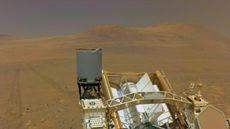 Perseverance rover rolls onto 'Crocodile' plateau on Mars to hunt for super-old rocks
NASA's Perseverance rover is exploring a new Mars region called Krokodillen, which is thought to harbor some of the oldest and most intriguing rocks on the Red Planet.
-
 Lights on Mars! NASA rover photographs visible auroras on Red Planet for the first time
NASA's Perseverance rover recently captured a photo of green auroras shining in the Martian sky for the first time. The alien light show, previously assumed to be impossible, could be visible to future astronauts.
mars -
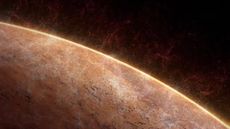 Scientists find hint of hidden liquid water ocean deep below Mars' surface
By studying seismic waves, researchers have found a layer deep beneath the surface of Mars that could contain enough liquid water to flood the planet with an ocean thousands of feet deep.
13 Commentsmars -
 NASA Mars satellite uncovers markings 'like paint dripping down a wall' on Martian surface
Wave-like soil patterns on the Martian surface match those found in Earth's cold, mountain regions, which could help scientists better understand the Red Planet's climate history and search for signs of life.
2 Commentsmars -
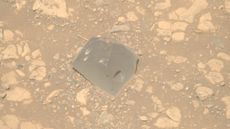 Mysterious, out-of-place 'Skull' rock on Mars leaves scientists baffled
NASA's Perseverance rover on Mars has discovered unusual "float" rocks on the rim of Jezero Crater while searching for signs of ancient microbial life. Scientists are investigating their origin.
8 Commentsmars -
 Life on Mars could survive — so long as you're one of these strange, hybrid lifeforms
Researchers bombarded lichens with a year's worth of Martian radiation in just 5 hours — and they survived, hinting that the extremophiles could potentially live on the Red Planet.
3 Commentsmars -
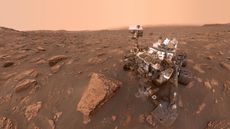 Curiosity rover finds largest carbon chains on Mars from 3.7 billion-year-old rock
NASA's Curiosity Rover has discovered long carbon chains on Mars. On Earth, molecules like these are overwhelmingly produced by biological processes.
mars -
 NASA rover reveals signs of crucial life-sustaining process on Mars
Samples drilled by the Curiosity rover on Mars have revealed abundant signs of a carbon cycle that remained hidden from orbital scans, alongside clues of how life may have been wiped out on the planet.
3 Commentsmars


