

-
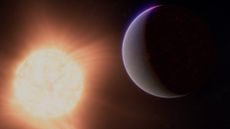 James Webb telescope detects 1-of-a-kind atmosphere around 'Hell Planet' in distant star system
Using the James Webb Space Telescope, scientists have discovered evidence of a carbon-rich atmosphere around the hellish world 55 Cancri e. This marks the best evidence yet of an atmosphere around a rocky exoplanet.
exoplanets -
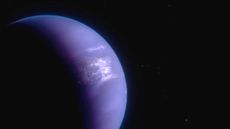 James Webb telescope spots wind blowing faster than a bullet on '2-faced planet' with eternal night
New James Webb Space Telescope observations of the exoplanet WASP-43b reveal that the hot gas giant is tidally locked, meaning one side permanently faces its sun while the other always stares out into space.
exoplanets -
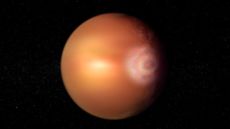 Strange light spotted over distant 'hell planet' may be 1st rainbow 'glory' found beyond our solar system
New data suggest that exoplanet WASP-76 b could harbor a massive, rainbow-colored light show known as a "glory." Until now, this phenomenon has been seen only within our solar system.
exoplanets -
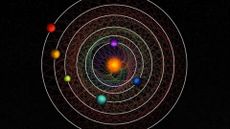 'Mathematically perfect' star system being investigated for potential alien technology
A distant star system housing 6 planets that move in 'mathematically perfect' orbits has ignited a search for possible alien technosignatures.
exoplanets -
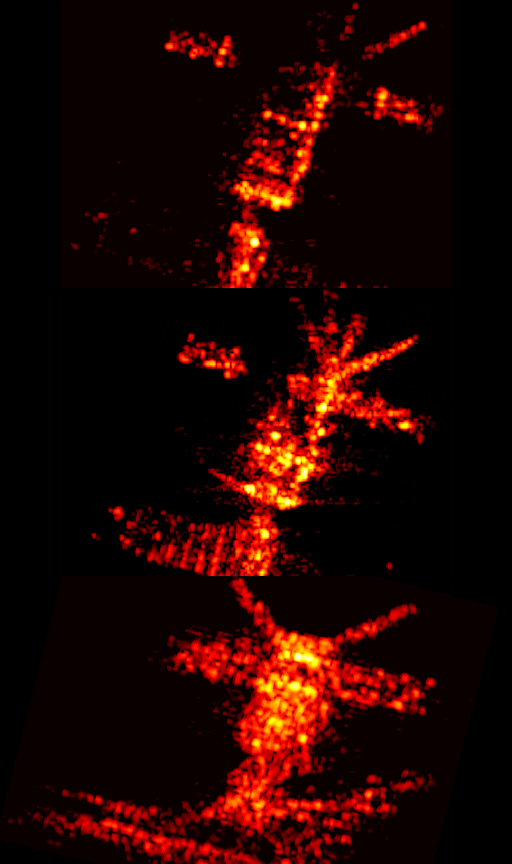 Radar images show Europe's doomed ERS-2 satellite buckle and burn during final orbits of Earth
New radar images show surprise changes to the doomed ERS-2 spacecraft as it tumbled through Earth's atmosphere on Feb. 21.
exoplanets -
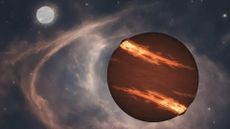 James Webb telescope makes ultra-rare detection of 2 planets orbiting dead stars
The James Webb Space Telescope has detected two alien planets orbiting white dwarfs, the collapsed husks of once-mighty stars. The discovery offers a hint of what our solar system will look like after the sun's eventual demise.
exoplanets -
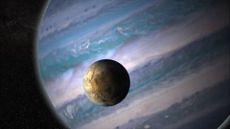 Are they exomoons or not? Scientists debate existence of 1st moons seen beyond our solar system
Team "pro-exomoon" is back to defend the discovery of the first and only exomoons potentially seen by humanity.
exoplanets -
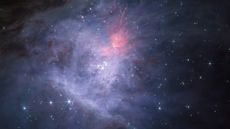 Physics-breaking 'rogue' objects spotted by James Webb telescope are emitting radio signals that scientists can't explain
A bizarre object discovered by the James Webb Space Telescope may be a pair of 'rogue' planets ― but a new study finds they are emitting radio signals rarely seen from other worlds.
exoplanets -
 5 Earth-like worlds may lurk in the outer reaches of the solar system, simulations suggest
The young sun may have captured several Mars- or Mercury-size exoplanets that now orbit in the outer reaches of the solar system, but identifying them will be extremely challenging.
exoplanets


