Get the world’s most fascinating discoveries delivered straight to your inbox.
You are now subscribed
Your newsletter sign-up was successful
Want to add more newsletters?
Join the club
Get full access to premium articles, exclusive features and a growing list of member rewards.
An account already exists for this email address, please log in.
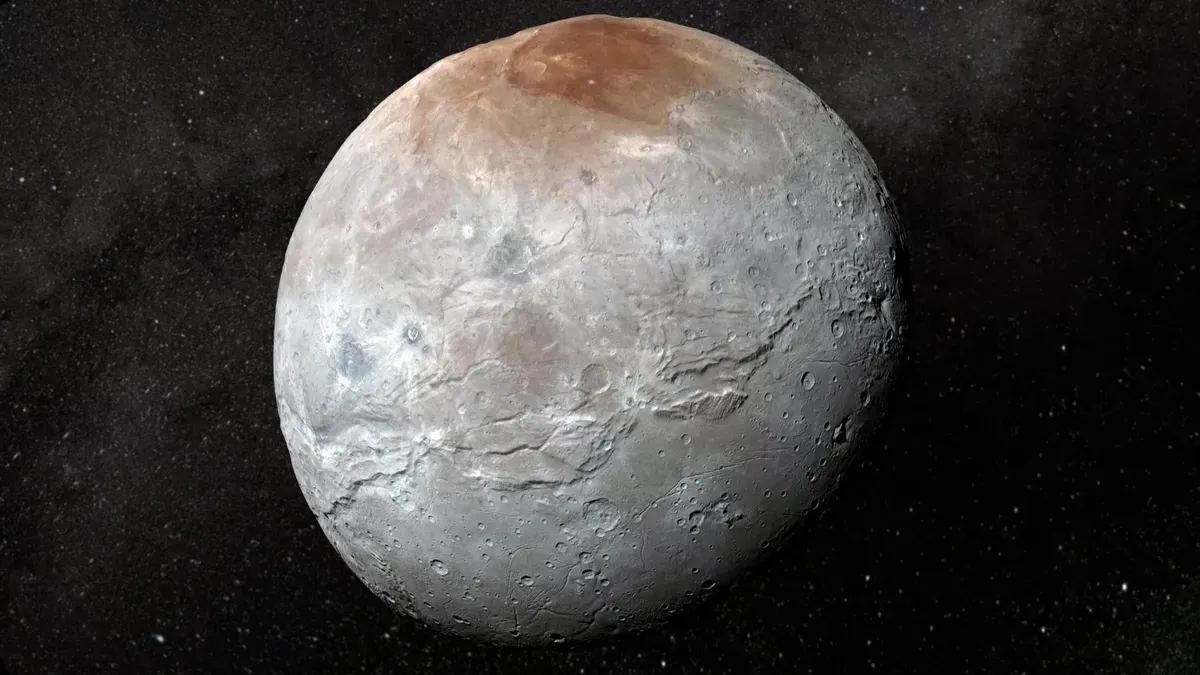
James Webb Space Telescope deciphers the origins of Pluto's icy moon Charon
Using the James Webb Space Telescope, astronomers have discovered carbon dioxide and hydrogen peroxide at the surface of Pluto's largest moon, Charon, potentially shedding light on its origins.
Using the James Webb Space Telescope (JWST), astronomers have detected carbon dioxide and hydrogen peroxide on the frozen surface of Pluto's largest moon, Charon. Detecting these molecules could tell scientists how Charon and other icy bodies at the solar system's edge were born.
Since its discovery in 1978, Charon has been extensively studied — but previous research has been limited in terms of what wavelengths of light could be explored during these analyses. That left gaps in our understanding of the surface composition of this moon of Pluto. As a result, though scientists have detected water ice, ammonia-bearing species and organic compounds on Charon, carbon dioxide and hydrogen peroxide have evaded detection. Until now, that is.
The team, led by Silvia Protopapa of the Southwest Research Institute (SwRI), filled in these gaps by studying Charon with the JWST's Near-Infrared Spectrograph (NIRSpec) instrument.
"Our research reveals that Charon’s surface preserves evidence of its formation through the presence of carbon dioxide, as well as signs of irradiation processes, indicated by the presence of hydrogen peroxide," Protopapa told Space.com. "These discoveries expand Charon's known compositional inventory, which includes water ice, ammonia-bearing species and organic materials responsible for its gray and red coloration."
A graph showing the light signature from Charon indicating the detection of hydrogen peroxide and carbon dioxide.
(Image credit: Silvia Protopapa (SwRI), Ian Wong (STScl))
Charon is a midsized body roughly 750 miles (1,207 kilometers) wide and located in the Kuiper Belt, a ring of icy debris, comets and dwarf planets, also referred to as trans-Neptunian objects (TNOs), at the solar system's edge.
Unlike many of the larger objects in the Kuiper Belt, Charon's surface is not obscured by volatile ices like methane, meaning it offers scientists valuable insights into the effects of sunlight exposure and cratering on these distant bodies. Additionally, Charon is the only mid-sized TNO for which geologic mapping is available. This is thanks to data gathered by NASA's New Horizons spacecraft, which visited the Pluto system around a decade ago.
Sign up for the Live Science daily newsletter now
Get the world’s most fascinating discoveries delivered straight to your inbox.
"Overall, these factors make Charon an invaluable target from which we can learn extensively," Protopapa said. "Our findings provide valuable insights into how processes such as sunlight exposure and cratering shape the surface of Charon and, by extension, other mid-sized icy bodies beyond Neptune's orbit."
Cool suprises on Charon
The composition of stars, planets and moons can be determined from the light they emit or reflect from their surface. This is possible because elements absorb and emit light at specific wavelengths. Thus, looking at a celestial body's spectra via a technique called "spectroscopy" reveals the "fingerprints" of elements and chemical compounds.
Protopapa and colleagues reached their findings by comparing JWST spectroscopic observations with lab-based measurements and detailed spectral models of the surface of Charon. This led them to conclude that carbon dioxide is primarily present as a surface veneer on a water-ice-rich subsurface.
"The surface of Charon, as revealed by the New Horizons mission, features numerous craters surrounded by bright ejecta blankets that are rich in water ice and ammonia-bearing compounds," Protopapa explained. "These geologic features suggest that materials from beneath the surface have been exposed by impact events, providing a window into the moon's subsurface composition.
"Our preferred interpretation is that the upper layer of carbon dioxide originates from the interior and has been exposed to the surface through cratering events."
She added that carbon dioxide was also expected because the compound is known to be present in regions of the protoplanetary disk from which the Pluto system formed. The fact that carbon dioxide wasn't spotted by NASA's New Horizons spacecraft when it visited Pluto and captured images of Charon in 2015 has been troubling scientists for some time.
"The detection of carbon dioxide was a satisfying confirmation of our expectations," Protopapa continued.
An image of the cracked and cratered surface of Pluto's moon Charon as seen by the New Horizon mission in 2015
(Image credit: NASA/JPL-Caltech)
What was not expected by the team was the detection of hydrogen peroxide.
"The detection of hydrogen peroxide on Charon came as a surprise. I honestly did not expect to find evidence of it on the surface," Protopapa said. "Hydrogen peroxide has been known to be present on Jupiter's moon Europa’s surface since the 2000s. I never imagined I would be writing a paper comparing these icy satellites, Charon and Europa, given how different their environments are."
The surprise presence of hydrogen peroxide on Charon suggested to the team that the water-ice-rich surface of Pluto's largest moon is being actively altered by ultraviolet light from the sun, energetic particles from the solar wind, and streams of charged particles from beyond the solar system called "galactic cosmic rays."
"Hydrogen peroxide forms from the combination of neighboring hydroxide ion radicals, which originate from the breakup of water molecules due to incoming ions, electrons, or photons," Protopapa continued. "Our team conducted new laboratory measurements to confirm that it is possible to generate hydrogen peroxide even when carbon dioxide is present."
The team hasn't finished with Pluto's largest moon yet. The JWST will continue to study Charon, and scientists will use the resulting data to better understand icy TNOs as a whole.
"Future JWST observations targeting the spectral gaps, not covered in the current data, could lead to new Charon discoveries and further expand its chemical inventory, possibly revealing other mechanisms at play," Protopapa said.
The team's research was published on Tuesday (Oct. 1) in the journal Nature Communications.
Robert Lea is a science journalist in the U.K. who specializes in science, space, physics, astronomy, astrophysics, cosmology, quantum mechanics and technology. Rob's articles have been published in Physics World, New Scientist, Astronomy Magazine, All About Space and ZME Science. He also writes about science communication for Elsevier and the European Journal of Physics. Rob holds a bachelor of science degree in physics and astronomy from the U.K.’s Open University