Get the world’s most fascinating discoveries delivered straight to your inbox.
You are now subscribed
Your newsletter sign-up was successful
Want to add more newsletters?
Join the club
Get full access to premium articles, exclusive features and a growing list of member rewards.
An account already exists for this email address, please log in.
James Webb telescope watches ancient supernova replay 3 times — and confirms something is seriously wrong in our understanding of the universe
The James Webb Space Telescope has zoomed in on an ancient supernova, revealing fresh evidence that a crisis in cosmology called the Hubble tension isn't going anywhere soon.
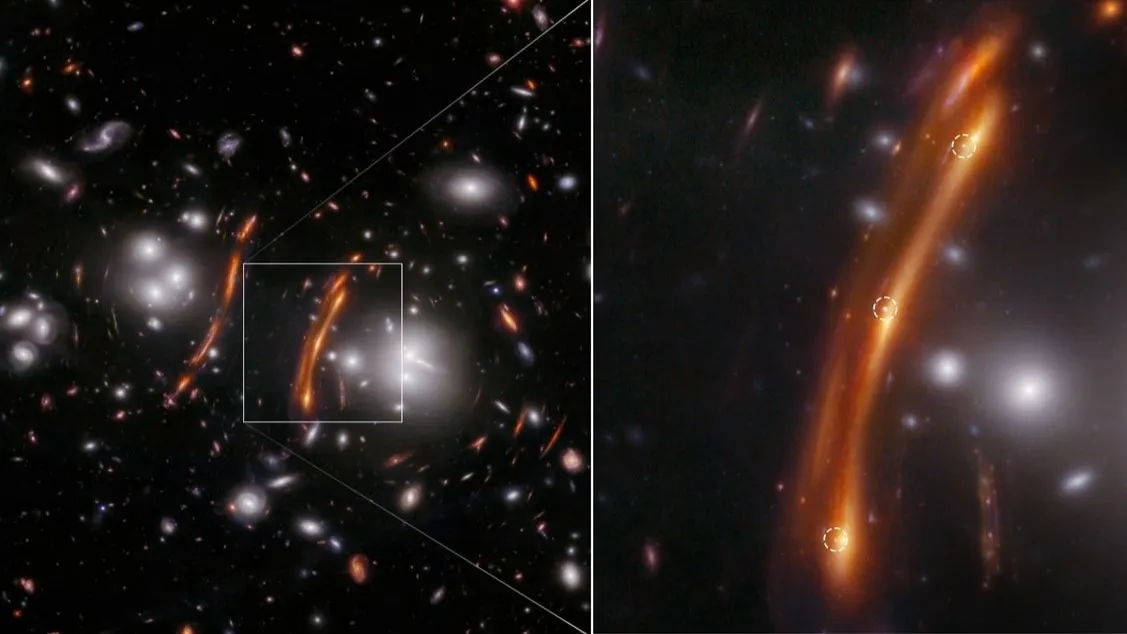
An ancient supernova from the early universe is magnified and duplicated three times (circled dots) through the phenomenon of gravitational lensing.
(Image credit: NASA, ESA, CSA, STScI, B. Frye (University of Arizona), R. Windhorst (Arizona State University), S. Cohen (Arizona State University), J. D’Silva (University of Western Australia, Perth), A. Koekemoer (Space Telescope Science Institute), J. Summers (Arizona State University).)
The James Webb Space Telescope (JWST) has discovered yet another troubling sign that there's something very wrong with our model of the universe.
Depending on which part of the universe astronomers measure, the cosmos seems to be growing at different rates — a problem scientists call the Hubble tension. Measurements taken from the distant, early universe show that the expansion rate, called the Hubble constant, closely matches our best current model of the universe, while those taken nearer to Earth threaten to break it.
Now, a new study using the gravitationally-warped light of a 10.2 billion light-year distant supernova has revealed that the mystery could be here to stay. The researchers released their findings inaseriesofpapers in The Astrophysical Journal. The Hubble tension calculations have also been accepted for publication in the journal, and are posted in a paper on the pre-print database arXiv.
"Our team's results are impactful: The Hubble constant value matches other measurements in the local universe, and is somewhat in tension with values obtained when the universe was young," co-author Brenda Frye, an associate professor of astronomy at the University of Arizona said in a statement.
Currently, there are two gold-standard methods for figuring out the Hubble constant. The first involves poring over tiny fluctuations in the cosmic microwave background, an ancient relic of the universe's first light produced just 380,000 years after the Big Bang. This method enabled astronomers to infer an expansion rate of roughly 67 kilometers per second per megaparsec (km/s/Mpc), which closely matches predictions made by the standard model of cosmology.
A collection of some of the most recent measurements of the Hubble constant. From left to right, the sources used to measure its value are: The cosmic microwave background images by the European Space Agency's Planck satellite; gravitational lensing and tip of the Red Giant Branch stars measured by NASA's Hubble space telescope; and cepheid stars measured by the James Webb space telescope
(Image credit: Future)
But the second method, measuring closer distances with pulsating stars called Cepheid variables, contradicts this — returning a puzzlingly high value of 73.2 km/s/Mpc. This discrepancy superficially may not seem like much, but it's enough to completely contradict the predictions made by the standard model. According to the model, a mysterious entity known as dark energy is supposed to be driving the universe’s expansion at a constant rate, but the new findings throw a wrench in this understanding.
Sign up for the Live Science daily newsletter now
Get the world’s most fascinating discoveries delivered straight to your inbox.
In the new studies, astronomers pointed JWST's near-infrared camera (NIRCam) at the galaxy cluster PLCK G165.7+67.0, also known as G16, which is located 3.6 billion light-years from Earth. There, they spotted three distinct points of light that came from a single type IA supernova whose light had been both magnified and bent, or gravitationally lensed, by a galaxy in front of it.
Type Ia supernovae occur when the material from one star falls onto the embering husk of a dead star, known as a white dwarf, leading to a gigantic thermonuclear explosion. These explosions are thought to always happen at the same brightness, making them "standard candles" from which astronomers can measure far-off distances and calculate the Hubble constant.
The evolution of the universe illustration seen with the Big Bang event on the left and the present on the right.
Follow-up observations made with the ground-based Multiple Mirror Telescope and Large Binocular Telescope, both in Arizona, confirmed the dots' point of origin.
By studying the time delays between the dots and plugging them, alongside the supernova's distance, into various models of gravitational lensing, the researchers produced a Hubble constant value of 75.4 km/s/Mpc, plus 8.1 or minus 5.5 — flatly contradicting the standard model once more.
The calculation is unlikely to be the final word on the tension, with other research groups pursuing their own lines of investigation into the cosmic conundrum. For their part, the researchers behind the new studies say that they will continue to gather vital clues from other exploding stars found around the galaxy.
Ben Turner is a U.K. based writer and editor at Live Science. He covers physics and astronomy, tech and climate change. He graduated from University College London with a degree in particle physics before training as a journalist. When he's not writing, Ben enjoys reading literature, playing the guitar and embarrassing himself with chess.