














Astronomers prepare for once-in-a-lifetime event: A 'new star' in the night sky
A rare nova explosion will soon bring a "new star" to the night sky, and scientists are excited.

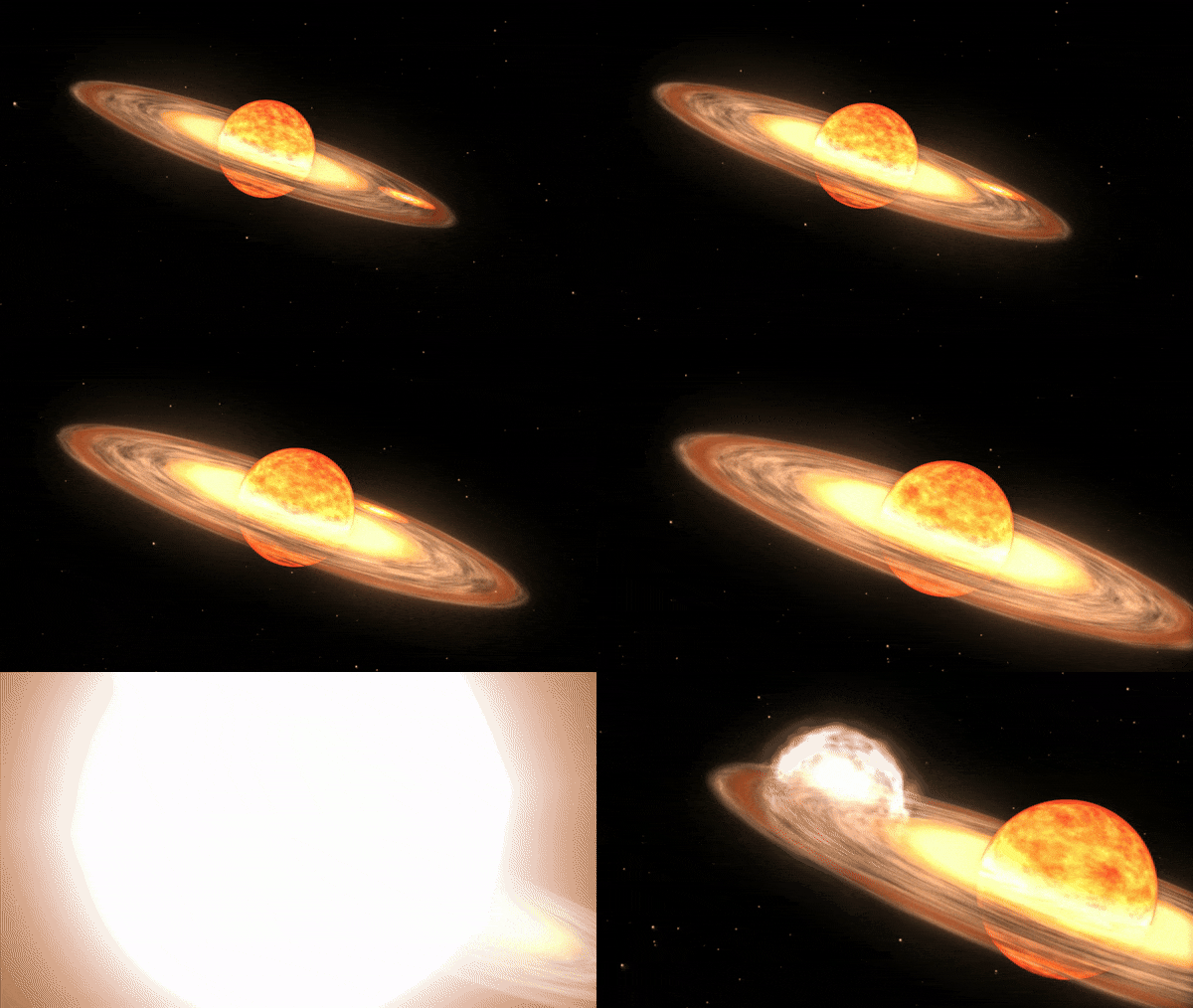
Any day now, our night sky will host a guest star.
Stargazers and astronomers around the world continue to gaze toward the Corona Borealis constellation 3,000 light-years from Earth, where a long-dead star is expected to reignite in an explosion so powerful it will briefly rival the brilliance of Polaris, the North Star. The stellar corpse last turned on almost 80 years ago and will not reignite for another 80 years, making this a nearly once-in-a-lifetime experience.
Already, the stellar remnant, a white dwarf called T Coronae Borealis that's feasting on material from a nearby red giant star, has revealed a tell-tale dip in brightness that "is right on top" of the one that preceded its previous outburst in 1946. Astronomers don't yet know for sure what's causing the dip, but they say it's just a matter of time before the nova satiates its hunger and explodes into a spectacular nova. "We know it's going to go off — it's very obvious," Edward Sion, a professor of astronomy and astrophysics at Villanova University in Pennsylvania, told Space.com.
The remarkable event is a treat not just for skygazers. Astronomers have earmarked precious time onboard a host of ground- and space-based telescopes to catalog every possible detail to learn more about novas, whose dynamics remain murky thanks to only a few outbursts cataloged over decades. T Coronae Borealis, or T Cor Bor for short, belongs to an elite club of ten recurrent novas known across the Milky Way, our home galaxy, offering astronomers a rare front-row seat to closely study a stellar corpse as it devours material to the extent that it caves in, thus recoiling in a violent explosion.
Insights from this event would eventually make their way to models of how stars work, astronomers say.
Related: James Webb telescope watches ancient supernova replay 3 times — and confirms something is seriously wrong in our understanding of the universe
T Cor Bor is being watched by NASA's Fermi gamma-ray space telescope every day — and, most of the time, every few hours. As soon as the nova erupts, gamma rays will skyrocket alongside a similar spike in the nova's brightness, allowing astronomers to decipher just how hot material is getting soon after the eruption, and how fast that material blows away from the white dwarf. Astronomers are also eager to learn more about how shock waves will whiz through space in the moments following the explosion, the specifics of which are not very well understood.
Get the world’s most fascinating discoveries delivered straight to your inbox.
"Usually, what's going on with these white dwarf stars takes so long we never see it again," Elizabeth Hays, who is the project scientist for the Fermi telescope, told Space.com.
The cadence of T Cor Bor's outbursts within a typical human lifetime makes it a unique case study, made even more special by the fact that there were no X-ray or gamma-ray telescopes in space 80 years ago — which was the last time the nova erupted.
"I'm very excited to see what it looks like — there are a lot of firsts here," said Hays.
In addition to the Fermi telescope, the James Webb Space Telescope, Swift and the INTEGRAL space telescopes as well as the ground-based Very Large Array in New Mexico will be redirected from their usual observing schedule to watch the event at its peak and through its decline into the abyss of space. Together, they'll capture the nova in various wavelengths for the first time. "There's a lot of cooperation when something interesting happens," said Hays.
The event will be visible to the unaided eye only for the first few days, to gamma- and x-ray telescopes for a few months, and to radio telescopes for years to come. Such long term observations of the explosion's aftermath can reveal how the outbursts spread over time and interacted with the companion red giant star. Astronomers will also be closely watching how the outburst decays; any "bumps" along the way would reveal intriguing clues about how the nova is interacting with its companion star's wind, Hays said.
And as violent as the explosion will be, "it's far enough away that it's not going to affect us," said Sion.
So, we can just look up and enjoy the cosmic show.
Originally posted on Space.com.

Sharmila Kuthunur is an independent space journalist based in Bengaluru, India. Her work has also appeared in Scientific American, Science, Astronomy and Space.com, among other publications. She holds a master's degree in journalism from Northeastern University in Boston. Follow her on BlueSky @skuthunur.bsky.social