
















Early warning indicator hidden within the Gulf Stream could signal the collapse of key Atlantic currents, study finds
Shifts in the Gulf Stream could help researchers predict the human-driven failure of a huge system of ocean currents known as the Atlantic Meridional Overturning Circulation.

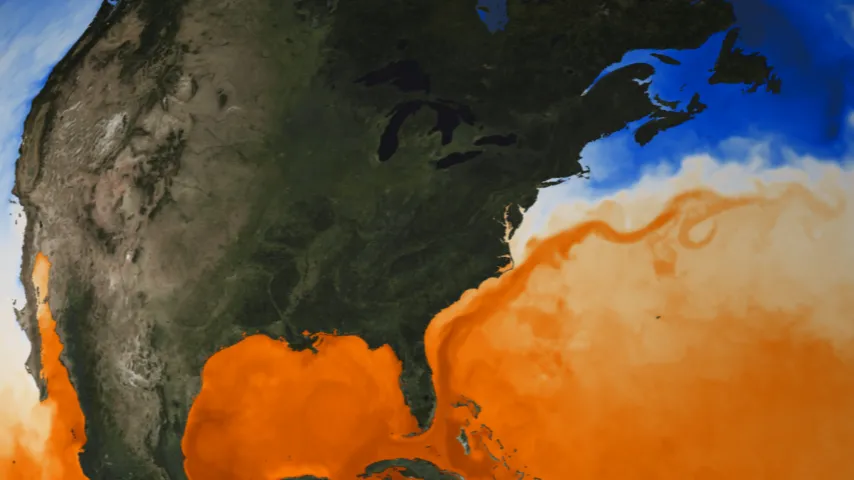
The Gulf Stream holds tantalizing clues about when other key Atlantic Ocean currents could collapse due to climate change, a new study finds.
Originating in the Gulf of Mexico and leaving the U.S. East Coast near Cape Hatteras in North Carolina, the Gulf Stream is a branch of the Atlantic Meridional Overturning Circulation (AMOC) — a giant system of ocean currents that brings heat to the Northern Hemisphere and Europe, in particular.
A growing body of evidence suggests that the AMOC is weakening and speeding toward a "tipping point," which could completely transform the climate in many parts of the world, including Northwest Europe and tropical monsoon regions. When the AMOC might collapse is uncertain, but an early warning signal hidden within the Gulf Stream could help scientists predict the event years before it happens, the new research shows.
"First, you have this very gradual northward drift [of the Gulf Stream], which is related to some AMOC weakening, but apparently there is also this jump when the AMOC is getting too weak, which is this early warning indicator," study lead author René van Westen, a postdoctoral researcher in climate physics at Utrecht University in the Netherlands, told Live Science.
Unlike other currents that form the AMOC, the Gulf Stream is wind-driven. After passing by Florida, it follows the U.S. East Coast northward to Cape Hatteras and then veers east into the North Atlantic Ocean. Although the Gulf Stream is a surface current, its position is controlled by much deeper currents that also belong to the AMOC and create tight vortices when they interact with the layers above. These spirals push the Gulf Stream as a whole southward — but as the AMOC weakens and the vortices loosen, the Gulf Stream may start to drift northward.
To explore these effects further, van Westen and Henk Dijkstra, a professor of physical oceanography at Utrecht University, simulated an AMOC collapse in an ocean model with a very high resolution over the Gulf Stream. In the climate models typically used to study the AMOC, the Gulf Stream "is smoothed out, so you hardly see any features and the dynamics are not well captured," van Westen said.
The researchers triggered an AMOC collapse in the model that was much more gradual than the collapse humans may be causing by heating Earth and accelerating Arctic ice melt, which prevents the formation of deep ocean currents. They observed the Gulf Stream's response in unprecedented detail, revealing for the first time an extremely abrupt, northward shift of the current 25 years before the start of the collapse.
Get the world’s most fascinating discoveries delivered straight to your inbox.
The results were published Feb. 26 in the journal Communications Earth & Environment.
The researchers found two stages in the Gulf Stream's response, both measured off Cape Hatteras at 71.5 degrees west longitude. First, as the AMOC gradually weakened over 392 simulated years, the Gulf Stream inched northward by 83 miles (133 kilometers). Second, as the AMOC continued to weaken over two more simulated years, the Gulf Stream suddenly jumped north by 136 miles (219 km). This abrupt shift happened just 25 years before the start of the AMOC collapse, suggesting it could be used as an early warning signal to predict the collapse.
While the two stages may be realistic, it's unlikely that the time lag between the abrupt Gulf Stream shift and an AMOC collapse would actually be 25 years in real life, van Westen said. That's because the model didn't account for global temperature rise, which is accelerating the collapse of the AMOC; the model only simulated an increase in fresh water in the North Atlantic.
A northward drift of the Gulf Stream has implications for ocean ecosystems that are presently north of the current in colder waters but may soon end up south of the current in warmer waters. The drift may also exacerbate sea level rise along the East Coast, van Westen said.
Already underway
Next, the researchers analyzed satellite data to determine whether the Gulf Stream has already begun shifting northward. "We found this relationship within our climate model, and now the next step was to look whether those results appear in observations," van Westen said. "What we found in observations is that, yes, indeed, the Gulf Stream has shifted northward over the past three decades."
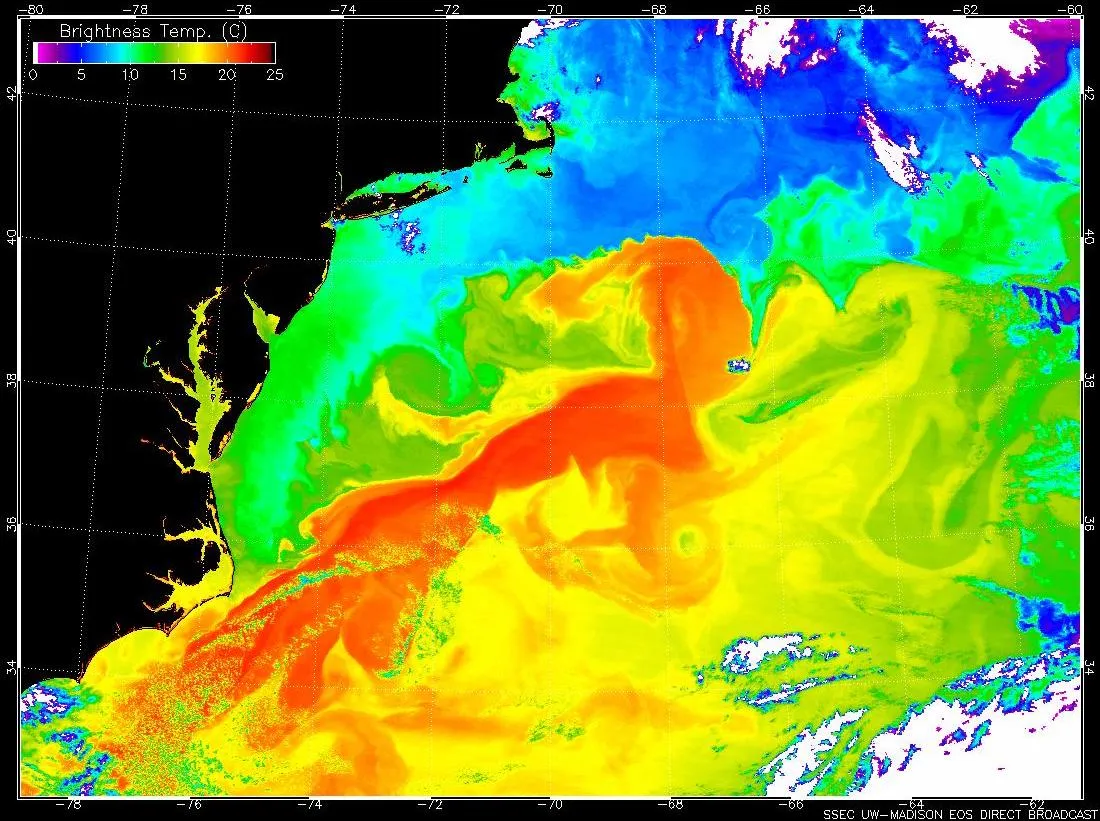
The point where the Gulf Stream leaves the East Coast near Cape Hatteras (bottom left) has been shifting northward for three decades, the new study found.
This finding is more evidence that the AMOC is weakening and means we are in the first stage of the Gulf Stream's response, van Westen said. Natural climate and atmospheric variability may have contributed to the slow drift, but those contributions are small relative to the AMOC's weakening, he added.
It is unclear when the transition to the second stage of the Gulf Stream's response will occur, but satellites are in place to detect this switch if and when it happens. The next task for researchers is to work out the true lag time between this second stage and the AMOC collapse so that the second stage can serve as a robust warning indicator, van Westen said.
The study is the most in-depth analysis of the potential impacts of an AMOC collapse on the Gulf Stream to date, but there are some caveats, said Maya Ben-Yami, a climate tipping point researcher at the Technical University of Munich and the Potsdam Institute for Climate Impact Research in Germany who was not involved in the research.
"This paper definitely points at Gulf Stream changes as a possible warning signal, but a lot more work would need to be done to confirm that, for example by looking across different models," Ben-Yami told Live Science in an email.
RELATED STORIES
It's possible that the abrupt northward shift could happen without the AMOC collapsing down the line, in which case it may not be an early warning indicator but rather a response to the weakening, she said.
Additionally, the rate of AMOC weakening in the study was likely slower than what can be expected under future warming conditions, meaning that the 25-year lag time could shrink to "almost nothing" and come too late to be an actionable warning signal, Ben-Yami said.
"Personally I think that it's also useful to have a signal that just tells you 'the tipping point has been crossed' without earlier warning, but I'd say we still don't know if Gulf Stream changes could be either type of signal," she said.
Van Westen, R. M., & Dijkstra, H. A. (2026). Abrupt Gulf Stream path changes are a precursor to a collapse of the Atlantic Meridional Overturning Circulation. Communications Earth & Environment, 7(1), 197. https://doi.org/10.1038/s43247-026-03309-1

Sascha is a U.K.-based staff writer at Live Science. She holds a bachelor’s degree in biology from the University of Southampton in England and a master’s degree in science communication from Imperial College London. Her work has appeared in The Guardian and the health website Zoe. Besides writing, she enjoys playing tennis, bread-making and browsing second-hand shops for hidden gems.
You must confirm your public display name before commenting
Please logout and then login again, you will then be prompted to enter your display name.