













Earth is wobbling and days are getting longer — and humans are to blame
New studies, which utilized AI to monitor the effects of climate change on Earth's spin, have shown that our days are getting increasingly longer and that our planet will get more wobbly in the future. These changes could have major implications for humanity's future.

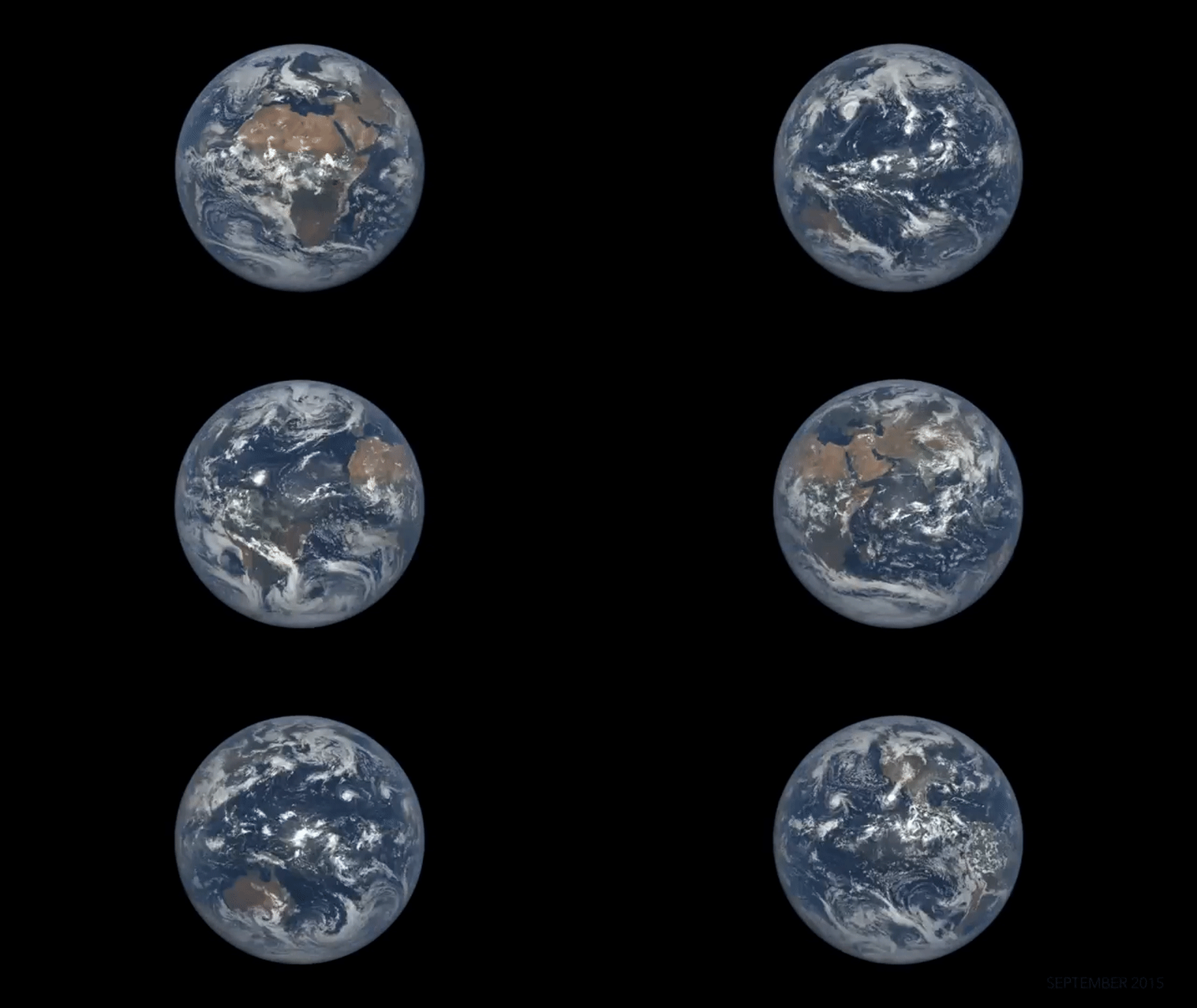
The length of Earth's days and the orientation of our planet are being thrown out of balance as human-caused climate change continuously alters Earth's spin, new research suggests.
Initially, these changes will be imperceptible to us, but they could have serious knock-on effects, including forcing us to introduce negative leap seconds, interfering with space travel and altering our planet's inner core, researchers warn.
A day on Earth lasts about 86,400 seconds. But the exact time it takes our planet to complete a single rotation can shift by tiny fractions of milliseconds every year due to a number of factors, such as tectonic plate movements, changes to the inner core's rotation and gravitational tugging from the moon.
However, human-caused climate change is another factor that can alter the length of our days, and scientists are just starting to realize how much this will affect our planet's spin in the coming years.
Over the past few decades, the rate of ice loss from Earth's polar regions, particularly Greenland and Antarctica, has been increasing rapidly due to global warming, leading to rising sea levels. Most of this extra water accumulates near the equator, causing our planet to bulge slightly around the middle. This, in turn, slows the planet's spin because more weight is distributed farther away from the planet's center — similar to how spinning figure skaters slow down by moving their arms away from their bodies.
In the new study, published July 15 in the journal PNAS, researchers used an advanced artificial intelligence program that combines real-world data with the laws of physics to predict how the planet's spin will change over time.
Related: 15 unexpected effects of climate change
Get the world’s most fascinating discoveries delivered straight to your inbox.

Global warming has triggered sea level rises, which are impacting Earth's rotation.
The results back up a similar study published in March, which suggested that Earth's days will get longer in the future. However, the new program offered much more precise estimates of how days will lengthen over time.
The same research team behind the new paper also released another study, published July 12 in the journal Nature Geoscience, which showed that the increased water near the equator is moving Earth's axis of rotation. This is making the magnetic poles wobble farther away from the axis every year.
Scientists previously found that this effect has likely been happening for at least the past three decades. However, the new study suggests the axis will move even farther from its current position than previous studies predicted.
"We humans have a greater impact on our planet than we realise," Benedikt Soja, a geodesist at ETH Zurich in Switzerland who was a co-author on both the new studies, said in a statement. "And this naturally places great responsibility on us for the future of our planet."
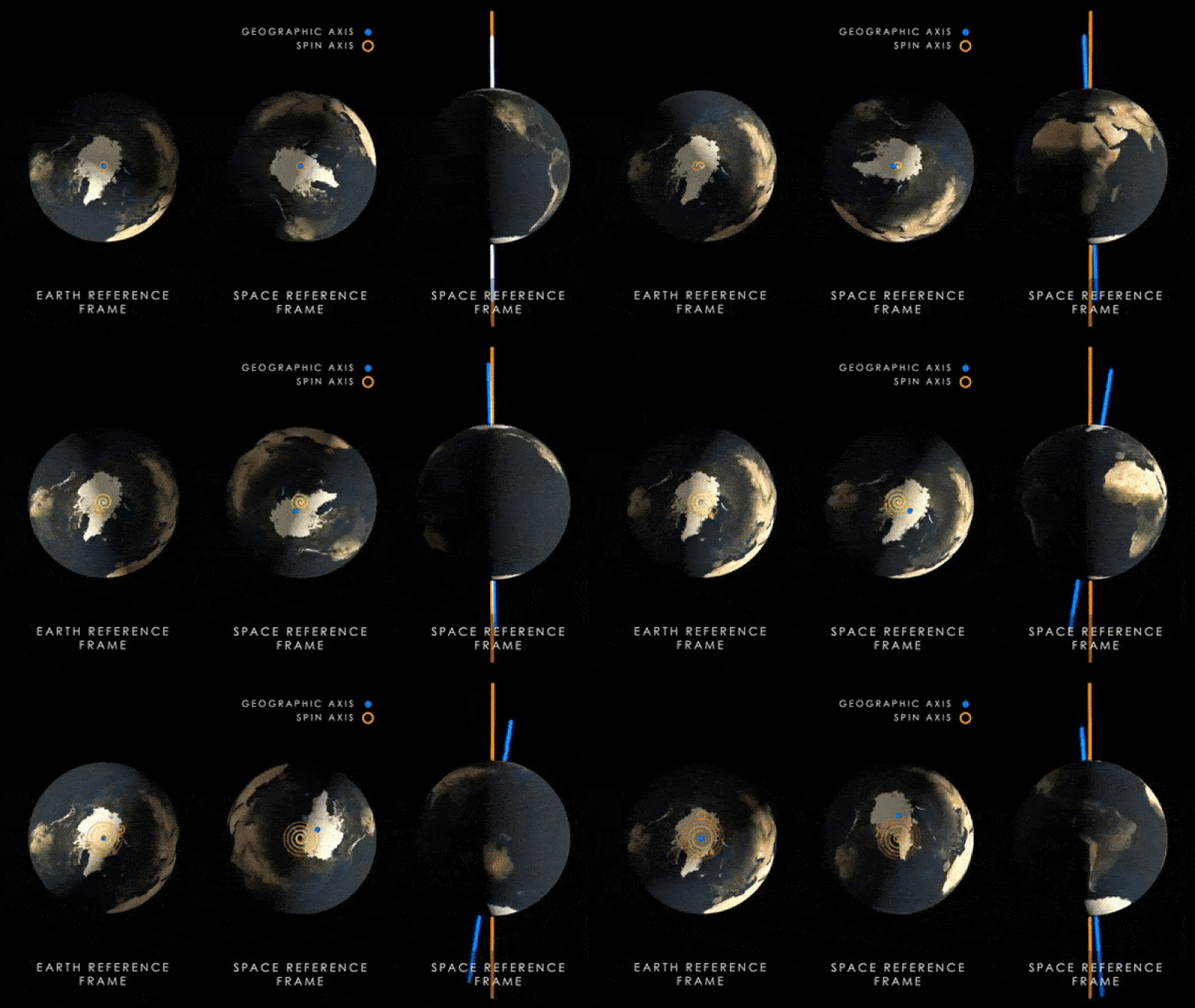
Earth's magnetic poles (blue) will begin to wobble around the planet's spin axis (yellow) as the latter begins to move as a result of climate change.
Spinning slower
Earth's days have always varied in length. Around 1 billion years ago, our planet likely took only 19 hours to complete a single rotation, before slowing to the 24 hours we experience today.
It also changes on shorter timescales. For example, in 2020, Earth was spinning more quickly than at any point since records began in 1960. In 2021, the planet's rotation began to slow down again even though we experienced the shortest-ever recorded day in June 2022.
But in general, Earth's rotation has been slowing for millennia, mainly due to a process known as lunar tidal friction, in which the moon's gravitational effect on our oceans pulls water away from the poles. At the moment, this effect is lengthening our days by around 2.3 milliseconds every century.
The new studies show that climate change is currently lengthening our days by around 1.3 milliseconds every century. However, based on current global temperature models, the researchers predict that this could increase to 2.6 milliseconds per century by the end of the 21st century, which would make climate change the biggest influence on our planet's spin.
Potential impacts

Any changes to Earth's spin will have to be accounted for during space travel, researchers say.
One of the most likely effects of longer days would be the need to introduce negative leap seconds — where we'd occasionally lose a second from some future days to accommodate the lengthening days, similar to how leap years work.
The March study suggests that this may need to start happening as soon as 2029, mainly to accommodate for how much the days have already lengthened over the past few millennia.
In the past, scientists have suggested this introduction could mess with the timekeeping of computers and smartphones. However, not everyone is convinced this will be a major issue.
The researchers of the new studies also noted that future changes could impact space travel.
RELATED STORIES
"Even if the Earth's rotation is changing only slowly, this effect has to be taken into account when navigating in space — for example, when sending a space probe to land on another planet," Soja said. It is therefore important to monitor these changes closely, he added.
The team also warned that the changes to Earth's rotational axis could alter the rotation of Earth's inner core, which could further increase how fast days lengthen. However, this potential interaction is still largely unknown.

Harry is a U.K.-based senior staff writer at Live Science. He studied marine biology at the University of Exeter before training to become a journalist. He covers a wide range of topics including space exploration, planetary science, space weather, climate change, animal behavior and paleontology. His recent work on the solar maximum won "best space submission" at the 2024 Aerospace Media Awards and was shortlisted in the "top scoop" category at the NCTJ Awards for Excellence in 2023. He also writes Live Science's weekly Earth from space series.