















How does the brain store memories?
The basis of memory is the synapse.

Memory is one of the building blocks of the brain. It can help keep us safe — that red stove burner is hot, don't touch it! — and forms the basis of our identities and narratives about our lives.
So how does the brain store memories and retrieve them?
The simplest answer is that the human brain reshapes itself with each new memory. This happens through the actions of synapses, or the tiny gaps between brain cells. Brain cells, or neurons, communicate with each other through an elegant electrochemical system. A change in the electrical charge of one cell triggers the release of chemicals called neurotransmitters across synapses. The neurotransmitters are then taken up by the neuron on the other side of the gap, where they trigger electrical changes in that cell.
"Ultimately, memories are encoded in circuits, and the synapses are just a means for etching out these circuits," said Don Arnold, a neuroscientist at the University of Southern California. "That's what changes in the brain when a memory is made, you have this new circuit that encodes the memory."
When one neuron continually stimulates another, their connection strengthens, meaning it becomes easier and easier for them to stimulate each other as time goes on. When they rarely communicate, their bond weakens, and sometimes they stop communicating altogether. At the most basic level, the brain can store memories by strengthening the connections between networks of neurons.
Where are memories stored in the brain?
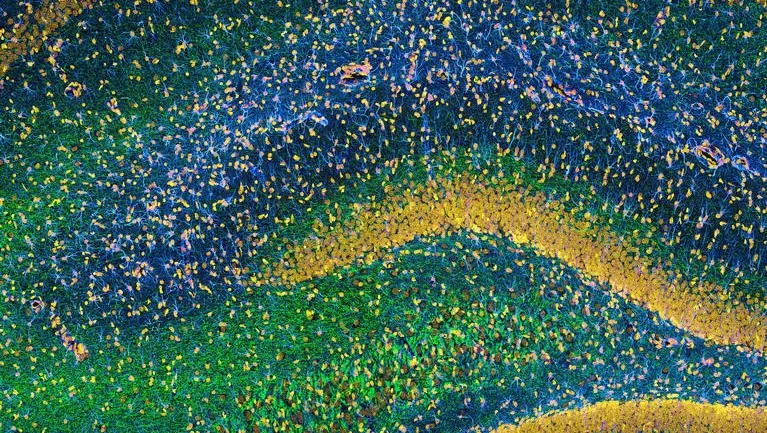
Human memories are stored in several brain regions. The most important is the hippocampus, which is actually a pair of regions tucked deep in the brain and curled into themselves like seahorses. These paired regions are important for initial memory formation and play a key role in the transfer of memories from short-term storage to long-term storage.
Short-term memory lasts for just 20 or 30 seconds before fading away. For example, you might remember a new phone number for the time it takes to dial it, but unless you rehearse the number again and again, the neural circuits that formed that short-term memory will stop activating together, and the memory will fade away.
Get the world’s most fascinating discoveries delivered straight to your inbox.
When you rehearse information or try to remember it, the hippocampus kicks in to strengthen the circuits. Over time, longer-term memories are transferred to the neocortex, the outer wrinkly part of the brain that is responsible for much of our conscious experience. (Though because nothing in the brain is simple, a 2017 study published in the journal Science found that some remnants of these long-term memories also stay in the hippocampus.)
The amygdala, an almond-shaped region of the human brain that helps process emotions such as fear, also plays a role in memory. In a study published in March in the journal Proceedings of the National Academy of Sciences, Arnold and colleagues the researchers found that when fish learned to associate the light with a painful sensation, they developed new synapses in one part of a brain region called the pallium, and lost synapses in another part of the pallium. The pallium is similar to the amygdala, and the part of the fish pallium where the synapses strengthened in the study is full of neurons involved in processing painful stimuli, while the fish lost synapses among neurons that process positive or neutral stimuli, Arnold said.
Emotion is an important component of memory-making, said Avishek Adhikari, a neuroscientist at the University of California, Los Angeles. Both positive and negative emotional situations are better-remembered than neutral events, likely for reasons of survival: It's probably important to remember things that were either very good for you, or very bad.
The brain releases higher concentrations of certain neurotransmitters in high-emotion scenarios, Adhikari told Live Science, and the presence of these neurotransmitters can strengthen the memory circuits in the hippocampus.
Other regions involved in memory are the basal ganglia and cerebellum, which handle the motor memory needed to, for instance, play a piano piece, and the prefrontal cortex, which helps with “working memory,” which is involved when you need to hold information in your head long enough to manipulate it, for instance when solving a math problem, according to the University of Queensland.

The physical representation of a memory, known as an engram, consists of a network of neurons that activate together. This engram is in a mouse hippocampus.
The mysteries of memory
The formation of new neurons also plays an important role in memory storage, even in adult brains. Scientists used to think that the brain stopped producing new neurons after adolescence, but research in the past two decades has shown that not only do adult brains make new neurons, but these neurons are key for learning and memory. A 2019 study in the journal Cell Stem Cell found that the hippocampus continues to generate new neurons even in people who are in their 80s and 90s.
Related content
It's hard to observe memory formation and processing in a working brain. Synapses are tiny and numerous (there are around a trillion in an adult human’s brain), and it's hard to do imaging beyond the brain surface, Arnold told Live Science. Imaging methods also need to be able to avoid interfering with the brain's function. New technology is enabling new discoveries, though. For instance, to peer into the zebrafish brain while it learns to associate a flashing light with an unpleasant sensation, Arnold and his colleagues alter the fish genome so that it displays fluorescent proteins on its synapses. The researchers can then use a specialized microscope to take images of these synapses and monitor them for change.
Understanding how memory works is important for moving toward treatment of diseases like Alzheimer's, which causes memory loss. Understanding some of the quirks of memory can also help improve memory. For example, the hippocampus is not only involved in cementing memory, but in navigating places – which makes sense, given the importance of remembering where you are and where you've been when trying to get around.. People who achieve astounding feats of memorization, like remembering pi to tens of thousands of digits, often borrow the hippocampus' spatial memory abilities to do so. They'll mentally associate each item they want to remember with a location in an imaginary place — a trick called a memory palace. By picturing this place in their mind, a person practiced in this technique can recall large amounts of information.
"It's a very weird thing to do," Adhikari said, "but the reason that works is because the hippocampus is particularly good at and prone to mapping spatial routes." Originally published on Live Science.
Originally published on Live Science.

Stephanie Pappas is a contributing writer for Live Science, covering topics ranging from geoscience to archaeology to the human brain and behavior. She was previously a senior writer for Live Science but is now a freelancer based in Denver, Colorado, and regularly contributes to Scientific American and The Monitor, the monthly magazine of the American Psychological Association. Stephanie received a bachelor's degree in psychology from the University of South Carolina and a graduate certificate in science communication from the University of California, Santa Cruz.